Slate Opens Pre-Orders for its $24,950 Bare-Bones Electric Pickup Truck
Electric vehicle startup Slate Auto believes it can overcome the challenges that have plagued many EV startups by offering an affordable, highly customizable electric vehicle with a starting price of $24,950. The Michigan-based company, backed by Amazon founder Jeff Bezos and Los Angeles Dodgers controlling owner Mark Walter, says every vehicle it produces will generate a positive gross margin.
Slate CEO Peter Faricy recently told CNBC that the company aims to achieve positive free cash flow and earnings before taxes, depreciation, and amortization by 2027. He acknowledged the ambitious nature of the goal, noting that no automotive company has accomplished such a feat before, but said ambitious targets are necessary to build a successful business.
Faricy believes Slate can succeed because of its simplified product lineup, customer-focused strategy, and lower break-even point of approximately 80,000 vehicles annually. That figure is slightly more than half of the company’s planned annual production capacity of 150,000 vehicles at its assembly plant in Warsaw, Indiana, which is currently under development while prototype vehicles continue to be built.
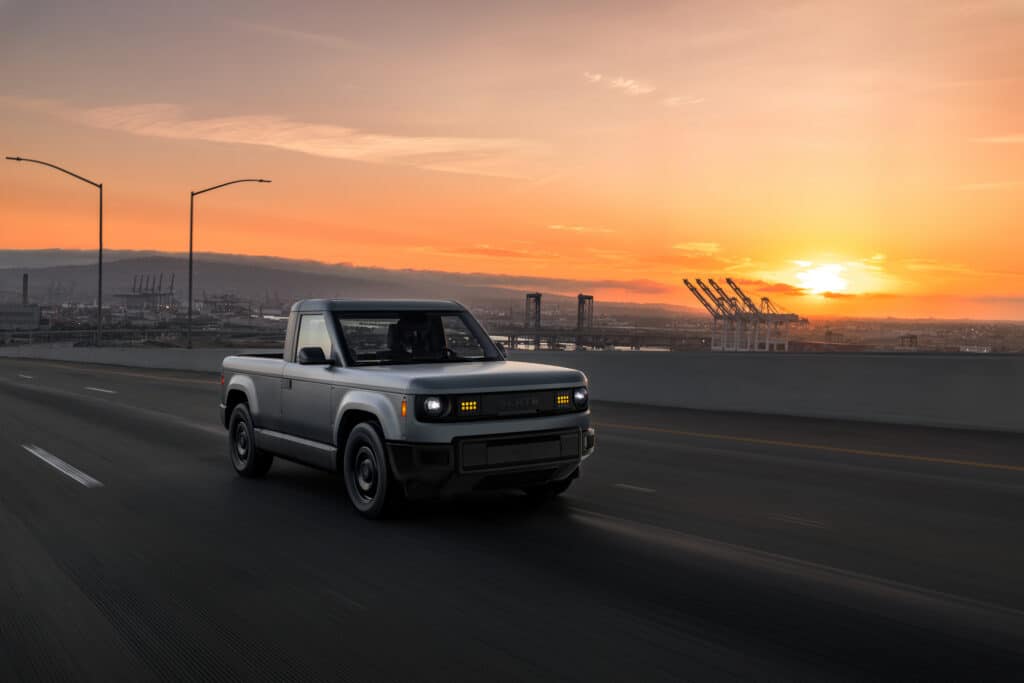
Slate’s flagship vehicle is a two-seat electric pickup truck designed with minimalism in mind. It features crank windows, optional speakers, and can be converted into a five-passenger SUV for an additional $5,000. The vehicle offers 181 horsepower, and 195 lb-ft of torque. While its performance does not match premium electric pickups, it aligns with other vehicles in its price range.
Slate Auto has announced a major change to the battery technology that will power its upcoming electric pickup truck. The startup revealed that it is replacing the nickel manganese cobalt (NMC) battery pack originally planned for the vehicle with a lower-cost lithium iron phosphate (LFP) battery supplied by Gotion.
The new battery packs will be manufactured by Gotion at its Illinois facility, located relatively close to Slate’s production plant in Indiana. The switch reflects both changing market conditions and the company’s focus on affordability as it prepares to launch what is expected to be the lowest-priced new electric vehicle in the United States.
LFP batteries have gained popularity in recent years because they are less expensive and more durable than traditional high-nickel battery chemistries. While they generally offer lower energy density and less range than comparable NMC packs, their lower cost makes them particularly attractive for budget-focused electric vehicles.
When Slate first developed its vehicle program, the company selected NMC batteries from South Korean supplier SK On in part because federal EV tax credit rules favored battery supply chains that met strict domestic sourcing requirements. At the time, concerns over foreign entities and limited domestic LFP production made the chemistry a less practical choice. However, changes to federal incentives and growing LFP manufacturing capacity in the United States opened the door for Slate to reconsider its battery strategy.
The company’s new 65-kWh LFP battery pack is less expensive than the originally planned NMC system. Producing the batteries close to the assembly plant also reduces transportation and logistics costs. Slate has adopted a module-free battery design that uses prismatic cells packed directly into the battery enclosure, allowing more efficient use of space.
As a result, the production version of the truck is now expected to deliver approximately 205 miles of range, a significant increase from the 150-mile estimate initially announced. According to Slate executives, the improved range was achieved while maintaining the company’s target price point of $24,950.
LFP chemistry also offers practical advantages for drivers. Unlike many other battery types, LFP batteries can routinely be charged to 100% and discharged to very low levels without significantly affecting long-term battery health. However, the switch comes with some compromises. Power output has been reduced from 201 horsepower to 181 horsepower due to the battery’s lower voltage, although the truck’s estimated 0-60 mph acceleration time remains unchanged at about eight seconds.
Slate had previously considered offering a larger battery pack capable of delivering around 240 miles of range. Company executives now believe the 205-mile version strikes the right balance between cost, performance, and customer needs. Because the new battery pack fully utilizes the available space beneath the vehicle, increasing range further would likely require a higher-density battery chemistry.
Slate Takes Risky Innovation Head-On
Slate operated in stealth mode until unveiling its first vehicle in April 2025. At the time, the company advertised a starting price below $20,000, but that figure included a $7,500 federal EV tax credit that is no longer available. Since its launch, the startup has raised more than $1.3 billion through three funding rounds, with investments led by Mark Walter’s TWG Global and an earlier Bezos-affiliated funding round.
Faricy said the company continues to raise capital as it prepares for customer deliveries later this year, with production expected to ramp up and deliveries beginning in the fourth quarter of 2026. Although he did not rule out taking Slate public in the future, he said 2027 would likely be too early, emphasizing that the company wants to focus on successfully launching and scaling its operations first.
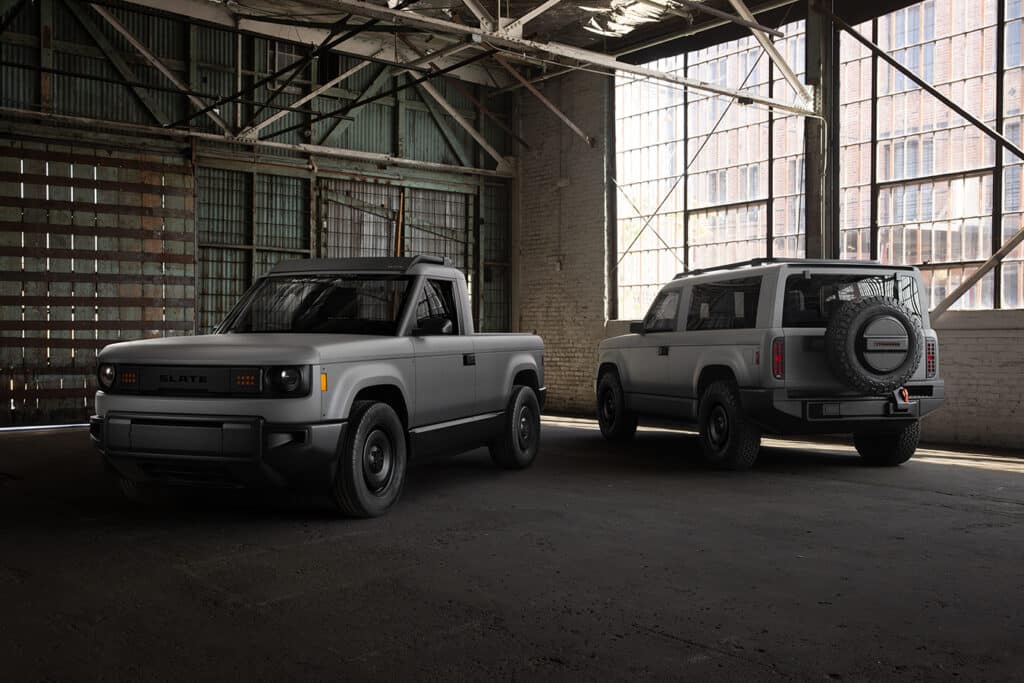
Slate has received more than 180,000 reservations for its vehicles. While reservations required a refundable $50 deposit, official orders will require a $300 nonrefundable down payment. Company executives expect the SUV version to account for 60% of sales, even though the pickup serves as the base model. Its starting price is roughly half the average cost of a new vehicle sold in the United States, according to Cox Automotive data.
Customization is central to Slate’s business model. Every vehicle will leave the factory in the same configuration to simplify manufacturing before customers personalize them with accessories and different body styles, including fastback and squared-off SUV designs that resemble vehicles such as the Jeep Wrangler. The company spent more than three years developing the concept after executives Chris Barman and Eric Keipper established the product roadmap.
Slate’s vehicles feature injection-molded composite exterior panels and extensive do-it-yourself customization options. Unlike many modern vehicles, Slate has eliminated built-in connectivity features, large infotainment screens, and traditional navigation systems. Drivers will instead use their own smartphones or tablets for music, navigation, and entertainment. A small display in front of the driver provides essential information such as speed, range, and warning indicators.

The company also eliminated traditional automotive paint. The exterior panels are designed to be wrapped with vinyl film, removing the need for an expensive paint shop. Slate plans to offer more than 100 standard wrap colors for under $500, while customers will have the option to create virtually any color or design they choose. The company will launch with more than 175 accessories, with over 80% priced below $500, including roof racks, stereos, and lighting accessories.
Slate continues to hand-build vehicles while gradually incorporating automation into its manufacturing process. The company currently produces about three vehicles per day and plans to transition to normal production operations by the fourth quarter. It must still complete federal testing and certification requirements covering range, safety, and other performance standards.
The company faces significant challenges in addition to broader EV market uncertainty. Its two-door body style is highly unusual in the U.S. market, where consumers generally prefer four-door trucks and SUVs. Ford reported that only 10% of Bronco sales last year were two-door models, while small pickups such as the Ford Maverick and Hyundai Santa Cruz are offered exclusively with four doors. Slate executives have not ruled out adding four-door vehicles in the future, but their immediate focus remains on the two-door pickup and SUV.
The vehicles will also be available exclusively with rear-wheel drive rather than all-wheel drive or four-wheel drive systems. Slate is expected to compete against a growing number of affordable gasoline and electric pickups, including future products from Ford and Stellantis.
For repair services, Slate partnered with RepairPal, an automotive service platform that connects vehicle owners with trusted repair shops across the United States.
Like Tesla and Rivian, Slate will sell directly to consumers instead of using traditional franchised dealerships. Faricy believes this approach will reduce costs and allow the company to maintain greater control over the customer experience as it attempts to establish itself in the competitive EV market.
EVinfo.net’s Take: Will Slate Make It? We Hope So
There is a lot to like about the Slate Truck. I love that it is stripped down, for example my 2024 BEV SUV that I bought used has lots of features I’ll never use and I would have rather paid less to skip them.
On the other hand, Slate is asking buyers to take on a lot of new concepts. Wrap instead of paint, smartphone instead of infotainment screen, manual crank windows, although buyers can upgrade many of these features.
The conversion kit to SUV is genius I think. But the two biggest challenges I can see are price and range. The price should be lower. The 2026 Ford Maverick XL Hybrid is advertised today with Employee pricing starting at $26,771.
Also the 205 range is super-low. The Bureau of Transportation Statistics says the average American driver travels 33-37 miles per day, so 205 really should be acceptable. But buyers still struggling with a wide variety of public charging problems will very likely reject the 205, wanting at least 300.

Electric Vehicle Marketing Consultant, Writer and Editor. Publisher EVinfo.net.
Services