Shell Triple 10 Challenge Concept EV Claims Under 10-Minute Charging, 25% Reduction in Battery Pack Cost
Shell has unveiled its Triple 10 Challenge Concept Car, a proof-of-concept electric vehicle created to showcase a new approach to battery electric vehicle design. Developed as a compact, mass-market EV, the vehicle challenges the industry’s growing dependence on larger battery packs by rethinking thermal management and overall vehicle efficiency.
The concept is built around three ambitious targets that Shell believes could shape the future of electric mobility: achieving a charging time of less than 10 minutes, delivering 10 kilometers of travel per kilowatt-hour of energy, and maintaining a lifecycle carbon footprint of just 10 tonnes of CO2 equivalent.
According to Shell, the Triple 10 Challenge vehicle is the first roadworthy EV to successfully demonstrate a simplified single-circuit cooling architecture capable of managing the thermal demands of the entire powertrain, even during extreme fast-charging conditions in real-world testing.
Cara Tredget, Vice President of Mobility and Lubricants Technology at Shell, said the project demonstrates how advanced thermal fluids can enable faster charging, lighter vehicle systems, and improved lifecycle efficiency. She noted that the technologies used in the concept are already available today and can be scaled for future EV development.
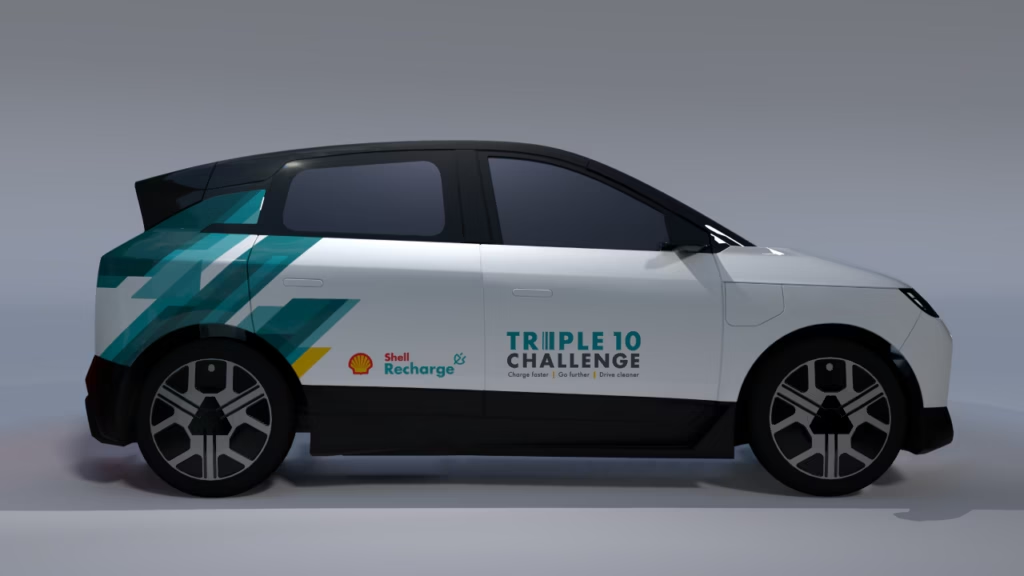
The vehicle was designed to achieve an efficiency rating of 10 km/kWh while utilizing a smaller battery pack. Shell estimates this delivers more than a 30% improvement in overall energy efficiency compared with many current-generation electric vehicles. The gains are attributed largely to the company’s advanced thermal fluid technology, which optimizes heat management throughout the vehicle.
The Triple 10 Challenge car can charge its battery from 10% to 80% in just 9 minutes and 54 seconds without sacrificing thermal stability or battery longevity. While some EVs currently on the market can achieve sub-10-minute charging times, they typically require chargers capable of delivering more than 300 kW. In contrast, Shell’s concept reaches this benchmark using a standard 175 kW charger.
The vehicle adds approximately 24 kilometers of driving range per minute of charging, compared with an average of 13 kilometers per minute for typical battery electric vehicles using the same charging power. This represents nearly 90% more range added during each minute of charging.
Shell estimates the vehicle’s total lifecycle carbon footprint at approximately 10 tonnes of CO2 equivalent. Through lightweight construction, optimized battery capacity, the use of recyclable and low-carbon materials, and charging powered entirely by renewable electricity, the concept is projected to reduce lifecycle emissions by roughly 50% compared with typical battery electric vehicles sold in Europe.
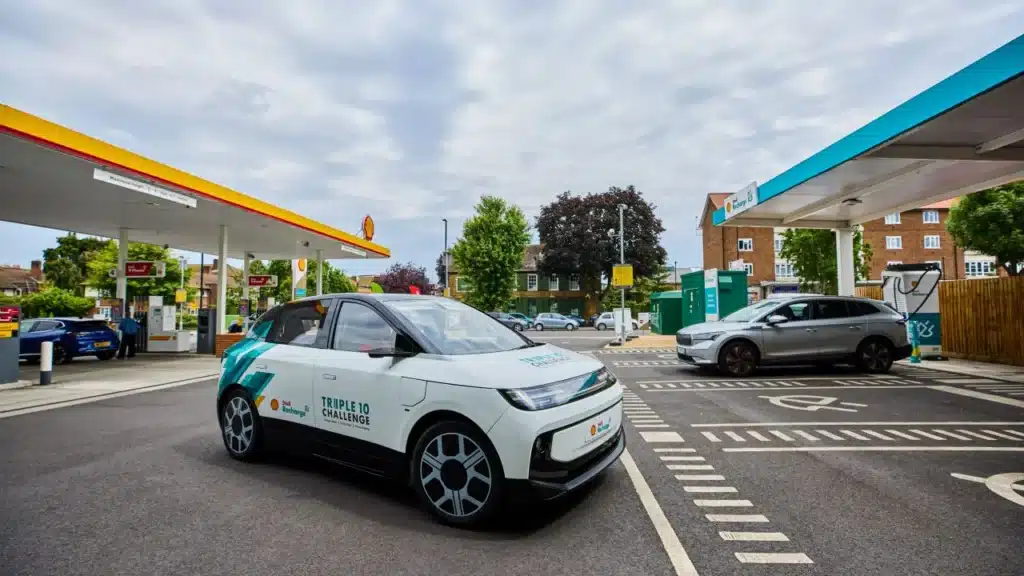
At the core of the vehicle’s performance is Shell Recharge thermal fluid. Unlike conventional cooling systems that rely on water-glycol mixtures, Shell’s dielectric fluid enables direct immersion cooling of battery cells while also indirectly cooling the electric motor and power electronics. This approach improves heat management across the entire powertrain and supports faster charging, lighter systems, and higher efficiency.
The concept vehicle was unveiled at the proving grounds of HORIBA MIRA and represents the culmination of Shell’s Triple 10 Challenge program. By combining a more compact battery pack with fewer modules and a simplified housing architecture enabled by immersive cooling technology, Shell estimates the design can reduce battery pack costs by approximately 25% compared with conventional EV designs.
Shell also announced that it is consolidating its electric vehicle offerings under the Shell Recharge brand. The integrated portfolio will include charging services, thermal fluids, and battery solutions for both business and consumer customers. As part of this transition, the Shell EV-Plus brand will be discontinued.
The project was developed in collaboration with several engineering partners. RML led battery pack architecture and vehicle integration, using Shell’s dielectric fluid to eliminate much of the heavy piping required by traditional cooling systems. Empel Systems developed the electric motor and drive units, leveraging the single-circuit cooling system to maintain high power density while supporting the vehicle’s efficiency goals. HORIBA MIRA conducted vehicle integration, testing, and validation using its Vehicle Thermal and Electrical Optimisation System (VTEOS), exposing the vehicle to simulated extreme weather conditions and demonstrating compatibility with conventional radiator systems.
The Triple 10 Challenge Concept Car continues Shell’s long history of ultra-efficient vehicle development. Previous projects include Project M, an ultra-efficient city car concept introduced in 2016, and the Starship program, launched in 2018 to improve freight efficiency through advanced Class 8 truck designs. Shell later partnered with Chinese truck manufacturer FAW Jiefang to develop the Starship Hybrid in 2023 and upgraded the vehicle in 2025 with a battery system utilizing immersive thermal cooling technology. The company’s commitment to efficiency innovation also extends to the long-running Shell Eco-marathon, which has challenged students for more than 40 years to design and build some of the world’s most energy-efficient vehicles.

Electric Vehicle Marketing Consultant, Writer and Editor. Publisher EVinfo.net.
Services