Shire Unveils First Line of Purpose-Built Electric Tractors for Airport Ground Operations
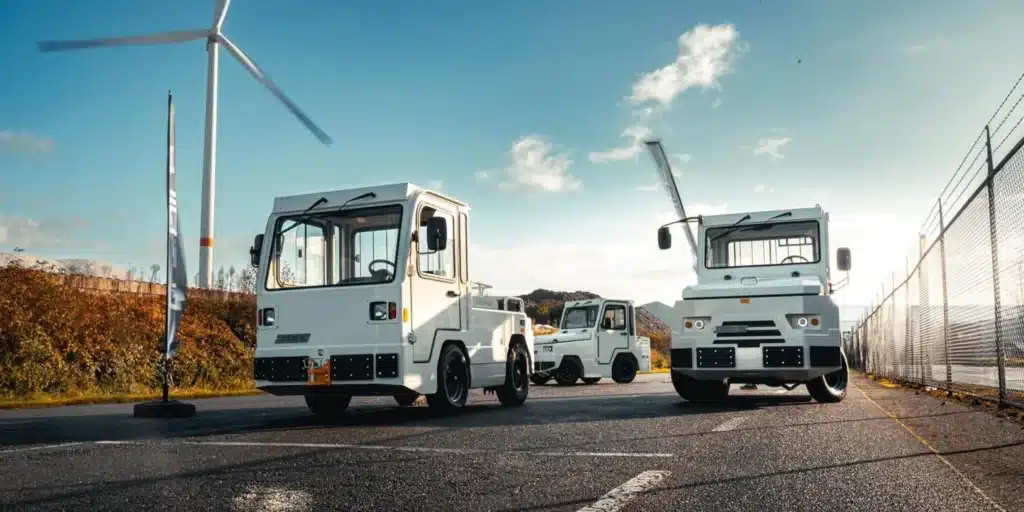
M-ECS’s aviation brand Shire has introduced its first range of purpose-built electric tractors designed for baggage and cargo operations, marking a major step toward decarbonizing airport ground handling. The news was reported by Airports International on October 7, 2025.
Baggage and cargo tractors account for an estimated 25–30% of total ground handling emissions, making them a key focus for Shire’s initial product line. The company confirmed that additional ground support equipment (GSE) families are already in development and can be customized to meet specific operator requirements.
According to Shire, its tractors are “electric by nature and smart by design.” Operators can integrate advanced digital options such as real-time monitoring of energy use and performance, predictive diagnostics to prevent failures and reduce downtime, and modular upgrades for future features. Among these is a proprietary collision detection and avoidance system currently being developed in-house.
“Ground handling is a tough environment,” said Gerd van Damme, Sales Director at Shire. “If you don’t design equipment with the operator’s economic and practical reality in mind, the solutions will never last.”
Founded in 2022, Shire operates as the aviation division of M-ECS (Mertens Electrification & Control Systems), a Belgian engineering company known for its expertise in automation, electrification, and smart system design. With this launch, Shire positions itself at the forefront of sustainable ground handling innovation, offering airports and service providers a reliable path toward cleaner, smarter operations.
According to news reports, there is no official word yet if Shire’s products will be available in North America. Shire is located in Willebroek, Belgium.
Why Ground Support Equipment Is Perfect for Electrification
Airports are uniquely positioned to lead the global shift toward cleaner transportation, and one of the most promising opportunities lies in the electrification of ground support equipment (GSE). From baggage tractors and cargo loaders to belt vehicles and tugs, GSE plays a vital role in every flight operation, and it’s also a prime candidate for full electrification.
Unlike passenger vehicles or long-haul trucks, most GSE operates within confined airport environments, following short, predictable routes. This makes electric powertrains an ideal fit. Electric GSE can easily complete multiple shifts on a single charge and recharge during scheduled downtime without disrupting operations.
Electrification also offers significant economic and environmental benefits. Electric vehicles have fewer moving parts than diesel-powered units, reducing maintenance needs and extending equipment life. Lower energy costs and fewer oil changes mean airports can save substantially over time, while also cutting harmful emissions that contribute to poor air quality around terminals and runways.
Electric GSE supports broader airport sustainability goals. As more airports commit to net-zero carbon operations, transitioning to electric ground equipment represents one of the fastest and most visible ways to reduce emissions. Many airports are already expanding charging infrastructure to support this shift, integrating energy management systems and renewable sources to further enhance efficiency.
Advances in battery technology, telematics, and smart diagnostics are making electric GSE even more capable and reliable. Real-time performance tracking, predictive maintenance, and modular battery options are now standard features on many next-generation vehicles.