150 New Rivian Fast EV Chargers Will Use 100% Renewable Energy
More than 150 EV chargers are set to be deployed across properties owned by Caruso, with installations scheduled to roll out over the next year. The network, developed by Rivian, will consist of public DC fast chargers compatible with all electric vehicles and supported by a renewable energy strategy.
Rivian states that every kilowatt-hour delivered through its charging network is matched annually with energy generated from renewable sources such as solar and wind. This accounting approach ensures that the total renewable energy the company develops or procures meets or exceeds the electricity consumed across its Rivian Waypoints and Adventure Network chargers.
The deployment will take place across multiple Caruso destinations in the Los Angeles region, significantly expanding fast-charging access within a relatively short timeframe. In addition to infrastructure, the partnership includes new Rivian showroom locations and planned ride-and-drive experiences designed to introduce more consumers to EV technology.
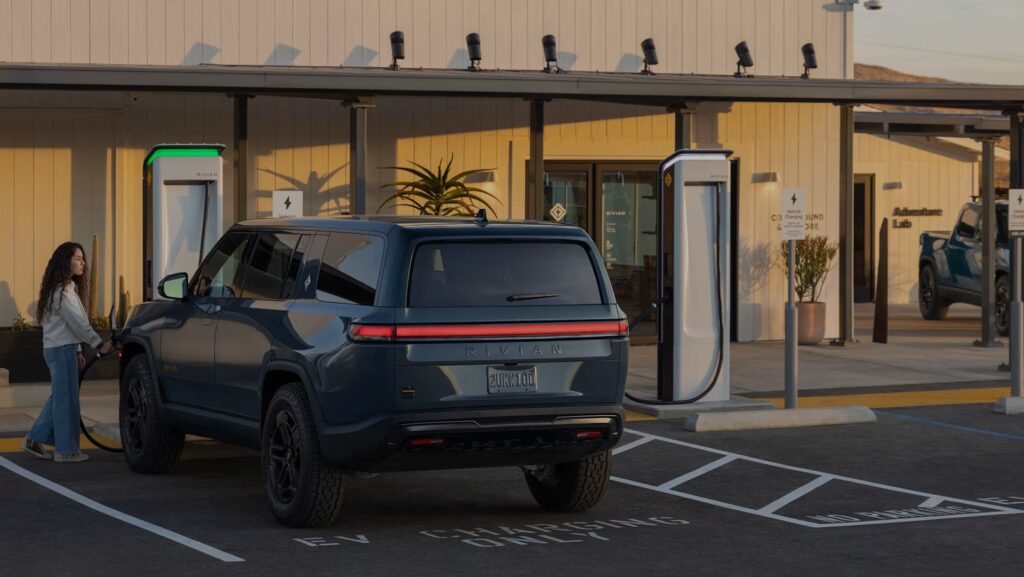
According to Caruso leadership, the initiative is intended to enhance the retail and hospitality experience by integrating charging directly into high-traffic destinations. The goal is to align with shifting consumer behavior, where mobility, shopping, and leisure increasingly intersect.
To support its renewable energy claims, Rivian uses a mix of procurement strategies. These include long-term power purchase agreements, investment in on-site and community-based solar and wind projects, and partnerships with utilities. In some cases, the company also sources energy from existing renewable installations while new capacity is developed.
Site selection for renewable projects is informed by regional grid composition. Areas with lower shares of clean energy are prioritized to maximize emissions reductions. This approach reflects the uneven distribution of renewables across the United States and aims to deliver greater system-wide impact by targeting regions that rely more heavily on fossil fuels.
Through this model, Rivian is positioning its charging network not only as infrastructure for EV adoption, but also as a mechanism for accelerating the transition to a cleaner energy grid.
Why Combining EV Charging With Renewable Energy is Important
Electric vehicles are often evaluated through the lens of tailpipe emissions, but the more rigorous measure is lifecycle analysis. Across a wide range of studies, the conclusion is consistent. EVs remain the cleanest form of transportation even when powered by electricity grids that still rely heavily on fossil fuels.
Lifecycle analysis accounts for emissions from manufacturing, fuel production, and operation over time. While EV production, particularly battery manufacturing, carries a higher upfront carbon footprint than internal combustion vehicles, that gap closes quickly in real-world use. Once on the road, EVs benefit from far greater energy efficiency and the absence of direct emissions. Even on coal-heavy grids, total emissions per mile are typically lower than those of gasoline vehicles. As renewable intensity improves, the advantage widens.
The key dynamic is that EVs get cleaner over time. Internal combustion vehicles are locked into the emissions profile of the fuel they burn. EVs, by contrast, inherit the trajectory of the grid. As utilities add solar, wind, and other low-carbon sources, every connected EV becomes cleaner without any modification to the vehicle itself.
Charging with renewable energy represents the optimal scenario. Pairing EVs with solar or wind power reduces lifecycle emissions to a fraction of those associated with gasoline vehicles. In some cases, particularly with high renewable penetration, operational emissions approach zero. This combination transforms transportation from a major emissions source into a low-impact system aligned with climate goals.
Beyond environmental benefits, the EV and renewable energy pairing has significant implications for national security. Petroleum-based transportation depends on global supply chains that are vulnerable to geopolitical disruption, price volatility, and strategic competition. Electrification shifts energy demand toward domestically produced resources. Solar and wind generation can be deployed locally, reducing reliance on imported fuels and insulating economies from external shocks.
This shift also enhances grid resilience. Distributed energy resources, including renewable generation paired with storage, create a more flexible and decentralized energy system. When integrated with EVs, which can function as mobile storage assets, the result is a more robust infrastructure capable of responding to disruptions.
The transition to electric mobility is not only about emissions reduction. It is a structural change in how energy is produced, distributed, and consumed. Lifecycle analysis makes the environmental case clear. When combined with renewable energy, the case extends to economic stability and national security.

Electric Vehicle Marketing Consultant, Writer and Editor. Publisher EVinfo.net.
Services