EVinfo.net Interviews OMI’s Luis Garelli About Company’s Astonishing Three-Minute EV Charging Breakthrough
On February 23, 2026, OMI unveiled a validated cathode capable of charging at a 20C rate, enabling a battery to go from near depletion to full charge in approximately three minutes. Based in Dallas, Texas, OMI has achieved a milestone that has long challenged the world’s largest battery manufacturers. As a supplier to companies such as Polaris Industries and Harley-Davidson, the company has established a reputation for engineering high-performance energy solutions that push beyond conventional limits.
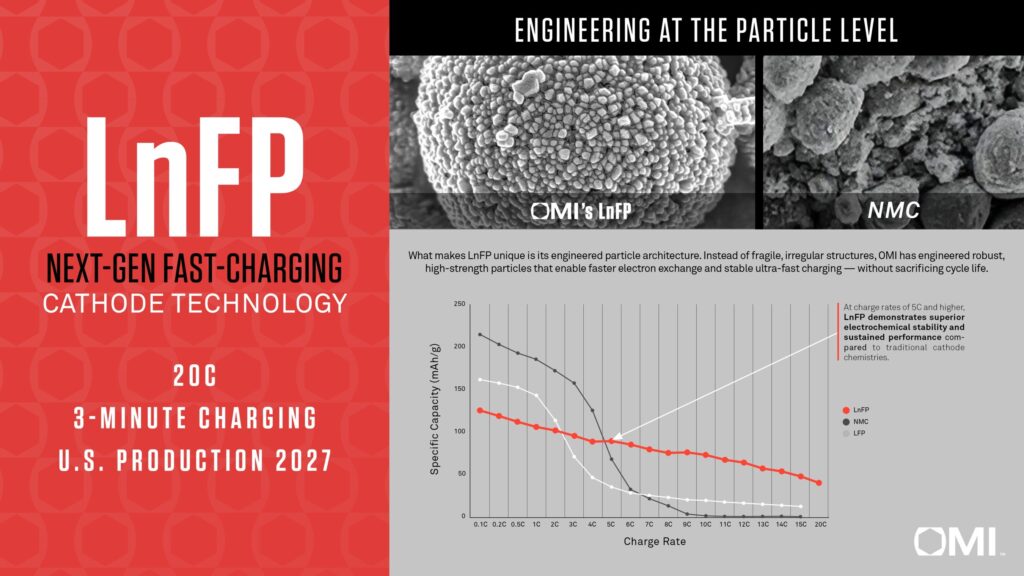
At the core of this breakthrough is LnFP, OMI’s proprietary active cathode material. Unlike traditional cathodes that rely on fragile and irregular particle structures, LnFP features a highly engineered particle architecture composed of robust, high-strength materials. This design enables faster electron exchange and supports ultra-fast charging without compromising cycle life.
Importantly, this advancement extends beyond laboratory validation. OMI reports that its LnFP material has been developed by testing under real-world conditions, demonstrating consistent extreme fast-charging performance while maintaining durability, safety, and chemical stability. A 20C charge rate fundamentally changes the charging experience. While current fast-charging systems still require meaningful dwell time, OMI’s nano-engineered, iron-based chemistry enables rapid lithium-ion transport while preserving structural integrity.
Cycle testing further reinforces its performance. Batteries utilizing LnFP have maintained strong output across thousands of charge-discharge cycles, even under aggressive high-rate conditions and in demanding applications such as off-road environments.
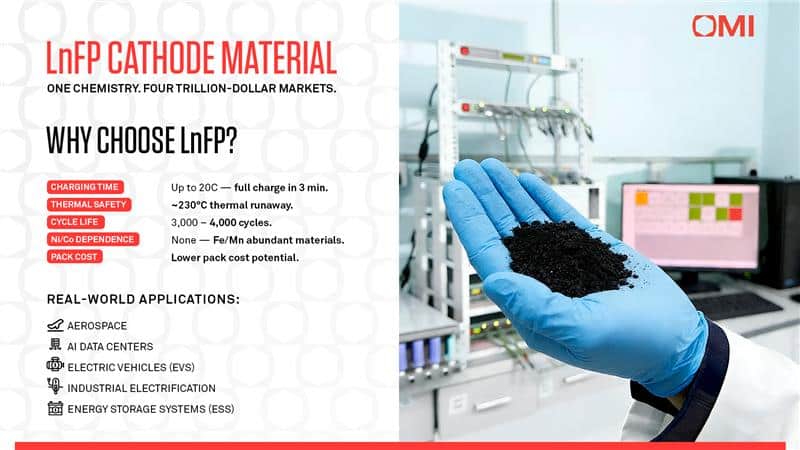
The formulation also eliminates cobalt entirely, reducing supply chain risk and improving cost scalability. OMI plans to begin small-scale U.S. production by 2027 and is actively engaging venture investors to support expansion. Demonstration vehicles incorporating the technology are expected within the same timeframe.
EVinfo.net had the honor of speaking with Arón Cabrera at OMI. CEO and founder Nick White added some background to OMI’s LnFP cathode claim.
White said: “In 2022 OMI was approached to JV the development of a hybrid off-road vehicle. Our background in mechanical and electrical systems was strong. We quickly realized our battery knowledge and battery management systems knowledge were lacking. We made the strategic decision to invest in this technology, allocating $3.8M to R&D and JV partnerships with two universities.”
“Our concept was how do we create a) a more robust LFP structure that bonds the Li+ and b) how to improve the pathways for the Li+ to move between cathode and anode. We decided to make no claims until we had made batteries, tested them, filed IP protection, and were ready to provide material to cell manufacturers, ready to test our cathode material. Everything stated is real, we are ready,” continued White.
As global electrification accelerates, charging speed remains one of the most critical constraints. With a validated 20C-capable cathode and a clear path to commercialization, OMI is positioning itself at the forefront of next-generation battery materials.
EVinfo.net Interviews Luis Garelli, Chief Technology Officer at OMI Motors
EVinfo.net had the great honor of interviewing Luis Garelli, Chief Technology Officer at OMI Motors.

Bill Pierce:
Luis, OMI has just pulled off something that most people thought was impossible. What was it like when you realized a three-minute charge was actually achievable?
Luis Garelli:
It was one of those rare moments where the data forces you to completely rethink what’s possible. When we saw stable performance at 20C—not just once, but consistently across cells—it became clear this wasn’t a lab anomaly. This was real.
What struck me wasn’t just the speed itself. It was the fact that the speed was unlocked. If you can reliably recharge in minutes instead of hours, you fundamentally change how energy is used across transportation, infrastructure, and industry. That’s when it clicked—we weren’t just improving batteries; we were redefining expectations.
Bill Pierce:
A three-minute charge sounds like something out of a sci-fi movie. How do you think this will change the way people use electric vehicles and other devices?
Luis Garelli:
It’s going to completely transform how we think about energy. For EVs, it means charging becomes as quick and seamless as filling up a gas tank—no more range anxiety or long waits at charging stations.
For energy storage systems, it means we can store and deploy renewable energy faster, making grids more efficient and resilient. AI data centers, which are power-hungry beasts, can benefit from rapid-charging backup systems to avoid downtime.
When charging drops from hours to minutes, behavior changes overnight. This isn’t just about faster charging—it’s a shift toward energy systems that operate in real time.
Bill Pierce:
Fast charging usually comes with some big trade-offs, like shorter battery life or safety risks. How did you guys manage to avoid those pitfalls?
Luis Garelli:
That trade-off is exactly what we refused to accept. High power typically comes at the expense of stability—but our data shows you don’t have to choose.
We engineered LnFP at the nano-structural level so it can handle extreme charge rates without degrading. What we see in testing is strong capacity retention, stable voltage behavior, and consistent cycling performance—even under aggressive conditions.
In simple terms: the material doesn’t just charge fast; it stays stable while doing it. That’s the difference between a flashy demo and a platform you can actually deploy.
Bill Pierce:
Cobalt-free batteries are a big deal, especially with all the ethical and supply chain issues around cobalt. How did you pull that off, and what does it mean for the industry?
Luis Garelli:
Moving away from cobalt wasn’t just a sustainability decision—it was a strategic one. Iron-based chemistries give you stability, cost advantages, and supply chain resilience all at once.
What’s important is that we didn’t compromise performance to get there. We’re seeing high-rate capability and strong capacity in a system built from abundant materials.
For the industry, that combination—performance plus scalability—is what enables real global adoption.
Bill Pierce:
OMI is a smaller company compared to the big players in the battery world. How did you manage to outpace some of the giants?
Luis Garelli:
Being small is actually one of our biggest advantages. We’re nimble, we’re focused, and we don’t have to deal with layers of bureaucracy. If we see a problem, we tackle it head-on.
While the big players are busy tweaking existing tech, we’re over here asking, “What if we did it completely differently?” That freedom to take risks and think outside the box is what got us here. And because we’re not tied to legacy systems, we can innovate faster—whether it’s for EVs, AI data centers, or industrial applications.
We didn’t try to iterate our way there—we approached the problem from first principles. Large organizations tend to optimize existing systems. We had the freedom to question the assumptions behind them. That allowed us to move faster, test more aggressively, and focus only on what mattered: performance validated by data.
Being small meant we could stay aligned—scientifically and strategically—and that speed of execution made all the difference.
Bill Pierce:
The 20C charge rate is impressive, but what does it mean for the bigger picture of global electrification?
Luis Garelli:
It removes one of the last bottlenecks. Electrification has always been limited not just by energy density, but by how fast you can move energy in and out of a system. At 20C, you’re operating in a completely different regime.
That means faster vehicle turnaround, more responsive energy storage, and systems that can handle peak demand without oversizing. It makes electrification not just viable—but efficient at scale.
Bill Pierce:
You’ve announced plans to start U.S. production by 2027. Why is domestic manufacturing such a big deal for OMI?
Luis Garelli:
If we’re going to lead the charge (pun intended) in electrification—whether it’s for EVs, energy storage, or industrial applications—we need to have the infrastructure to back it up right here at home.
Because performance doesn’t matter if you can’t scale it reliably.
By building domestic production, we control quality, reduce supply chain risk, and align manufacturing with innovation. It allows us to move from validated results to real deployment without friction.
If you’re going to lead in next-generation energy, you need both the technology and the infrastructure—and we’re building both.
Bill Pierce:
OMI has a reputation for tackling the ‘impossible.’ What’s next on your list of challenges to solve?
Luis Garelli:
We’ve proven high-rate performance. Now we’re expanding the envelope.
That means continuing to push energy density, optimizing for different form factors, and adapting the platform to new use cases—from mobility to high-demand infrastructure.
The key is that we’re building on a validated foundation. Once you establish that kind of performance, it opens up a much broader design space.
Bill Pierce:
You’ve worked with companies like Polaris and Harley Davidson. How have those partnerships influenced the way OMI approaches innovation?
Luis Garelli:
They forced us to build for reality, not just for results.
When your technology goes into vehicles that operate in harsh, unpredictable environments, there’s no margin for compromise. It has to perform consistently, under stress, over time.
That mindset—designing for durability, reliability, and real-world conditions—is embedded in everything we do. If it doesn’t hold up outside the lab, it doesn’t count.
Bill Pierce:
If you had to sum up what OMI is all about in one sentence, what would you say?
Luis Garelli:
OMI is about pushing boundaries and making the impossible possible. Whether it’s EVs, energy storage, AI data centers, or industrial electrification, we’re here to create solutions that don’t just work—they change the way people live and interact with technology.
We take what’s been accepted as a limitation—and turn it into a solved problem, backed by real data.
About OMI
OMI provides comprehensive OEM manufacturing services that enable companies to accelerate product development and expand their brand capabilities. By outsourcing design, engineering, and production, partners can fast-track new product introductions through OMI’s fully integrated and streamlined manufacturing approach.
With more than 27 years of experience, OMI has established itself as a global technology leader focused on eliminating manufacturing complexity. The company operates over 200,000 square feet of production space across the United States, Mexico, and China, delivering vertically integrated solutions that span research and development, Design for Manufacture, and full-scale production and assembly for Fortune 500 clients.
As a global engineering and sourcing hub, OMI combines deep technical expertise with an extensive manufacturing infrastructure to support scalable, high-performance product development. Its capabilities include large-scale global manufacturing capacity, decades of engineering experience, and fully U.S.-made battery management systems and controls, positioning the company as a reliable partner for advanced technology solutions.
Through its globally integrated platform, headquartered in the United States with additional operations in Mexico, China, and Bangladesh, OMI has spent nearly three decades partnering with OEMs to design, engineer, and manufacture products efficiently. This end-to-end approach reduces operational complexity, shortens time to market, and supports long-term scalability for its partners.

Electric Vehicle Marketing Consultant, Writer and Editor. Publisher EVinfo.net.
Services