Average U.S. Gas Price Spiked to $4.39, Requests for Hertz EV Reservations Increased Nearly 25% in March
On April 23, 2026, Reuters reported that early indications suggest U.S. car rental companies are seeing a shift toward electric vehicles as rising fuel costs, driven by the Iran war, continue to influence consumer behavior.
At Hertz, which supplies vehicles to rideshare drivers through partnerships with Uber and Lyft, EV reservation requests climbed nearly 25% in March compared with February. The strongest growth has been concentrated on the West Coast, where gasoline prices are typically highest, according to the company’s mobility division.
On May 1, 2026 NBC News Los Angeles reported the average price for a gallon of regular gasoline remains above $6.00 in Los Angeles and several other California counties. AAA reported on May 1 the current national average for regular gas as $4.392, and the year ago average at $3.187.
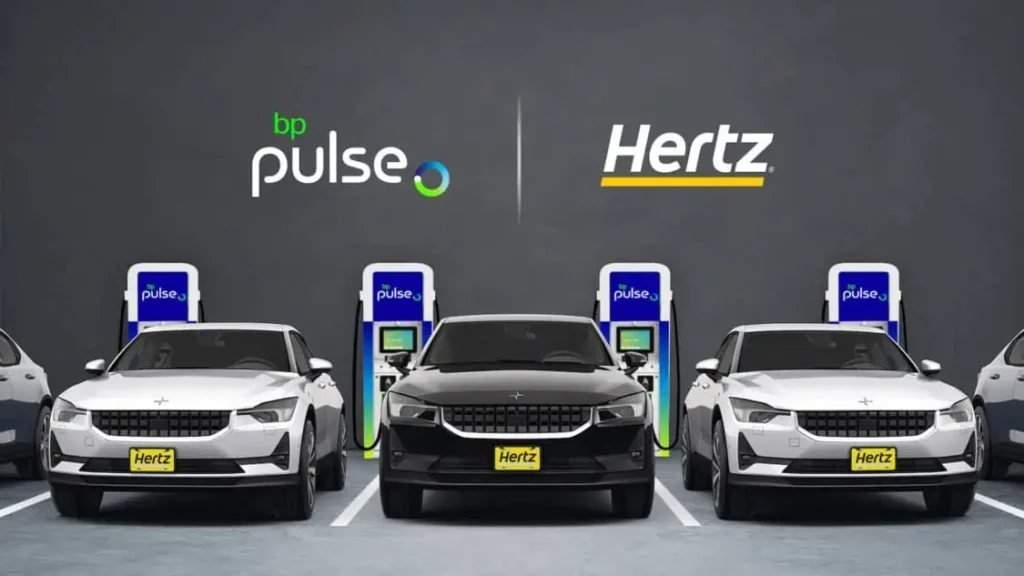
A similar trend is emerging at Turo, often described as an Airbnb for vehicles. EV bookings rose 11% during the final three weeks of March versus the prior three-week period. On March 31, when U.S. gas prices exceeded $4 per gallon for the first time since 2022, EV reservations on the platform surged 47% year over year.
The price spike is linked to disruptions in the Strait of Hormuz caused by the Iran conflict, a key global transit route for oil and liquefied natural gas. Since late February, average U.S. gasoline prices have jumped more than one-third, based on data from the U.S. Energy Information Administration.
While sharp increases in fuel costs do not typically trigger immediate changes in vehicle purchasing behavior, the scale of this spike is pushing consumers to explore alternatives.
New figures from Bloomberg, released on April 28, 2026, show that EV sales climbed rapidly in March across several key markets. In countries such as United Kingdom, France, and South Korea, demand accelerated as fuel costs rose. During the first four weeks following the outbreak of the Iran conflict, consumers in France, Germany, and the UK purchased a combined 206,200 electric vehicles, a 44% increase compared to the same period last year. In South Korea, EV transactions more than doubled, while Italy saw sales reach 16,000 units, up 67% despite historically slower adoption.
In the U.S., the response has been more mixed. New EV sales declined 25% year over year in March, according to Cox Automotive, partly due to the expiration of a $7,500 federal tax credit. However, used EV sales are rising, and rental demand is shifting as consumers look for short-term ways to offset fuel expenses.
Cox reported in March 2026, 42,924 used EVs sold in a single month. That was up 54% from February, and up 28% year over year. Q1 as a whole hit over 100,000 units, the second-strongest quarter on record and up 12% on the same period last year.
Car Rental Gateway reported a 16% increase in EV and hybrid bookings in March. Analysts suggest rental operators with established EV fleets could benefit if elevated fuel prices persist.
Stronger demand is also stabilizing the used EV market. According to ACV Auctions, prices that had been declining for months began to firm in early March as oil prices climbed, giving electric vehicles renewed traction amid sustained pressure at the pump.
EVinfo.net’s Take: The Iran War Is Supercharging EV Adoption Worldwide
The global electric vehicle transition just received an unexpected catalyst, and it did not come from policy, subsidies, or automaker innovation. It came from geopolitics.
Since the outbreak of the Iran conflict in early 2026, disruptions to oil supply chains, particularly through the Strait of Hormuz, have sent shockwaves through global energy markets. Oil prices have surged, gasoline costs have climbed sharply, and consumers are responding in a predictable but powerful way: they are rethinking dependence on fuel.
This is not theoretical. It is already showing up in real market behavior.
Across Europe, automakers are reporting what one executive described as a “seismic shift” in electric vehicle interest, with EV inquiries and sales rising sharply as fuel prices spike. In parallel, global analysts and climate leaders say the conflict has effectively “supercharged” the transition toward electrification and renewable energy as countries look to reduce exposure to volatile fossil fuel markets.
The Economics Have Changed Overnight
For years, EV adoption has been driven by a mix of environmental concerns, government incentives, and gradual improvements in technology. The Iran war has introduced a much more immediate and visceral driver: cost.
When gasoline crosses psychological thresholds such as $4 per gallon in the United States or €2 per liter in Europe, the total cost of ownership equation shifts dramatically. Suddenly, EVs are no longer just a forward-looking choice, they become a financially rational one in the present.
Rising oil prices are directly increasing the operating cost of internal combustion vehicles, while electricity prices remain comparatively stable in most markets. This widening gap is pushing consumers toward EVs at a faster rate than policymakers alone ever could.
A Global, Not Regional, Shift
What makes this moment different from past oil shocks is its global synchronization. Europe, Asia, and parts of North America are all experiencing the same price pressures at the same time.
In Asia, which relies heavily on oil shipments through the Strait of Hormuz, the impact is particularly acute. In Europe, EV interest and registrations are accelerating rapidly. Even in markets where EV momentum had slowed, the trend is reversing as fuel costs rise.
This is not just a demand story, it is a structural shift.
Energy security is now directly tied to transportation choices. Countries and consumers alike are recognizing that electrification reduces exposure to geopolitical risk in a way that gasoline-powered mobility simply cannot.
EVs as a Strategic Hedge
One of the most overlooked aspects of this transition is how existing EV adoption is already cushioning the economic impact of the crisis. Electric vehicles reduce oil demand at scale, effectively insulating parts of the economy from fuel price volatility.
This reframes EVs from being purely environmental solutions to becoming strategic assets. They are no longer just about emissions reduction. They are about resilience.
What Happens Next
The key question is whether this surge in EV adoption will persist once oil markets stabilize. History suggests some pullback is possible, but this situation is different in one critical way: the perception of risk has changed.
Even if prices moderate, the awareness of how quickly fuel costs can spike is now embedded in consumer behavior. That alone is enough to sustain higher baseline interest in EVs.
The Iran war may not have started the electric vehicle transition, but it is accelerating it in a way few policy frameworks ever could.

Electric Vehicle Marketing Consultant, Writer and Editor. Publisher EVinfo.net.
Services