Alpitronic’s New EV Chargers Can Deliver up to 1,000 Kilowatts to a Single Port
Charging speed remains one of the biggest barriers to broader EV adoption, and megawatt charging has the potential to reduce charging times to levels approaching a traditional gasoline fill-up. Some future EVs could recharge from 10% to 80% in seven minutes or less if paired with batteries and charging systems designed for these higher power levels.
Recognizing this need, Italian EV charging hardware manufacturer Alpitronic has begun testing its new HYC1000 megawatt charging system at its North American headquarters in Charlotte, North Carolina. The new charger is capable of delivering up to 1,000 kW of power through a single port for heavy duty electric trucks and up to 600 kW for passenger EVs. While no passenger EV currently sold in the U.S. can accept charging at those levels, the technology could pave the way for significantly faster charging in the future and encourage automakers to develop vehicles capable of taking advantage of higher power outputs.
According to Alpitronic Americas President Mike Doucleff, who recently demonstrated the system in a video with Out Of Spec Reviews, the HYC1000 introduces several new capabilities beyond the company’s existing chargers. Alpitronic has rapidly expanded its presence in North America through partnerships with major charging providers including IONNA, Walmart, Mercedes-Benz High Power Charging, Electrify America, and bp pulse. Hundreds of the company’s HYC400 chargers have already been installed across the country.
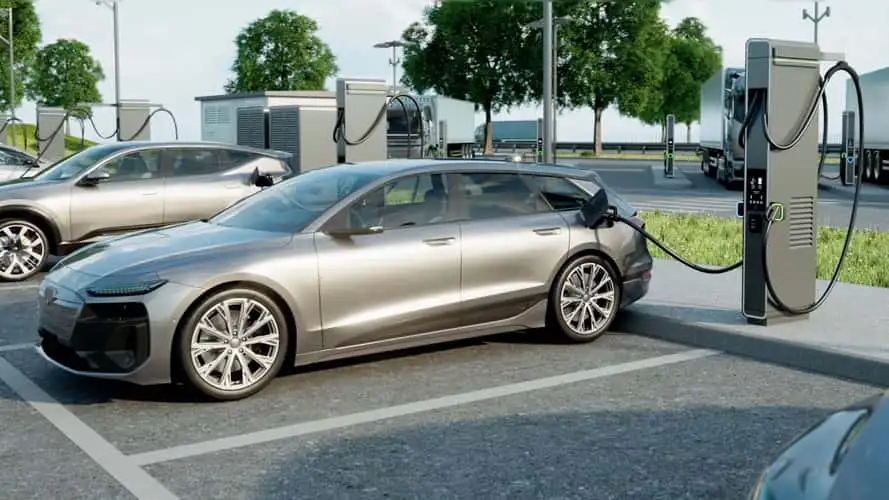
The HYC1000 features tall, slim charging dispensers that support two charging cables per unit. Depending on customer requirements, they can be equipped with Tesla’s NACS connector, CCS connectors, or the Megawatt Charging Standard (MCS) connector for commercial trucks. Each dispenser includes overhead cable management arms to reduce cable weight, a vehicle-facing touchscreen, and an integrated payment card reader.
Each tower contains two charging plugs capable of simultaneously delivering up to 600 amps at 1,000 volts, allowing each port to provide as much as 600 kW. That exceeds today’s fastest public chargers in the U.S., including Tesla’s V4 Superchargers and the Gravity Charging Center in New York City, which currently top out at 500 kW. Even the fastest upcoming passenger EVs, including the Porsche Cayenne Electric, BMW iX3, and Lucid Gravity, are expected to peak at roughly 400 kW.
One of the HYC1000’s most significant advantages is its modular design. Using the MCS standard, the system can be configured to deliver up to 1,500 amps at 1,000 volts, enabling charging speeds of up to 1,000 kW for heavy duty vehicles. This flexibility allows charging sites to serve both commercial trucks and passenger vehicles simultaneously using different connector combinations.
Alpitronic also partnered with Mercedes-AMG to develop a specialized version of the HYC1000 capable of delivering 1,000 kW to a passenger vehicle. During testing in Italy, the Mercedes-AMG Concept GT XX reached a charging peak of 1,041 kW, demonstrating what future EVs may be capable of achieving.
Power distribution is handled through a central cabinet containing eight 125 kW silicon carbide power modules that can support as many as eight charging dispensers. Each 125 kW module is further divided into 62.5 kW sections, allowing the system to dynamically allocate power based on the charging needs of each connected vehicle.
For example, if a Chevrolet Equinox EV that can accept around 150 kW is charging beside a Hyundai Ioniq 5 capable of drawing up to 350 kW, the system automatically delivers the appropriate amount of power to each vehicle without wasting available capacity. Since EV charging speeds naturally decrease as batteries fill, this intelligent load balancing maximizes efficiency across the entire charging station.
Alpitronic is not alone in using dynamic power sharing, as Tesla, ChargePoint, and Electrify America have implemented similar technology. Likewise, Alpitronic is not the only company pursuing megawatt charging in North America. Tesla has begun deploying Megachargers for the Tesla Semi, while Kempower is also developing megawatt charging solutions for electric trucks.
Megawatt charging is already becoming available in China and Europe on mass-market EVs. Although passenger EVs in the U.S. are not yet capable of utilizing these extreme charging speeds, the arrival of systems like the HYC1000 suggests that the infrastructure is being built ahead of the vehicles. As future battery technology advances, megawatt charging could eventually become a major step toward making EV ownership even more convenient.
EVinfo.net’s Take: Congrats to Alpitronic and Alpitronic Americas President Mike Doucleff
I had the honor of meeting Alpitronic Americas President Mike Doucleff, who wisely realizes the growing importance of influencer marketing. See EVinfo.net’s influencer marketing services.
I’d like to see other EV and EV charging leaders follow Mike’s excellent lead.
I’m excited to see Alpitronic growing fast in the U.S. and this new ultra-fast system. As China and Europe continue expanding their electric vehicle markets at a rapid pace, the United States faces increasing pressure to modernize its charging infrastructure. While EV sales in the U.S. continue to grow, one of the biggest obstacles preventing wider adoption remains charging speed. Drivers and fleet managers want charging that is fast, reliable, and convenient, especially during road trips. Investing in ultra-fast charging technology is one of the most effective ways for the U.S. to close the gap with global EV leaders.

Electric Vehicle Marketing Consultant, Writer and Editor. Publisher EVinfo.net.
Services