CATL to Mass-Produce Sodium-Ion Batteries, Targeting 600 Km Range
In May 2026, Car News China reported CATL will launch a series of mass-produced sodium-ion battery products this year as the company expands beyond traditional lithium-ion chemistries. The move is expected to capitalize on the abundance of sodium raw materials while reducing production costs and minimizing exposure to volatile lithium supply chains.
Speaking at the 2026 Equipment Powerhouse Forum on May 30, CATL Chief Scientist and Chinese Academy of Engineering Academician Wu Kai confirmed that the company’s sodium-ion battery manufacturing bottlenecks have been resolved, clearing the way for large-scale commercialization.
According to CATL’s product roadmap, the company plans to deploy sodium-ion batteries across a wide range of applications, including passenger vehicles, commercial trucks, battery-swapping systems, and grid-scale energy storage.
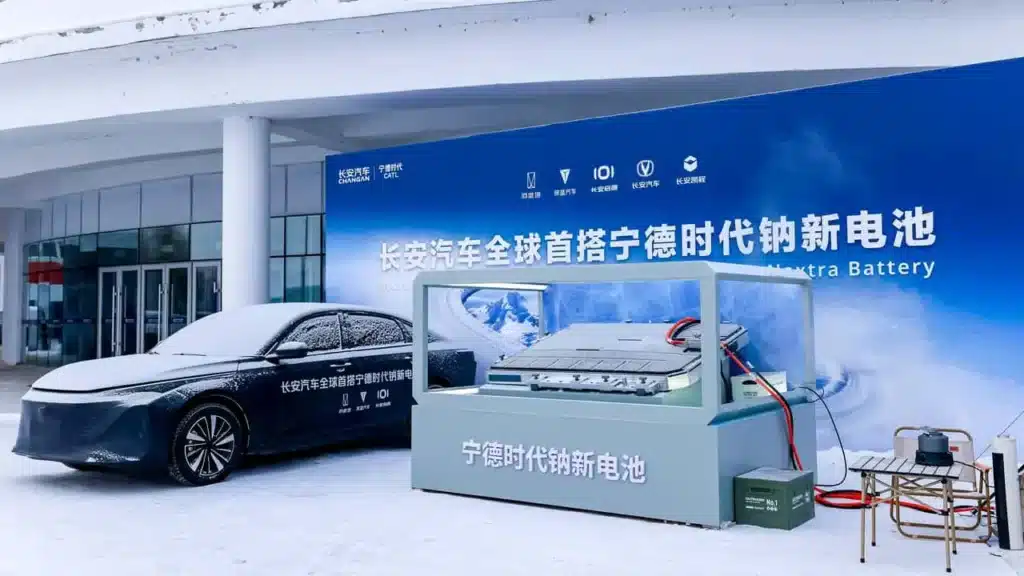
In February, EVinfo.net reported CATL and automaker Changan Automobile were preparing to introduce the world’s first passenger vehicle powered by a sodium-ion battery, with plans to place it on public roads by mid-2026.
Cold-weather performance is where the sodium-ion battery stands out most. CATL says its Naxtra battery discharges power at minus 30 degrees Celsius is three times higher than that of LFP batteries, while range retention remains above 90 percent at minus 40 degrees Celsius. Power output is also reported to remain stable at temperatures as low as minus 50 degrees Celsius, addressing one of the most persistent challenges facing EV adoption in colder climates.
At the same time, CATL continues investing in next-generation lithium-air battery research as part of its long-term technology strategy.
Expanding Sodium-Ion Production
CATL’s commercialization efforts follow a major expansion of its sodium-ion business, including a recently announced 60 GWh supply agreement that represents the world’s largest single order for sodium-ion batteries.
Unlike lithium-ion batteries, sodium-ion technology relies on widely available raw materials, allowing manufacturers to reduce dependence on lithium while lowering material costs and improving supply chain stability.
The first generation of CATL’s sodium-ion batteries is expected to target affordable passenger vehicles and stationary energy storage applications. However, the company is already developing higher-energy-density versions capable of delivering driving ranges of up to 600 kilometers on a single charge, positioning future sodium-ion batteries as competitors to entry-level lithium iron phosphate (LFP) battery systems.
Long-Term Focus on Lithium-Air Batteries
While sodium-ion batteries are moving toward mass production, CATL is also advancing research into lithium-air battery technology.
Lithium-air batteries use metallic lithium as the negative electrode while drawing oxygen directly from the surrounding atmosphere to serve as the positive reactant during discharge. Because oxygen does not need to be stored inside the battery pack, the technology eliminates much of the weight associated with conventional cathode materials.
During discharge, lithium reacts with oxygen to form lithium peroxide. This electrochemical process offers the potential for significantly higher theoretical energy density than today’s lithium-ion batteries, including both liquid-electrolyte and solid-state designs. As a result, lithium-air batteries are widely viewed as one of the industry’s most promising long-term battery technologies.
CATL Maintains Market Leadership
The expansion into sodium-ion production comes as CATL continues to dominate China’s EV battery market.
According to China EV DataTracker, CATL installed 29.06 GWh of electric vehicle batteries in China during April 2026, giving the company a 46.6% share of the domestic market.
Of that total, 19.53 GWh consisted of lithium iron phosphate (LFP) batteries, while 9.53 GWh came from nickel-manganese-cobalt (NMC) ternary battery packs.
This shows how rapidly LFP is beginning to dominate the global EV battery market. LFP batteries do not use nickel or cobalt. Instead of these expensive, controversial and supply-constrained metals, LFP batteries use iron and phosphorus to form the cathode.
With sodium-ion batteries entering mass production alongside its existing LFP and NMC manufacturing lines, CATL is expanding its battery portfolio while positioning itself for future advances in next-generation energy storage technologies.

Electric Vehicle Marketing Consultant, Writer and Editor. Publisher EVinfo.net.
Services