Ford and Geely Join Forces in Europe to Produce Next-Generation Multi-Energy Vehicles in Spain
On July 23, 2026, Ford Motor Company and China’s Geely Automobile Holdings (Geely Auto) announced an agreement to establish a Europe-focused joint venture at Ford’s manufacturing facility in Valencia, Spain. The partnership will manufacture Ford and Geely multi-energy passenger vehicles for European customers, creating a larger production base designed to compete in one of the world’s most challenging automotive markets.
Europe’s automotive industry is undergoing rapid transformation as manufacturers face stricter emissions regulations, rising operating costs, and increasing competition from new global automakers. These pressures have changed expectations around vehicle manufacturing costs, technology capabilities, and software-driven customer experiences.
By combining production volumes, Ford and Geely aim to maximize the capacity of the Valencia plant, reduce manufacturing costs, and create a more competitive production model for the European market. The companies believe the partnership will allow them to deliver advanced multi-energy vehicles while supporting economic growth and employment in the Valencia region.
Subject to regulatory approvals, the joint venture is expected to begin operations during the first half of 2027, with the first vehicles scheduled to leave the production line in 2028. Ford will continue manufacturing the Ford Kuga at the Valencia facility during the transition period.
The partnership builds on a relationship between Ford and Geely that dates back to 2010, when Ford sold Volvo Cars to Geely. Ford has pointed to Geely’s efforts to strengthen and expand Volvo as an example of the companies’ shared commitment to quality, efficient sourcing, continuous improvement, and customer choice during the global shift toward electrification.
“For nearly 50 years, Valencia has built some of the most-loved cars in our history, and now this team will help build our future”, said Jim Baumbick, President, Ford of Europe. ” That’s why we’re building a flexible, cost-effective industrial system with a capable partner in Geely Auto. Together we can fully utilize a best-in-class plant with a great workforce and match the industry’s new cost benchmark. This is all part of Ford’s vision to give European drivers rally-bred handling, true off-road capability and multi-energy technology, with a distinct Blue Oval DNA.”
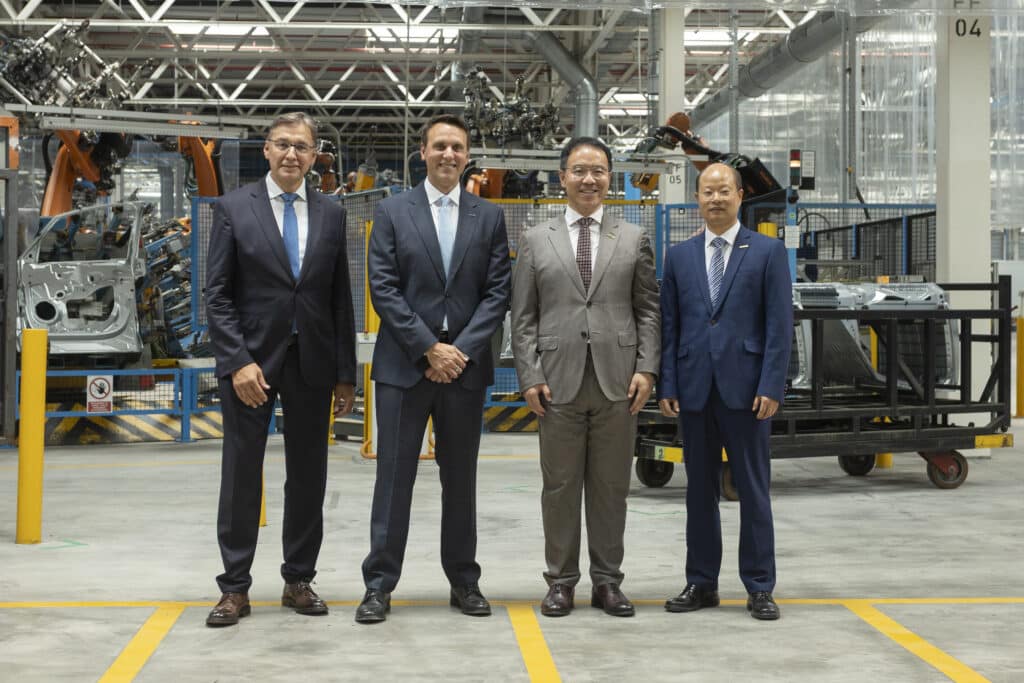
“This JV with Ford in Europe reflects our commitment to open, collaborative product development as part of our growth strategy, deepening our local presence and commitment to customers in Europe”, said Alex Nan, Vice President of Geely Auto Group. “We are dedicated to delivering vehicles that European customers will choose on merit: on industry leading features, on high-quality and on actively contributing to Europe’s green future. Put simply: we are building cars in Europe, for Europe, alongside a trusted partner.”
Valencia Plant to Become Low-Carbon Mobility Manufacturing Hub
The joint venture will transform Ford’s Valencia facility into a shared, high-tech manufacturing center designed to compete with the industry’s evolving global cost standards. The plant, which has a potential annual production capacity of approximately 500,000 vehicles, has been one of Europe’s most advanced automotive manufacturing sites since opening in 1976.
Valencia was the first manufacturing location established in Spain by a non-Spanish automaker and became the birthplace of the original Ford Fiesta, Ford’s first global front-wheel-drive vehicle and one of the company’s most successful models.
Under the proposed ownership structure, Ford will hold a 66% stake in the joint venture, while Geely Auto will own 34%.
Ford and Geely Vehicle Plans
The partnership will combine the engineering, manufacturing, and product development expertise of both companies to produce low-emission and zero-emission passenger vehicles tailored specifically for European drivers. The vehicles will offer a range of powertrain choices, including electrified options, along with advanced digital features.
Ford Vehicles
Ford Kuga: Production of the Ford Kuga, one of Europe’s most popular plug-in hybrid models, will continue at the Valencia plant without interruption.
New Compact Bronco SUV: Valencia will begin producing a new member of Ford’s global Bronco family in 2028. The rugged, compact SUV will be designed for European roads and positioned as an adventure-focused vehicle.
All-New Multi-Energy Crossover: Ford and Geely will jointly develop a new family crossover scheduled for launch in 2028. The vehicle will feature Ford’s engineering approach and driving dynamics as part of Ford’s plan to introduce five new multi-energy vehicles in Europe by 2029.
Geely Vehicles
Geely Auto plans to manufacture two electric SUVs at the Valencia facility as part of its European expansion strategy. The first Geely-branded vehicles produced through the joint venture are expected to enter production in 2028.
The partnership also supports Geely Auto’s global growth strategy following overseas sales of 474,228 vehicles during the first half of the year. For Ford, the agreement represents another step in its approach of using strategic partnerships to improve speed, efficiency, and scale while competing in Europe’s increasingly competitive automotive market.
Together, Ford and Geely aim to create a flexible manufacturing platform capable of producing the next generation of electric, hybrid, and low-emission vehicles while strengthening Europe’s automotive supply chain.
EVinfo.net’s Take: Ford and GM Face Pressure From Both Washington and Beijing
For much of the last century, Ford and General Motors defined the global automotive industry. Today, both companies find themselves squeezed between two powerful forces: rapidly changing, horribly bad U.S. federal policy and the relentless rise of China’s automotive sector.
The first challenge is domestic. Over the past several years, Ford, GM, and other automakers invested billions of dollars in electric vehicle programs based on expectations that federal policy would continue supporting EV adoption through incentives, emissions regulations, and infrastructure investments. When political priorities suddently and foolishly shifted, automakers were left with product plans, manufacturing investments, and supply chain commitments built for a market that has not developed as quickly as many expected. The result has been billions of dollars in EV-related losses, delayed projects, and difficult decisions about future investments.
At the same time, a far more formidable challenge is emerging overseas. While U.S. policy has shifted back and forth depending on election cycles, China has spent decades consistently supporting its automotive industry through industrial policy, supply chain investments, research funding, and consumer incentives. The strategy is now paying dividends. Chinese automakers are quickly expanding globally, offering competitive vehicles with advanced technology and aggressive pricing.
The clearest example came earlier this year when BYD surpassed Ford in global vehicle sales, a milestone that would have seemed unthinkable only a decade ago, and a sign of America’s decline due to the massive blunders of the current federal administration. BYD has evolved from a battery manufacturer into one of the world’s largest automotive companies, while several other Chinese brands are rapidly expanding into Europe, Latin America, Southeast Asia, and other key markets.
Meanwhile, Ford and GM face another problem closer to home: hybrids. While Ford and GM focused heavily on fully gas-powered vehicles, consumer demand for hybrids has surged. Toyota, Hyundai Motor Group, and Honda now dominate the U.S. hybrid market, accounting for roughly 86% of hybrid sales. These automakers spent years refining hybrid technology and are now benefiting from strong consumer demand for vehicles that offer improved fuel economy without requiring charging infrastructure.
Ford and GM still possess iconic brands, vast manufacturing capabilities, and significant engineering talent. However, the competitive landscape has changed dramatically. The challenge is no longer simply transitioning from gasoline to electric vehicles. It is competing against global rivals that have spent years building advantages in batteries, software, manufacturing efficiency, and hybrid technology.
The next decade may determine whether Ford and GM remain industry leaders or become examples of how quickly the automotive world can change.

Electric Vehicle Marketing Consultant, Writer and Editor. Publisher EVinfo.net.
Services