ChargerHelp Report Finds EV Charging Reliability Is a Recovery Problem
The 2026 ChargerHelp Reliability Report finds that improving EV charging reliability requires more than adding technicians or deploying more chargers. The report concludes that the biggest obstacles to restoring failed chargers are diagnostic limitations, fragmented responsibilities, parts logistics and delays between the companies involved in recovery.
ChargerHelp based its analysis on approximately 547 million charger telemetry data points and 217,000 curated records covering chargers, sites, work orders and issues. Its operations and maintenance data included 6,747 charging assets across 37 hardware manufacturers, 139 models, 49 customers, 1,600 sites and 40 states and provinces. During the 12-month analysis period, 1,448 assets experienced at least one issue, producing 2,951 reported issues and 2,730 resolved issues analyzed.
The report shifts the focus from simply measuring uptime to examining mean time to repair, or MTTR. ChargerHelp found a median resolution time of about nine days. About 45% of issues were resolved within a week and 79% within a month, but 11% took more than 60 days. The difference between the nine-day median and 22-day mean reflects a long tail of exceptionally lengthy repairs.
A major finding is that much of the recovery clock is spent waiting rather than performing physical repairs. For issues requiring a single work order, the median time before dispatch was two days and the median active work period was also two days, with total resolution taking seven days. Issues requiring multiple work orders had a median resolution time of 32 days, compared with seven days for single-work-order cases.
Across 1,921 dispatched issues, the median wait between identification and creation of the first work order was three days. Approximately 26% waited eight days or more before field action, while nearly 8% waited more than 30 days. ChargerHelp says these delays frequently result from diagnostic investigation, system approvals, scheduling, vendor coordination and other dependencies.
Diagnostic visibility is particularly important. Hardware-level information is often controlled by manufacturers and unavailable to network operators or third-party service providers. OCPP data can support charging-session management but may not provide enough information to identify difficult hardware failures remotely. Without adequate diagnostic information, technicians may be dispatched without knowing the root cause or the parts required.
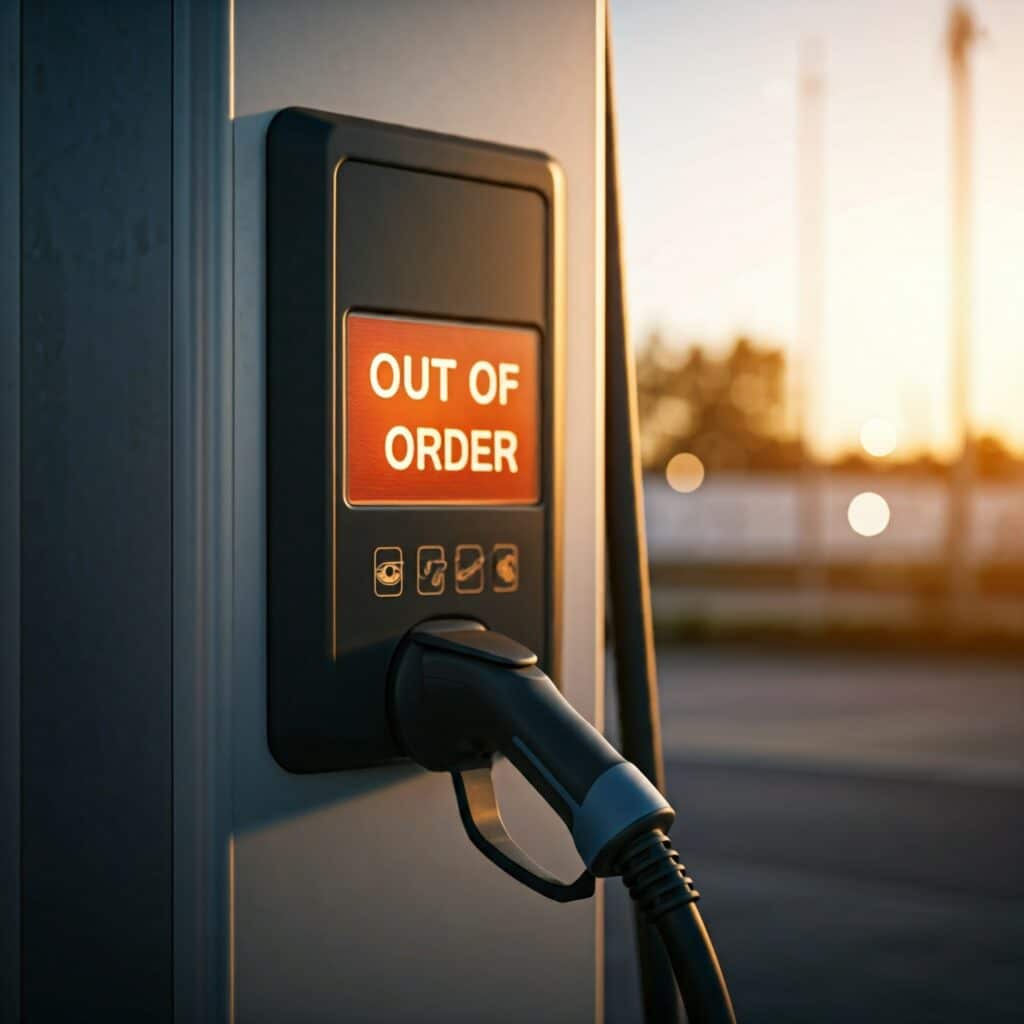
The report also identifies coordination gaps among site hosts, hardware manufacturers, network providers, utilities and field-service companies. Each organization may control part of the recovery process, creating handoffs where responsibility and information can become unclear. Parts availability can add additional delays, particularly when components must be obtained from overseas manufacturers.
Warranty and service agreements can also contribute to the problem. ChargerHelp says traditional arrangements often emphasize time-to-site or payment for individual visits rather than complete resolution. Parts-only warranties can leave site hosts responsible for labor, while other warranty structures require additional verification before coverage is approved. The report argues that contracts should instead encourage rapid resolution and lower MTTR.
Remote recovery represents another opportunity. Nearly 18% of issues in the full resolved population closed without a truck roll. Among long-duration cases lasting more than eight days, 30% closed with zero work orders and had a median resolution time of 17 days, compared with 18 days for single-visit cases. ChargerHelp cautions, however, that the zero-work-order category also includes duplicate tickets, monitoring noise and other cases, so it is not a direct measure of confirmed remote repairs.
The report recommends three changes to move the industry toward 99% uptime: adopt a unified operational model, provide appropriate access to OEM-level diagnostic data, and streamline parts and on-site logistics. Shared databases, clearly defined responsibilities and escalation procedures could reduce delays between partners. Customer-facing service agreements should also emphasize time-to-resolution rather than simply time-to-site.
ChargerHelp notes that the U.S. charging network is aging as it expands. Paren data showed active U.S. charging ports increasing from 61,271 to 78,431 between April 2025 and March 2026, while 37.6% of U.S. ports were already at least three years old. The report argues that maintaining this growing installed base will require operators to focus increasingly on recovery, lifecycle management and reliability rather than deployment alone.
The central message is that EV charging reliability is an ecosystem issue. Faster recovery depends on better information, coordinated decision-making, appropriate parts and clearly defined accountability. As charging becomes essential infrastructure for drivers and fleets, reducing MTTR and delivering consistently reliable charging will become increasingly important to the industry’s ability to support EV adoption at scale.
EVinfo.net’s Take: Why EV Charging Reliability Matters
Charging reliability is becoming just as important as charging availability as the electric vehicle market expands. Installing more charging stations does not solve the problem if drivers arrive at a charger that is offline, cannot initiate a session or fails during charging.
For EV drivers, a reliable charging network creates confidence. Drivers need to know that a charger will work when they need it, particularly on longer trips or when they depend on public charging because they do not have access to home charging. An unreliable station can mean searching for another charger, waiting for an available port or changing travel plans. Repeated failures can also undermine confidence in the broader EV experience.
Reliability is especially important for commercial fleets. Electric buses, delivery vehicles, trucks and other fleet vehicles depend on predictable charging to remain in service. A failed charger can prevent a vehicle from completing its scheduled route, potentially disrupting operations and increasing costs. For fleet operators, charging infrastructure is not simply an amenity. It is part of the operating system of the fleet.
EVSTAR Protects EV Charging Infrastructure Beyond the OEM Warranty
EVSTAR is helping EV charging businesses reduce the financial and operational risks associated with charger failures through insurance-backed warranty and protection programs. Its solutions are designed for OEMs, charge point operators, fleet operators, infrastructure developers, service providers, resellers and other companies deploying EV charging equipment.
EVSTAR’s StarProtect Pro provides protection beginning at the time of charger purchase, covering mechanical and electrical failures, accidental damage, power surges, parts and labor. StarProtect Legacy protects chargers that were already installed without an original protection plan, while StarProtect Extend provides coverage for equipment whose OEM warranty has expired.
For businesses operating charging infrastructure, unexpected repairs can quickly translate into higher costs and equipment downtime. EVSTAR says its programs are designed to provide consistent coverage across different charger manufacturers while managing the claims, repair and replacement process. Its warranties are underwritten by AIG Warranty and are filed in all 50 states and Washington, D.C.
EVSTAR also offers OEM Warranty Backstop programs, allowing charging manufacturers to transfer warranty liability while maintaining their customer-facing warranty process. The company works with certified service providers and can source OEM-approved replacement parts when repairs are required.
As the U.S. charging network continues to expand, protecting the equipment already deployed is becoming an important part of maintaining reliable charging infrastructure. EVSTAR’s approach combines warranty protection with repair and service support to help keep charging assets operational and reduce unexpected ownership costs.

Electric Vehicle Marketing Consultant, Writer and Editor. Publisher EVinfo.net.
Services