Life-Cycle Emissions of EU’s BEVs are 73% Lower Than ICE, Says New Report
On July 8, 2025, the International Council on Clean Transportation (ICCT) released a groundbreaking report assessing the environmental impact of battery electric vehicles (BEVs) in the European Union. This comprehensive life-cycle assessment (LCA) provides a clear picture of the greenhouse gas (GHG) emissions associated with different passenger car powertrain types, including gasoline, diesel, natural gas internal combustion engine vehicles (ICEVs), hybrid electric vehicles (HEVs), plug-in hybrid electric vehicles (PHEVs), battery electric vehicles, and hydrogen fuel cell electric vehicles (FCEVs).
The analysis examines emissions across the entire vehicle life cycle: production and recycling of vehicles and batteries, fuel and electricity production, consumption, and maintenance. By factoring in these stages, ICCT offers an updated and holistic perspective on the real climate impact of each powertrain type.
Key Findings Underscore the Advantages of BEVs
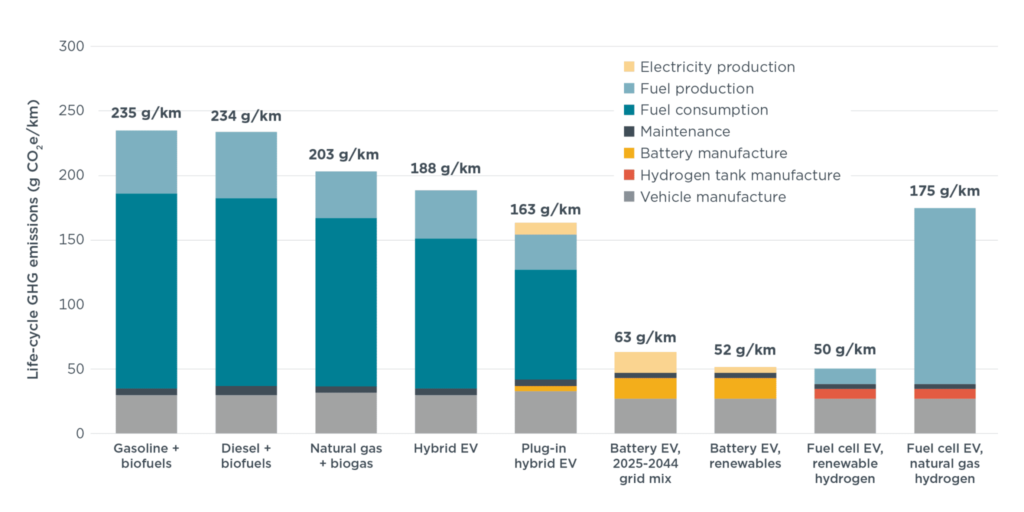
One of the most striking conclusions is that BEVs have life-cycle emissions nearly four times lower than gasoline cars. When powered by the projected 2025–2044 average EU electricity mix, BEVs produce just 63 grams of CO₂-equivalent per kilometer—representing a 73% reduction compared to gasoline vehicles, which emit 235 grams per kilometer. For BEVs running solely on renewable electricity, emissions drop even further to 52 grams per kilometer, an impressive 78% reduction.
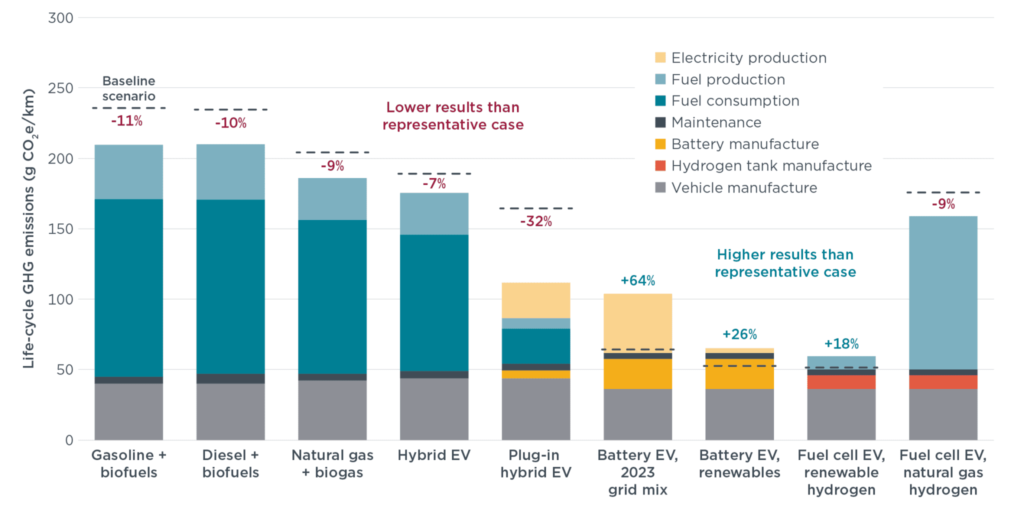
While BEVs entail about 40% higher production emissions than ICEVs, largely due to battery manufacturing, these are offset after just 17,000 kilometers of driving—usually within the first one or two years of use. Furthermore, the life-cycle emissions of BEVs have declined by 24% compared to ICCT’s 2021 assessment, reflecting ongoing decarbonization efforts within the EU electricity mix.
Hybrid and plug-in hybrid vehicles also demonstrate improvements, with life-cycle emissions 20% and 30% lower than gasoline cars, respectively. However, the report emphasizes that diesel vehicles show emissions similar to gasoline cars, and natural gas-powered vehicles offer only a modest 13% reduction.
Policy Implications and Recommendations
Based on these findings, ICCT strongly supports the phaseout of new ICEV, HEV, and PHEV registrations by 2035 to align with EU climate targets. The report stresses that, given the EU’s current and projected electricity mix, only BEVs offer a clear path to large-scale GHG reductions. FCEVs could also achieve significant reductions but only if powered by renewable hydrogen.
The study highlights the importance of complementary policies to address emissions from vehicle production, including stricter battery carbon footprint standards under the EU Battery Regulation and sustainability criteria for purchase incentives. Additionally, continued decarbonization of the EU power sector, improvements in BEV energy efficiency, and stricter energy standards can further drive down life-cycle emissions.
While life-cycle emissions-based regulations could be effective, ICCT cautions against immediate implementation due to high administrative burdens and data verification challenges. Instead, the organization recommends harmonizing LCA methodologies to ensure accurate, representative emissions estimates that reflect real-world conditions and evolving electricity mixes.
The 2025 report reinforces the conclusion that BEVs, particularly when paired with renewable electricity, remain the most effective solution for deep decarbonization of Europe’s passenger vehicle fleet. As EU policymakers push forward toward climate neutrality, ICCT’s analysis offers a crucial data-driven foundation to guide future regulatory and market decisions.
EVinfo.net’s Take
EVinfo.net appreciates this impactful report by the ICCT. Europe is far ahead of the United States in EV adoption and strong policies for the environment. The US government has made many mistakes in regards to electric vehicles recently, for instance cutting the federal EV tax credits and removing itself from the vitally important Paris Agreement on Climate Change.
These mistakes will make global human-caused climate change worse, create more unhealthy smog in the US, cost American drivers more money, decrease national security, hurt the US economy, lose many auto industry jobs, and help China move farther ahead of the US and Europe in the EV race.
But not all is doom and gloom.
We predict EV sales growth will slow down after the cut, after a boom before the cut. However, after a short time, EV sales will tick back up in the US.
Luckily, EVs are not only the most eco-friendly transportation, they are also the most cost-effective over time. Mainly because of the cost issue, but for many reasons, EVs will continue growing in the US and globally. Our transportation future is electric, and absolutely nothing can stop that.
Why can’t EVs be stopped? Economics 101. The more convenient and cost effective option nearly always wins. Trying to save gas cars in 2025 is the same as trying to save horse-drawn carriages when the first gas cars took to the roads.


Electric Vehicle Marketing Consultant, Writer and Editor. Publisher EVinfo.net.
Services