GM’s New AV, AI, Computing Upgrade, V2H Aids Push to New Number One EV Seller Crown in USA
On October 22, 2025, General Motors (GM) announced a wide, far ranging upgrade across its entire automotive ecosystem, promising impressive advancements in nearly every facet of the automotive industry.
At its GM Forward media event, General Motors revealed how its scale in manufacturing, software development, and AI innovation is transforming vehicles from simple transportation tools into intelligent assistants.
Chair and CEO Mary Barra, joined by senior company leaders, introduced advancements across autonomy, AI, robotics, energy, and software, illustrating GM’s evolution toward a smarter, safer, and more connected future of mobility.
Conversational AI with Google Gemini Coming 2026, Eyes-Off Driving Coming in 2028
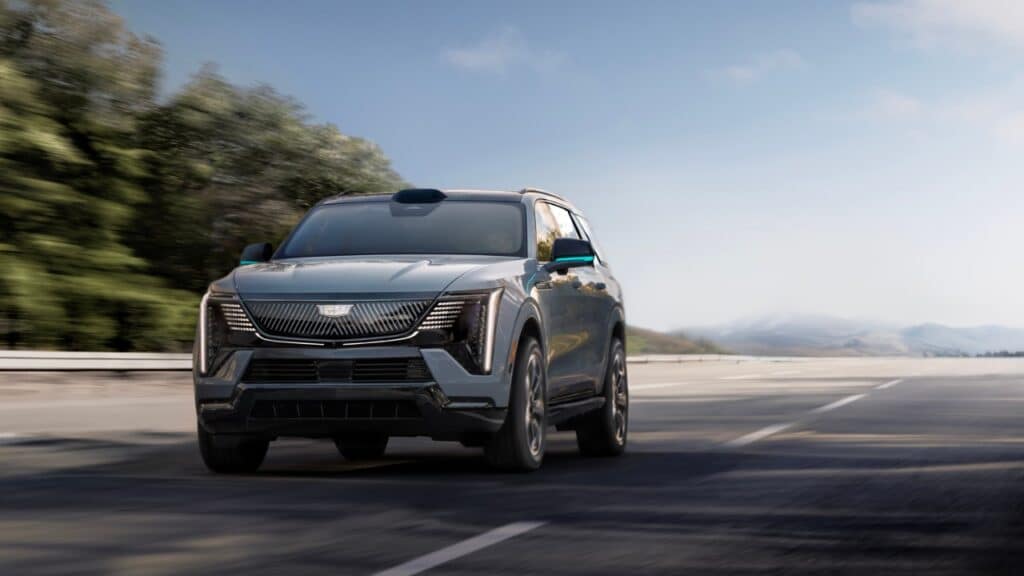
GM announced that “eyes-off” autonomous driving will debut in 2028 on the all-electric Cadillac ESCALADE IQ. Building on more than 700 million miles driven with Super Cruise and 600,000 miles of mapped hands-free roads in North America, GM’s experience with autonomy and safety systems lays the groundwork for this next step in personal freedom behind the wheel.
Starting next year, GM vehicles will integrate conversational AI powered by Google Gemini, enabling natural interactions between drivers and their cars. Future GM-developed AI will be customized for each vehicle and driver, learning preferences through OnStar connectivity. Drivers could ask about one-pedal driving, detect early maintenance issues, or get dinner recommendations through seamless, voice-based communication.
A Unified Software and Computing Platform
In 2028, GM will launch a fully reimagined centralized computing platform, beginning with the Cadillac ESCALADE IQ. Designed for both EVs and gas vehicles, the platform unites propulsion, safety, infotainment, and control systems on one high-speed core, delivering 10x more over-the-air update capacity, 1,000x more bandwidth, and up to 35x more AI performance. This marks a shift toward vehicles that continuously evolve and improve throughout their lifetime.
Intelligent Robotics at Scale
GM highlighted progress at its Autonomous Robotics Center (ARC) in Warren, Michigan, and its Mountain View, California lab. Over 100 specialists are developing AI-driven robotics that learn from decades of GM production data to enhance safety, efficiency, and precision. New collaborative robots (“cobots”) are now being introduced into U.S. assembly plants to improve both productivity and workplace quality.
Powering Homes and the Grid
Most new GM EVs can already provide backup power for homes, and soon they will support bidirectional power to the grid. Beginning in 2026, the GM Energy Home System, combining a stationary home battery and bidirectional EV charger, will be offered via leasing. It will first roll out to GM EV owners, expanding later to all homeowners seeking integrated solar and backup power options.
GM’s Road Ahead
Together, these breakthroughs represent GM’s next chapter: a unified vision of mobility defined by intelligence, sustainability, and scale. Through AI, robotics, and advanced computing, GM is crafting vehicles that learn, adapt, and deliver a personalized experience for every driver.
With GM’s EV Share Jumping from 10.8% to 15.2%, Will GM Be the New Number One EV Seller in the USA?
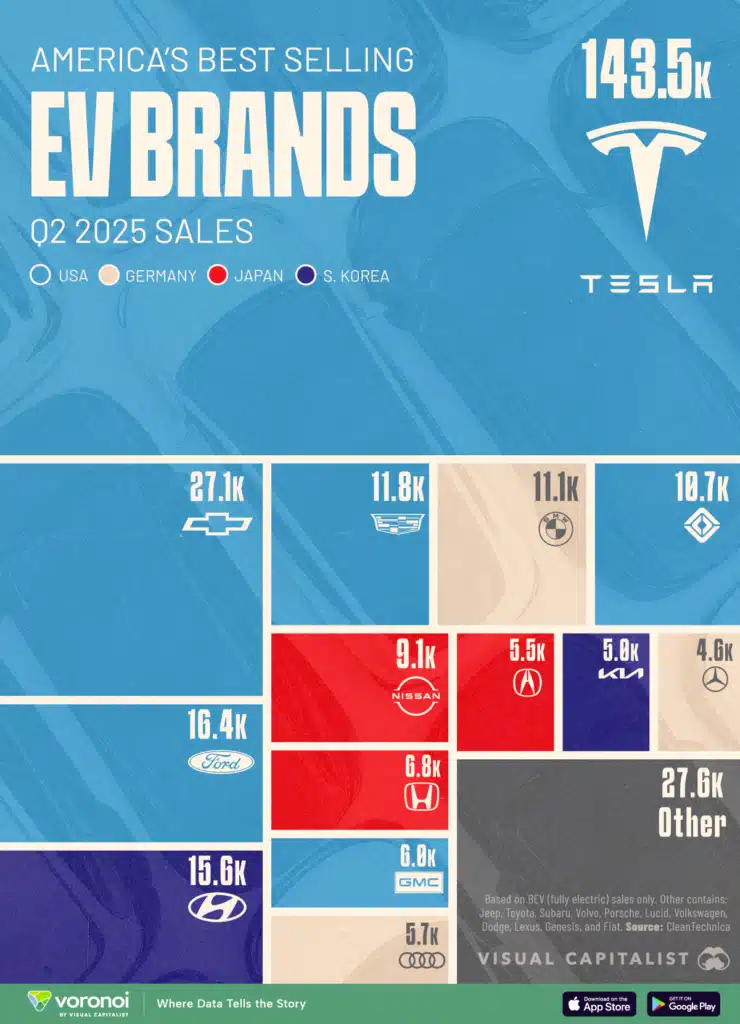
On October 10, 2025, Visual Capitalist released an article giving details on America’s best-selling EV brands, showing Q2 2025 sales figures. GM showed astounding growth, with GM’s combined share reaching 15.2% of the U.S. EV market, up from 10.8% in Q1. Chevrolet led GM’s EV sales with 27,135 units sold, placing it second overall.
Tesla’s Lead Drops to 38% in August US EV Sales, an 8 Year Low
Tesla remains the leader in the U.S. electric vehicle market for now, with a 48.5% share with 143,535 units delivered in Q2 2025. However, Tesla’s share continues to drop dramatically. Since the Q2 numbers were reported, Tesla’s market share dropped to a new near eight-year low in August, according to data from research firm Cox Automotive shared exclusively with Reuters, accounting for 38% of August US EV sales.
Ford and Hyundai Battle for Third Place
While Tesla dominates, competition in the next tier is intensifying. Ford and Hyundai are in a close race for third place, with market shares of 5.5% and 5.3% respectively. Ford delivered just over 16,000 EVs during the quarter, while Hyundai followed closely with more than 15,000. Both automakers continue to grow their electric portfolios, targeting the mid-market with a mix of affordability, performance, and range.
Other players such as BMW, Rivian, and Audi trail behind, each maintaining smaller volumes but contributing to a more diverse and competitive EV landscape. As the market expands, 2025 is shaping up to be a defining year for legacy and emerging automakers alike.
EVinfo.net’s Take: GM Will be the New Leader
Once the undisputed leader of the U.S. electric vehicle market, Tesla has gradually lost ground over the past five years as its CEO has made horrible mistakes, competition has intensified, and the market has expanded. In 2021, Tesla held more than 70% of all U.S. EV sales, but by 2022 that figure had fallen to around 65%. In early 2023, Tesla’s share dropped to roughly 57%, and by the second quarter of 2025 it had stabilized near 48.5%. By August 2025, Tesla’s market share slipped further to about 38%, marking its lowest level since 2017.
As of now, EVinfo.net predicts GM will be the new number one EV seller in America. The gap between Tesla’s 38% and GM’s 15.2% continues to get smaller, as GM may overtake Tesla soon. Although Hyundai is making great moves and significant progress, the current “America first” plan by the federal government favors domestic companies, although tariffs are hurting the whole automotive sector significantly, along with damaging the greater economy as a whole and threatening a recession.
Re-Establish the EV Tax Credit, Stop the Tariffs
GM was forced to absorb a $1.6 billion loss as car manufacturers were forced to pivot from their in-progress electric vehicle plans, after legislation signed on July 4 abruptly discontinued an important federal EV tax credit that had been in place since 2008. Lawmakers eliminated the credit on incredibly short notice, a very bad decision that hurt America’s economy and helped China further dominate the global automotive industry.
The government made a rare good decision by unfreezing NEVI EV charging funds, now EVinfo.net recommends it goes a step further by stopping the tariffs and re-establishing the federal EV tax credit. Doing this would go a long way towards helping our automotive OEMs compete with China, as the transportation future of the globe is no doubt fully electric.

Electric Vehicle Marketing Consultant, Writer and Editor. Publisher EVinfo.net.
Services