Ford Transitions Lightning to EREV, Launches BESS Business, Plans 50% Electrified Vehicles by 2030
Ford Motor Company announced a series of actions to sharpen execution of its Ford+ plan, redeploying capital toward higher-return opportunities aligned with customer demand and long-term profitability. The strategy emphasizes affordability, powertrain choice, and disciplined investment, while scaling back select large electric vehicle programs where demand, cost pressures, and regulatory shifts have weakened the business case.
Ford will leverage its U.S. manufacturing footprint to expand production of trucks and vans, accelerate hybrids and extended-range electric vehicles (EREVs), and launch a new battery energy storage systems (BESS) business. Pure EV development will focus on Ford’s flexible, low-cost Universal EV Platform, designed for smaller, high-volume, affordable vehicles.
“This is a customer-driven shift to build a stronger, more resilient, and more profitable Ford,” said CEO Jim Farley. “We are redeploying capital into higher-return growth opportunities, including Ford Pro, our truck and van leadership, hybrids, and a new battery energy storage business.”
The actions are expected to put Ford’s Model e business on a path to profitability by 2029, with annual improvements beginning in 2026, while also supporting margin expansion in Ford Blue and Ford Pro. Ford anticipates approximately $19.5 billion in special items through 2027, including about $5.5 billion in cash impacts. To support the strategy, Ford plans to hire thousands of employees across the U.S.
Product and Platform Strategy
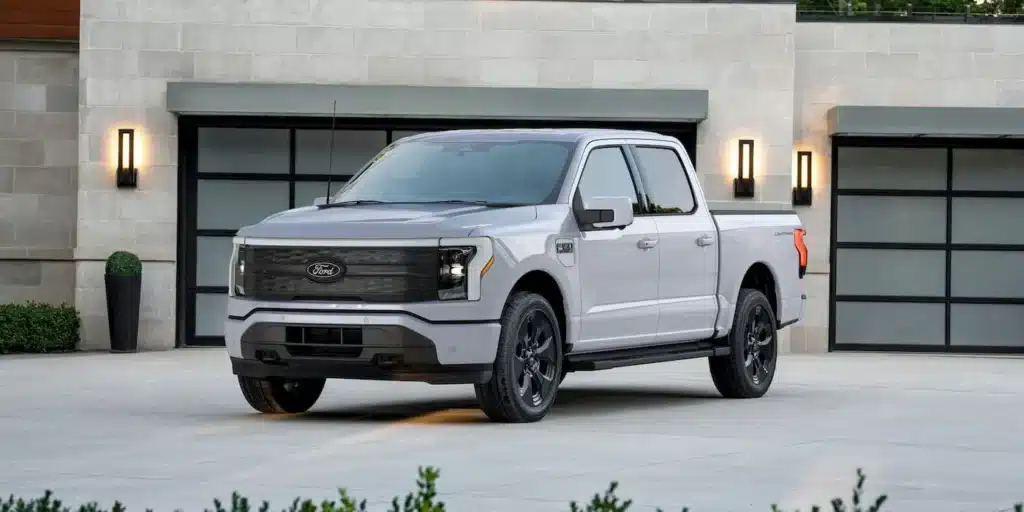
By 2030, Ford expects roughly 50% of global volume to come from hybrids, EREVs, and fully electric vehicles, up from 17% in 2025. The first vehicle on the Universal EV Platform, a midsize electric pickup, will launch from Louisville Assembly Plant in 2027. The next-generation F-150 Lightning will transition to an EREV architecture, offering an estimated 700+ miles of range, while production shifts support increased gas and hybrid F-150 output.
Ford will replace previously planned electric commercial vans with gas and hybrid alternatives in North America and adjust its European EV roadmap while maintaining a full electrified van lineup.
Manufacturing and Energy Storage Expansion
Key facilities will be repurposed to support trucks, vans, and energy storage. Tennessee’s BlueOval City will become a truck-focused plant, while Ohio Assembly will anchor Ford Pro commercial vehicle production. Ford is also launching a battery energy storage business, repurposing Kentucky battery capacity to produce large-scale LFP-based storage systems for data centers, utilities, and industrial customers, targeting at least 20 GWh annually by late 2027.
Outlook
Ford reaffirmed its commitment to carbon neutrality by 2050 and raised its 2025 adjusted EBIT outlook to approximately $7 billion, citing underlying business strength and cost improvements.
EVinfo.net’s Take: Don’t Be Too Critical of Ford
As a lifelong environmentalist, I was drawn to EVs from the start. I thoroughly researched EVs to be sure I’d be able to pull off owning one, as a startup owner on an extremely tight budget, the economics had to work also. I found that EVs are not only the most eco friendly vehicle, but the most cost effective as well. I fell in love so much with all the positive benefits of EVs, that I decided to make writing about them my full time job at EVinfo.net.
My environmentalist colleagues will no doubt be critical of Ford for pulling back on BEVs yet again, in favor of hybrids and internal combustion engine (ICE) vehicles. But I say don’t be too critical of Ford. The company is just trying to survive. And long term, BEVs (battery electric vehicles) will win.
And survival in America’s auto industry has become more challenging than ever in 2025. Faced with blow after blow to the gut with bad federal government policy, the industry is reeling and struggling to survive.
First the federal EV tax credit was abruptly yanked away, when it should have been slowly phased out over years. This caused OEMs to lose billions. In October, GM lost 1.6B due to this mistake.
Most recently, another horrible government mistake was when the administration announced it is reversing the current vehicle fuel efficiency standards.
Transportation remains a major source of greenhouse gas emissions in the United States, with cars and trucks responsible for most of those emissions, according to the EPA.
The push to weaken the nation’s Corporate Average Fuel Economy (CAFE) standards threatens to worsen three of the most persistent problems facing the United States: our dependence on oil, the high cost of gasoline, and the accelerating impacts of global warming. These standards were created to make vehicles more efficient, cut fuel costs for families, and reduce the pollution driving climate change. Rolling them back moves the country in the opposite direction.
And then there’s intense auto industry competition from China, offering high-quality, low priced EVs, hybrids and gas vehicles. All of these bad anti-EV policies hurt America’s auto industry, and help China’s.
Electrified vehicles now make up 43% of global auto sales as of Q1 2025, up from just 9% in 2019. China accounts for more than half of global BEV sales, with Europe and the U.S. trailing behind. The ability for America’s auto industry to compete globally keeps shrinking.
Long term though, BEVs will win and become the dominant form of transportation worldwide. The reason is superior cost-effectiveness, just like renewable energy is more cost effective than all fossil fuel and nuclear energy.
Hybrids are just a temporary bridge to full electrification. Ford’s moves are just for survival in a much more challenging time, so don’t be too critical of the company.

Electric Vehicle Marketing Consultant, Writer and Editor. Publisher EVinfo.net.
Services