Watt Electric Vehicle Company Plans Integrating Donut Lab’s In-Wheel Motors
Donut Lab’s in-wheel motor technology is taking its first step into a full electric vehicle platform through a new partnership with WATT Electric Vehicle Company. By pairing Donut’s compact, high-power hub motors with WATT’s battery system, the two companies have developed a new EV skateboard platform, with a working prototype scheduled to debut at CES next month.
Donut Lab first drew significant attention at last year’s Consumer Electronics Show (CES) in Las Vegas with the unveiling of its small yet powerful electric motors. At the time, the company highlighted a wide range of potential applications, from drones and industrial equipment to automotive propulsion, wind turbines, and even household appliances. Nearly a year later, that vision is materializing in the automotive sector.
“WATT EV’s PACES platform provides the perfect canvas to showcase the full potential of our advanced motor technology,” said Marko Lehtimäki, CEO of Donut Lab. “The exceptional low mass of PACES allows our high-torque, high-power-density in-wheel motors to truly shine, delivering a driving experience that would be impossible with heavier platforms. When you combine our direct-drive precision control with WATT’s lightweight engineering expertise, you create something genuinely transformative, a vehicle architecture that’s lighter, more efficient, more powerful, and infinitely more engaging to drive.”
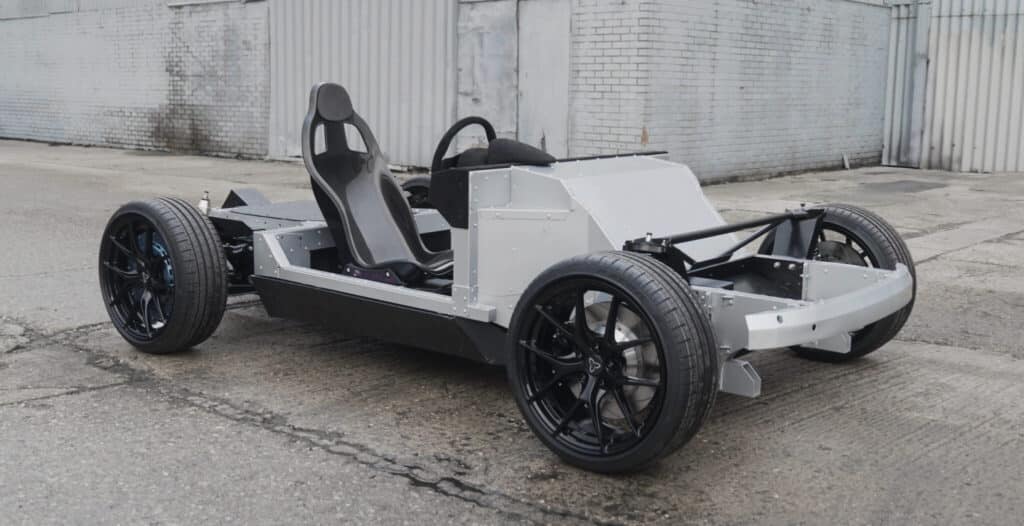
“The integration of Donut Lab’s revolutionary in-wheel motor technology represents a significant leap for what PACES can offer the automotive world,” said Neil Yates, CEO of WATT Electric Vehicles. “Its motors, inverter, and software systems, perfectly complement our lightweight platform philosophy. The direct, fine control of the individual wheel speeds brings an agility and that is perfectly complemented by the low mass and inertia of our chassis technology. This skateboard can produce vehicles that will set new benchmarks for EV handling.”
The new platform builds on WATT’s previously developed Passenger and Commercial EV Skateboard (PACES), a lightweight aluminum architecture designed for low-volume electric vehicle production. The updated version integrates Donut’s motors directly into the rear wheel hubs, with an all-wheel-drive configuration planned for future iterations. By eliminating traditional drive units, the in-wheel motor layout enables an even more space-efficient design than conventional EV platforms.
According to the companies, the flexibility of the skateboard opens the door to a wide range of vehicle applications. The architecture is intended to support everything from recreational vehicles such as beach buggies to high-performance sports cars and commercial delivery vehicles, underscoring the potential of hub motor technology to reshape EV packaging and design.
EVinfo.net’s Take: In-Wheel Motors (Hub Motors) Offer Great Potential for Space-Saving and Flexibility
In-wheel electric hub motors are often cited as a potential breakthrough in EV design, offering clear advantages in packaging efficiency, modularity, and vehicle layout flexibility. By placing the motor directly in the wheel, manufacturers can eliminate traditional drive units, free up interior and cargo space, and enable advanced functions such as precise torque vectoring. Despite these benefits, hub motors remain rare in mainstream electric vehicles due to persistent technical and economic challenges.
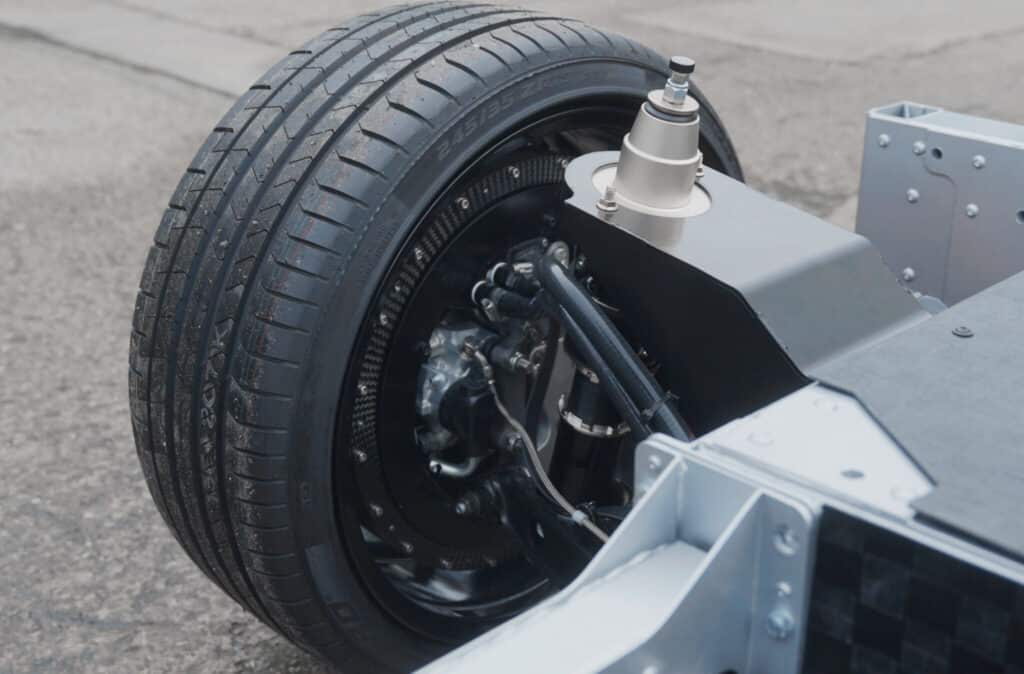
The most significant barriers are cost, unsprung mass, and durability. Locating the motor in the wheel increases unsprung weight, which can negatively affect ride comfort, handling, and suspension tuning. Hub motors are also more expensive than centralized drivetrains and must withstand constant exposure to road impacts, water, and debris, raising concerns about long-term reliability. These factors have limited adoption in high-volume passenger vehicles.
That said, interest is growing, particularly among Chinese automakers and niche vehicle developers. Dongfeng has brought hub motors into production with models such as the Voyah Zhuiguang and E70, using rear in-wheel motors supplied by Protean to improve modularity and space utilization. Geely has demonstrated the concept’s flexibility with prototypes like the EX5, featuring 90-degree wheel rotation for sideways movement. Nissan explored the technology in its BladeGlider concept, while Hyundai and Kia have developed the Uni Wheel system to enable compact, adaptable integration across vehicle types.
Beyond major OEMs, companies such as Lightyear have used in-wheel motors to maximize efficiency in solar-assisted vehicles, while others, including Donut Lab and WATT EV, are applying the technology to lightweight skateboard platforms. Additional niche and prototype applications range from specialty three-wheelers to off-road and commercial vehicles.
Looking ahead, in-wheel motors are most likely to gain traction first in specialized use cases such as urban mobility, delivery vehicles, and performance-oriented platforms. As materials, suspension design, and cost structures improve, hub motors could move closer to broader adoption, potentially reshaping how future EVs are engineered.
Don’t Miss TEAL at CES 2026 in Las Vegas
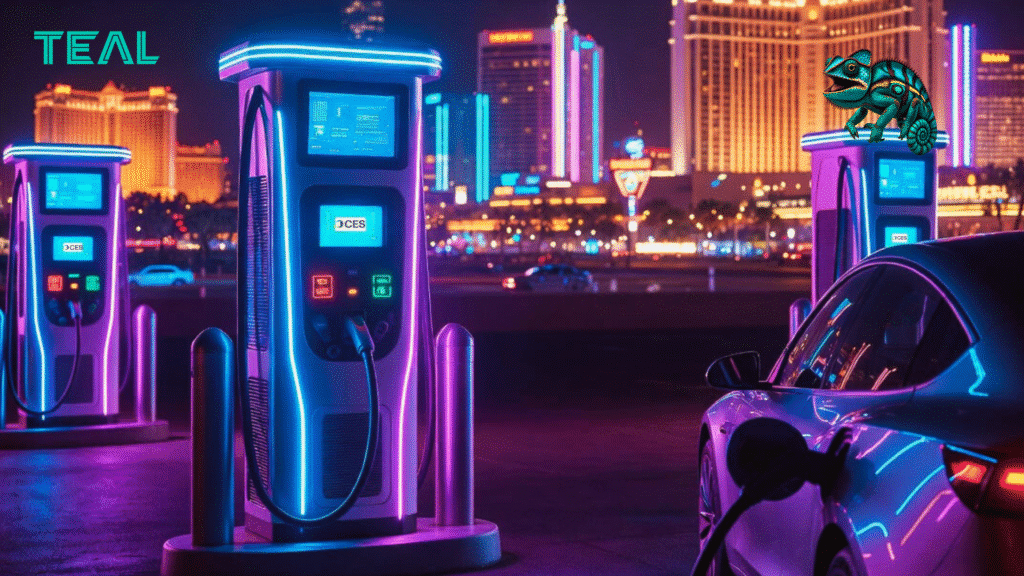
Using Donut’s compact, high-power hub motors with WATT’s battery system, a working prototype is scheduled to debut at CES next month, don’t miss it. While at the show, be sure to meet the TEAL team.
TEAL will be at CES 2026 in Las Vegas to showcase how reliable connectivity can solve one of the EV industry’s most persistent challenges: public EV charging reliability. While EV charging uptime has improved, failure rates remain high, with roughly one in seven public charging attempts still unsuccessful. Driver satisfaction reflects this gap, with fewer than half of EV drivers satisfied with charger reliability or availability.
A major root cause is connectivity. More than 55 percent of EV charging failures stem from network issues rather than hardware faults. Chargers rely on continuous cellular connectivity for payments, authentication, monitoring, and diagnostics, yet many deployments depend on single-carrier or limited connectivity solutions that leave stations effectively offline when networks fail.
TEAL addresses this problem with its Network Orchestration Service and GSMA-certified eSIM technology, which allow charging stations to automatically switch between carriers, ensuring consistent uptime and reducing operational complexity. The platform provides multi-carrier redundancy, global coverage across 195 countries, real-time monitoring, and centralized management through a unified dashboard.
By improving charger reliability, TEAL helps operators reduce downtime and costs while giving drivers greater confidence that stations will work when they arrive. With rapid growth and a mission to democratize global connectivity, TEAL is positioning itself as a critical enabler of reliable EV charging infrastructure and broader electrification, with CES 2026 serving as a key forum to engage industry partners and stakeholders.

Electric Vehicle Marketing Consultant, Writer and Editor. Publisher EVinfo.net.
Services