What if Fleet Electrification Required Zero Capital Upfront? Meet Alyath at ACT Expo 2026
That’s the question most fleet operators haven’t been asked because the entire electrification model has been built around the assumption that you’ll write a check before you see a result. Millions committed to vehicles, chargers, depot upgrades, and grid infrastructure before a single route goes electric. Capital diverted from core operations into long-lived assets you’ll own, depreciate, and maintain for decades. And the risk? That stays with you, too.
This is the model the industry has accepted. It’s also the reason most electrification programs stall.

The economics don’t work for fleet operators who are measured on return on invested capital, not on sustainability commitments. When you’re asked to deploy $5-15M+ before reliability is proven – locking up budget years ahead of operational benefit – phased rollouts become impossible. You’re forced into “big-bang” investments that create stranded capacity risk if load requirements shift, grant timelines slip, or vehicle OEMs exit the market.
And the capital problem has a compounding partner: grid delays. Even after you commit the budget, utility interconnection queues stretch 24 to 36 months. Regulatory approvals, engineering studies, transformer procurement, construction scheduling – all of it sits between your capital commitment and your first electrified roll-out. The mandates aren’t waiting. The grants have expiration dates. And every month in the queue is a month your fleet keeps running on diesel.
If you’re heading to ACT Expo in Las Vegas, May 4-7 2026, this is the conversation that matters. The sessions will cover policy, technology, and deployment. But in the hallway conversations – the ones that actually shape decisions – the talk will center on one question: how do you electrify without the capital trap?
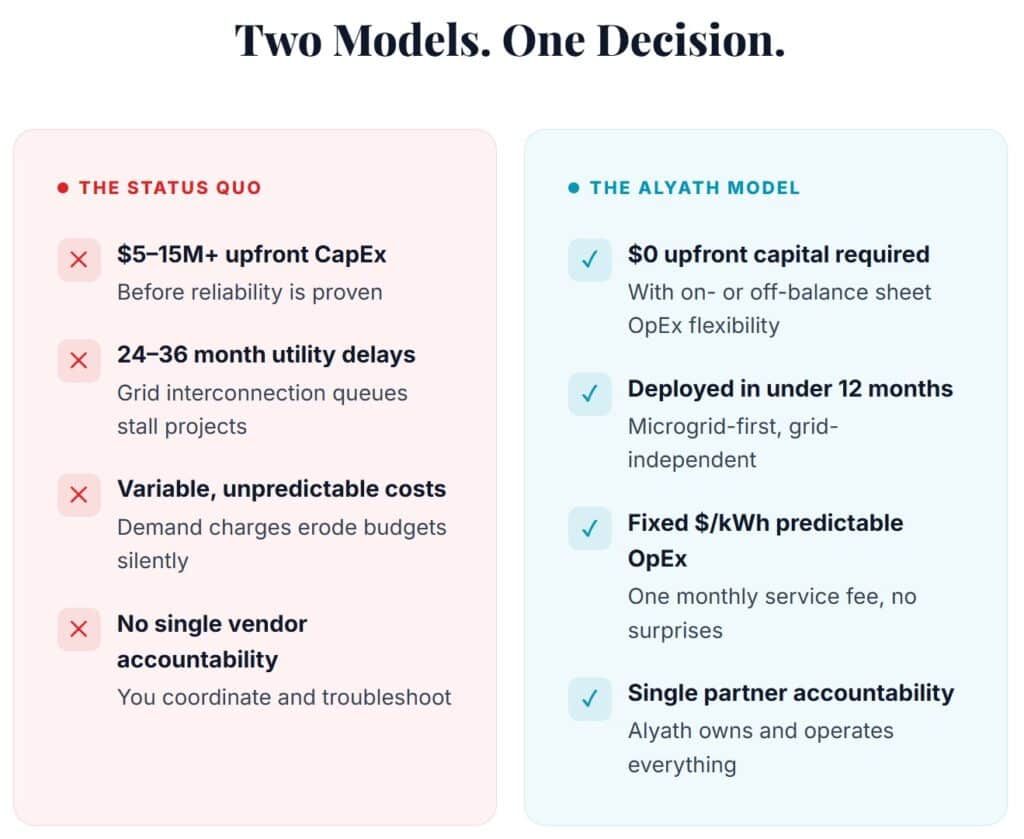
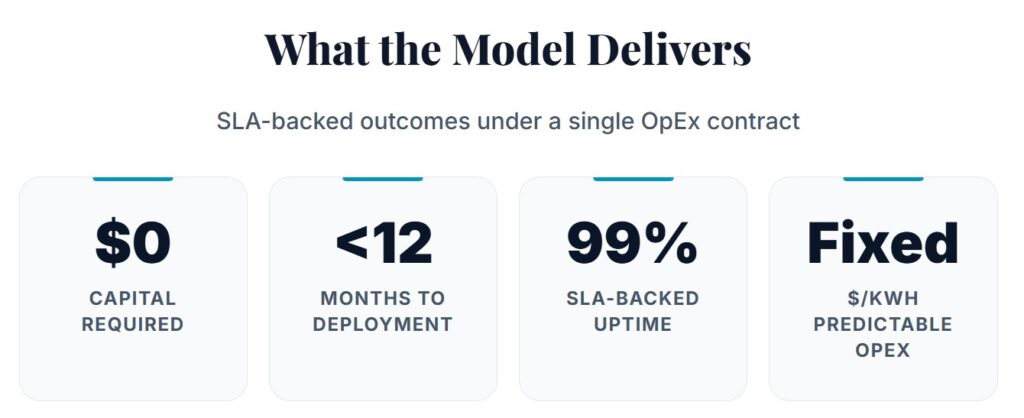
There is a fundamentally different model. One where the entire infrastructure – on-site power generation, battery storage, depot charging, vehicles, software, and operations – is delivered under a single, predictable OpEx contract. No capital outlay. With on- or off-balance sheet flexibility. One monthly service fee. One accountable partner.
This is what Alyath builds. Alyath calls it Infrastructure as a Service – because that’s what it is.
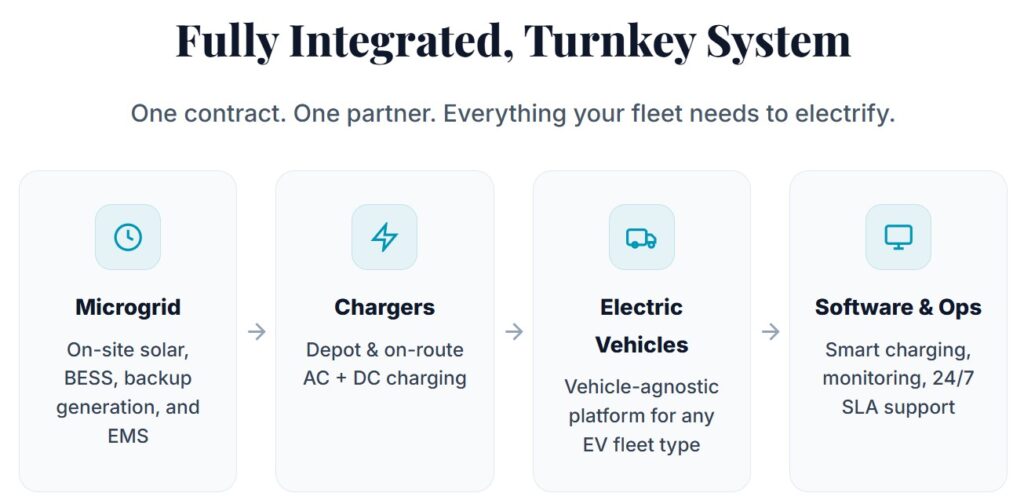
What makes this an infrastructure partnership – not a product sale – is the transfer of operational risk. You don’t own the assets, carry the depreciation, or manage the vendors. Alyath does. Your CFO gets the optionality of an operating expenditure (OpEx) line item instead of a multi-year capital commitment, and your operations team gets a single accountable partner with Service Level Agreement-backed performance guarantees.
The infrastructure beneath that contract is what solves the grid problem. Alyath deploys on-site microgrids – integrating solar generation, battery energy storage, power conversion, and resilient backup generation – designed specifically around your load profile. This microgrid-first, grid-independent architecture means your depot has power certainty from day one, independent of utility interconnection timelines. When the grid does come online, it becomes a supplement, not a dependency. Deployment in under 12 months, not 24 to 36.
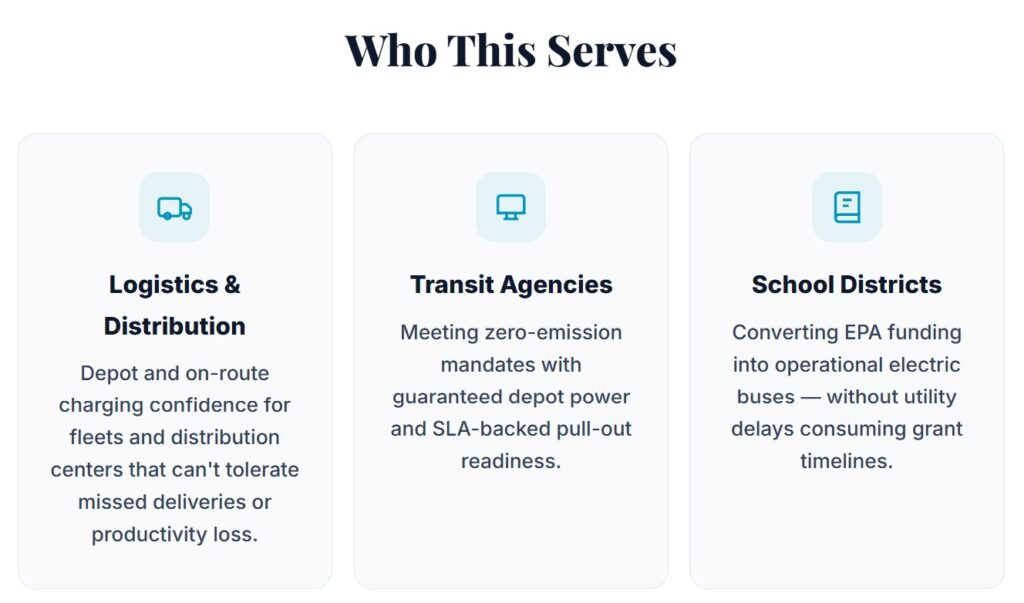
This isn’t theoretical. It’s the model Alyath is deploying across logistics operators and distribution centers who need next-day pull-out readiness, every day, with zero tolerance for service disruption. Transit agencies trying to meet zero-emission mandates without blowing through capital budgets. School districts that secured EPA funding but can’t get power to the depot. And semi operators running long-haul routes who need both depot and on-route charging confidence.
The common thread across all of these is that the fleet operator’s job is to move people and goods – not to become an energy infrastructure developer. When electrification forces you into that role, something has gone wrong with the model.
The fleets that are making real progress aren’t the ones with the biggest capital budgets. They’re the ones that found a way to decouple electrification from upfront capital risk entirely – and from grid dependency along with it.
If you’re attending ACT Expo, the Alyath team welcomes the chance to talk through what this model looks like for your specific operation. No pitch – just a conversation about whether there’s a better path from where you are today to where your fleet needs to be.
Alyath serves four primary markets: fleet operators (transit agencies, school districts, logistics companies), facility operators (distribution centers, ports, campuses), critical infrastructure (data centers, defense, emergency services), and general facility charging. For fleet customers, the offering extends to full vehicle procurement and operations management, making it a soup-to-nuts electrification solution.
The company positions its service against the traditional model on several dimensions including cost predictability, speed to power, asset risk, and operational simplicity, arguing that customers are better served by converting long-lived infrastructure investments into a fixed monthly service expense.
The Alyath team will be on-site all week at ACT Expo. Reach out to schedule a meeting, or find the team in the expo hall to talk about infrastructure.
Contact:
Oscar Bode
Chief Strategy and Risk Officer
obode@alyath.com
https://alyath.com

Electric Vehicle Marketing Consultant, Writer and Editor. Publisher EVinfo.net.
Services