How EVSTAR Is Redefining Reliability in EV Charging Infrastructure
Electric vehicle adoption in North America has experienced a volatile start to 2026. The rollback of federal EV tax credits, combined with affordability concerns and charging infrastructure gaps, slowed momentum that had been building in prior years. For many consumers, the upfront cost advantage narrowed, and hesitation returned to the market. However, geopolitical forces are now reshaping that trajectory.
The ongoing Iran war has triggered a sharp spike in global fuel prices, creating a renewed economic case for electric vehicles. Disruptions to oil supply chains, particularly through the Strait of Hormuz, have driven gasoline prices significantly higher across North America, with increases exceeding $1 per gallon in the United States and even higher spikes in regions like California. Oil markets have surged past $100 per barrel, amplifying inflationary pressure and raising the daily cost of driving internal combustion vehicles.
This shift is already influencing consumer behavior. As fuel costs rise, the total cost of ownership equation tilts back in favor of EVs. What was previously a long-term savings argument is now an immediate financial reality. Drivers are once again prioritizing alternatives to gasoline, and EVs are emerging as a hedge against volatile energy markets.
Notably, the used EV market is seeing the strongest impact. Unlike new EVs, which still face higher upfront costs and longer delivery timelines, used EVs offer immediate availability and significantly lower price points. In a high fuel cost environment, that combination becomes highly compelling. Buyers who may have been priced out of the new EV market are turning to used options to capture fuel savings without the initial capital burden.
Cox Automotive’s Q1 2026 Industry Insights and Sales Forecast Call, held March 25, 2026, reported that Americans purchased 93,500 used EVs in the first quarter, a 17% increase from Q4 2025 and nearly 12% above Q1 2025 levels. The used EV market share reached approximately 2.1%.
This mirrors patterns seen globally. In Europe, surging petrol prices linked to the Iran conflict have already driven a rebound in EV sales and interest, signaling how quickly demand can respond to fuel price shocks. Analysts note that rising fuel costs often act as a tipping point, converting consumer curiosity into actual purchase decisions.
The broader takeaway is clear: EV adoption is no longer driven solely by policy incentives. While subsidies and tax credits play an important role, external economic shocks, particularly those tied to energy security, can accelerate adoption far more rapidly.
In North America, the recent slowdown may prove temporary. As long as fuel prices remain elevated, EVs regain their strongest value proposition: predictable, lower operating costs. In that environment, both new and used EV markets are positioned to rebound, with used vehicles leading the charge as the most accessible entry point for cost-conscious consumers.
EV Charging Reliability Is a Major Barrier to Adoption
In April 2026, electric vehicle (EV) charging reliability remains one of the largest barriers to EV adoption.
The 2025 S&P Global Mobility Electrification Consumer Survey, spanning nearly 8,000 respondents across eight countries, underscores a critical reality: EV charging infrastructure remains both the primary driver of consumer confidence and the most persistent barrier to adoption.
While charging networks continue to expand, the real-world user experience is still falling short. In the near term, reliability remains a major concern, with 47% of EV owners reporting at least one issue when using public charging stations.
Charging reliability is not just a technical issue, it is a fundamental obstacle to broader EV adoption. Inconsistent performance, equipment failures, and service delays erode driver confidence and create uncertainty around daily usability. Addressing reliability at scale is essential to accelerating the transition to electric mobility.
EVSTAR’s Warranty Solutions
EVSTAR’s warranty solutions directly tackle the challenge of EV charging reliability by providing comprehensive coverage that removes financial risk and operational uncertainty. Unlike self-underwritten warranties, which expose stakeholders to significant liabilities, EVSTAR offers the only fully underwritten warranty solution in the EV charging industry. This structure ensures claims are backed by a trusted third party, reducing exposure for operators, manufacturers, and customers alike.
By eliminating out-of-pocket repair costs and streamlining the service and claims process, EVSTAR minimizes downtime and accelerates repairs. This not only improves charger uptime but also builds long-term customer trust by delivering a consistent, reliable ownership experience.
EVSTAR Expands Product Offerings with Post-Sale and Aftermarket Solutions
EVSTAR is expanding its product portfolio with new post-sale and aftermarket solutions designed to strengthen lifecycle protection for EV charging infrastructure. Announced in March 2026, the new offerings reinforce EVSTAR’s role as a leading renewable energy service and warranty administrator focused on simplifying the ownership experience for EV charging assets.
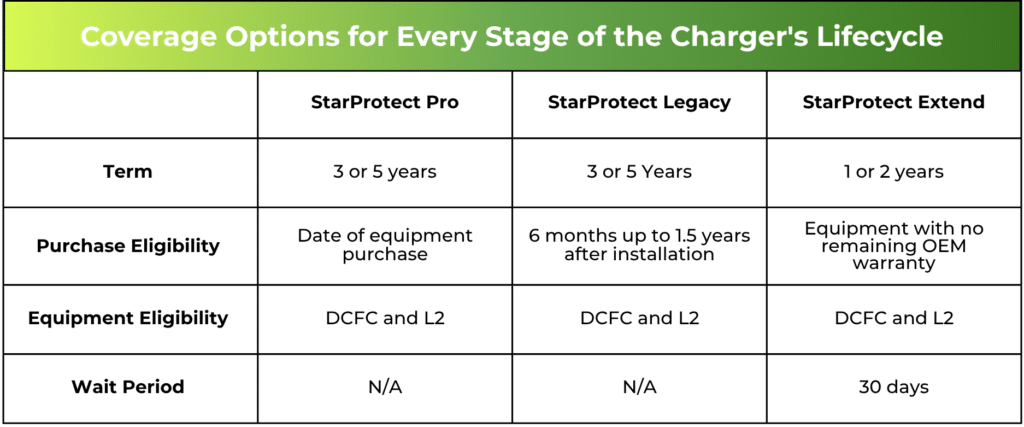
The company’s mission centers on delivering comprehensive warranty services that make the purchase, installation, protection, and repair of EV chargers more efficient and cost-effective. With the introduction of StarProtect Legacy and StarProtect Extend, EVSTAR is addressing critical gaps that exist beyond the initial point of sale.
StarProtect Legacy is designed to close a common coverage gap by allowing protection to be added after installation when it was not included in the original purchase. Coverage can be applied starting six months after installation and up to six months before the OEM warranty expires.
This enables partners to align and standardize protection across deployed assets. The solution is particularly relevant for OEMs, value-added resellers, charge point operators, distributors, fleet operators, infrastructure developers, and service providers managing diverse charging networks.
For assets that have already exceeded their manufacturer warranty, StarProtect Extend introduces new coverage options to maintain operational continuity. Available in one- or two-year terms, it allows aging but functional chargers to remain protected, extending asset life and reducing downtime risk.
Together with StarProtect Pro, these solutions create a full lifecycle protection framework that spans new installations, in-warranty systems, and out-of-warranty infrastructure.
EVSTAR’s offerings include protection against mechanical and electrical failures, power surges, and accidental damage, with parts and labor included. Backed by underwriting through AIG Warranty and supported by a network of national EVSE installers and service providers, EVSTAR delivers reliable maintenance and rapid repair capabilities across both commercial and residential environments.
Reach out to the expert EVSTAR team today for more information.

Electric Vehicle Marketing Consultant, Writer and Editor. Publisher EVinfo.net.
Services