New Rove EV Charging Opens in Costa Mesa, CA With 40 Chargers, On-Site Amenities
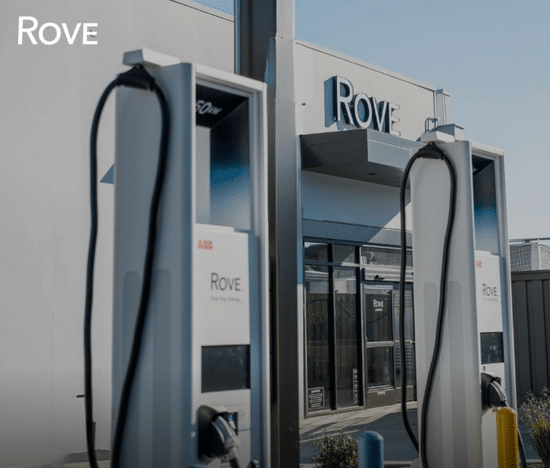
On April 14, 2026, ABC 7 Eyewitness News reported that Rove opened its new electric vehicle (EV) charging center in Costa Mesa, California, the company’s second SoCal location. The first one opened in Santa Ana in October 2024.
“We can charge any kind of car, they’re fast, and they’re reliable. We have 100% availability,” Bill Reid, CEO of Rove, said to ABC news.
Rove’s DCFC chargers are able to accommodate NACS, the less common CHAdeMO charging ports, as well as CCS ports. Like its other location, Rove includes an on site, scaled down Gelson’s market branded as ReCharge. Drivers can grab a meal, pick up coffee, or shop for everyday grocery and household items while their vehicle charges.
Gelson’s President and CEO Ryan Adams noted that the concept was a natural fit, given that customers typically spend 15 to 30 minutes charging. That window aligns well with a quick shopping or food stop, turning charging time into something productive.
Most EVs can add a meaningful amount of range in that timeframe. Beyond the market, the site also features a lounge with WiFi and restrooms, creating a one stop experience. Compared to rising fuel costs, charging here is also relatively affordable. According to Rove’s Reid, the average session costs around $20 and delivers roughly 150 to 200 miles of range.
Rove also addresses a common pain point for EV drivers. Many public chargers require specific apps and updated payment details, which can slow down the process. At Rove locations, chargers accept direct payments through Apple Pay, credit, or debit cards, allowing drivers to plug in and start charging quickly.
This new site brings Rove’s total to two locations, with additional sites planned near major freeways. The goal is to make EV ownership more convenient by combining fast charging with everyday amenities in a single stop.
The new site is conveniently located off the Harbor Boulevard near Merrimac Way and the Orange Coast College Campus in Costa Mesa.
COSTA MESA CENTER HOURS
Rove Charging. 24 HOURS | 7 DAYS A WEEK
Rove Lounge 12 AM – 4 AM
6 AM – 11:59 PM | 7 DAYS A WEEK
ReCharge by Gelson’s Market 6 AM – 9 PM | 7 DAYS A WEEK
Why Full Service EV Charging Hubs Are a Good Idea
Full service EV charging hubs are quickly emerging as one of the most effective ways to improve the charging experience and accelerate adoption. Charging is not just about electricity. It is about time, convenience, and reliability. When done right, hubs solve all three.
Traditional gas stations are built around a five minute stop. EV charging, even at fast speeds, typically takes longer. That difference is often framed as a disadvantage, but it becomes a strength when the location is designed properly. A well planned hub turns charging time into useful time. Drivers can eat, work, shop, or relax instead of waiting in their cars.
This is where full service hubs stand out. Networks like Rove are building sites that combine high speed chargers with amenities such as food, coffee, retail, lounges, restrooms, and WiFi. The result is a destination, not just a utility stop. It mirrors the evolution of airports and rest stops, where services are built around dwell time rather than speed alone.
Reliability is another major advantage. Concentrating chargers in one location makes maintenance, monitoring, and uptime easier to manage. Instead of scattered single units that may or may not work, hubs provide redundancy. If one charger is down, others are available. That reduces range anxiety and builds trust with drivers.
There is also a strong business case. Retail and food services generate additional revenue, helping offset infrastructure costs. At the same time, businesses benefit from increased foot traffic. Charging becomes an anchor that drives customers to spend time and money on site.
From a grid perspective, hubs can be optimized with energy management systems, battery storage, and even renewable generation. This allows operators to reduce peak demand charges and improve overall efficiency. Over time, hubs could also support advanced capabilities like load balancing or integration with distributed energy systems.
Perhaps most importantly, full service hubs make EV ownership feel normal. They replicate and improve on the familiarity of refueling, while adding comfort and utility. For new adopters, that matters. Convenience and confidence are often the deciding factors.
The takeaway is simple. EV charging is not just an infrastructure challenge, it is an experience design challenge. Full service hubs solve both, making them a critical piece of the transition to electric transportation.

Electric Vehicle Marketing Consultant, Writer and Editor. Publisher EVinfo.net.
Services