Used EV Sales Break Records in U.S. as Gas Prices Hit 4-Year High
On April 28, 2026, USA Today reported that average gasoline prices across the United States have climbed to their highest point since the onset of the Iran conflict, driven by growing concern that tensions could evolve into a prolonged energy disruption. Efforts to resolve the situation remain stalled, with Washington and Tehran at an impasse over reopening the Strait of Hormuz and bringing an end to the two-month standoff.
According to the American Automobile Association, the national average for regular gas reached $4.229 per gallon today, marking the highest level since the early phase of the Russia-Ukraine war in 2022.
While global leaders have welcomed the pause in active conflict, the Strait of Hormuz remains closed, sustaining upward pressure on global energy markets.
The Used EV Market is Breaking Records
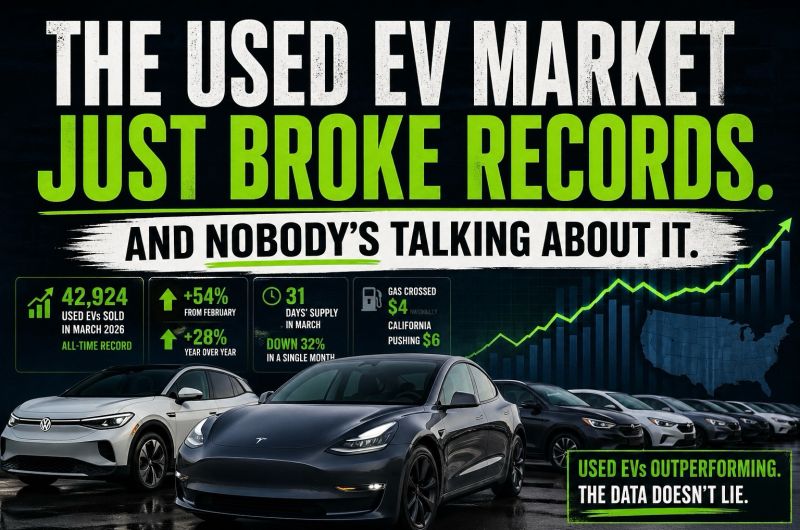
EV industry veteran Angelo Elyassi reported on his Linkedin account yesterday the following:
“The US used EV market just broke an all-time record. The mainstream press barely noticed.
In March 2026, 42,924 used EVs sold in a single month. Up 54% from February. Up 28% year over year. Q1 as a whole hit over 100,000 units, the second-strongest quarter on record and up 12% on the same period last year. At the same time, gas crossed $4 nationally, California pushed toward $6, and CarGurus logged a 40% surge in used EV listing views. Tesla Model 3 searches alone were up 52%.
The price story is the one that changes everything. Used EVs now average $34,821. Used gas cars average $33,487. Three years ago that gap was over $10,000. Cox Automotive’s Director of Industry Insights called it directly: “That affordability shift has clearly shown up in the data, significantly expanding access for mainstream buyers.”
At the $20k to $30k price point, a used gas car gets you a five-year-old Camry with 50,000 miles. A used EV in the same range gets you a Tesla Model 3 or VW ID.4, typically a year newer and 20,000 fewer miles. And 56% of used EVs on the market today are selling for $30,000 or less.
The supply wave is why this is just beginning. Around 1.1 million EVs were leased between 2023 and 2025 under the IRA’s leasing loophole. Cox expects 300,000 of those leases to expire in 2026, 600,000 in 2027, and up to 660,000 in 2028. Many lessees are walking away rather than buying at the residual value, pushing clean, well-maintained, low-mileage cars directly onto dealer lots. Experian expects EVs to make up 15% of all off-lease vehicles by the end of this year, up from 7.7% in Q1.
Used EV days’ supply hit 31 days in March, down 32% in a single month, now just four days above gas car inventory. The cars are not sitting.
I am shopping for a used EV right now. Three dealerships have come back to tell me the model I wanted is already sold.
Meanwhile, new EV sales cratered 28% in Q1 to 212,600 units. The $7,500 federal tax credit is gone. Tariffs added roughly $3,800 to every new vehicle. New EV inventory sits at 130 days’ supply. The market has split, and the split is getting wider.
I have been in this industry for over 15 years. The transition does not announce itself. It shows up in the data first.
It is showing up. ⚡️”
EVinfo.net’s Take: The Pro-War Movement is Killing the Anti-EV Movement, in an Ironic Twist
If you think the anti-EV narrative is being undone, it is not happening because critics suddenly embraced electrification. It is being eroded by a different force entirely: geopolitical instability and the resurgence of pro-war energy politics.
Modern conflict has a predictable economic pattern. Tensions rise, supply chains tighten, and fossil fuel markets react immediately. Oil becomes volatile, logistics costs increase, and consumers feel it first at the pump. The recent pressure around the Strait of Hormuz is a textbook example. When a single chokepoint can disrupt global supply, the vulnerability of oil dependence becomes impossible to ignore.
This is where the anti-EV argument begins to break down. For years, opposition to electric vehicles has leaned on cost concerns, range anxiety, and infrastructure gaps. Those are real considerations, but they are incremental problems. Oil price shocks are systemic. When gasoline spikes, the conversation shifts from preference to exposure. Consumers are no longer comparing technologies in theory. They are reacting to immediate financial pressure.
Pro-war positioning accelerates this shift. Increased defense posturing, sanctions, and regional instability all contribute to tighter energy markets. The result is higher and less predictable fuel costs. That unpredictability undermines one of the core psychological anchors of the anti-EV movement: the assumption that gasoline will remain a stable baseline.
Electric vehicles operate on a different economic model. Electricity pricing is more localized, more regulated, and increasingly tied to domestic generation. As investment in renewables expands, the link between mobility and global conflict weakens. That does not make EVs immune to market forces, but it changes the risk profile in a meaningful way.
There is also a strategic dimension. Governments that prioritize energy security during periods of conflict tend to accelerate electrification, not slow it. Domestic production, grid resilience, and reduced reliance on imported fuel become policy priorities. In that environment, EV adoption is not just an environmental decision. It is a geopolitical one. EVs and renewable energy enhance national security during geopolitical conflicts.
This does not mean the anti-EV movement disappears. Concerns around infrastructure reliability, upfront cost, and grid capacity remain valid and need to be addressed with rigor. But the broader narrative is shifting. The more unstable the global oil market becomes, the harder it is to argue that maintaining dependence on it is the safer or more practical path.
The irony is clear. The same forces that reinforce fossil fuel demand in the short term are weakening the long-term case against electrification. Conflict drives prices up, exposes vulnerabilities, and pushes both policymakers and consumers to reconsider alternatives.
The outcome is not ideological. It is structural. As long as global energy remains tied to geopolitics, every escalation strengthens the underlying case for electric mobility.

Electric Vehicle Marketing Consultant, Writer and Editor. Publisher EVinfo.net.
Services