New AMG GT is First to Use Axial Flux Motors in a Fully Electric Western Production Car
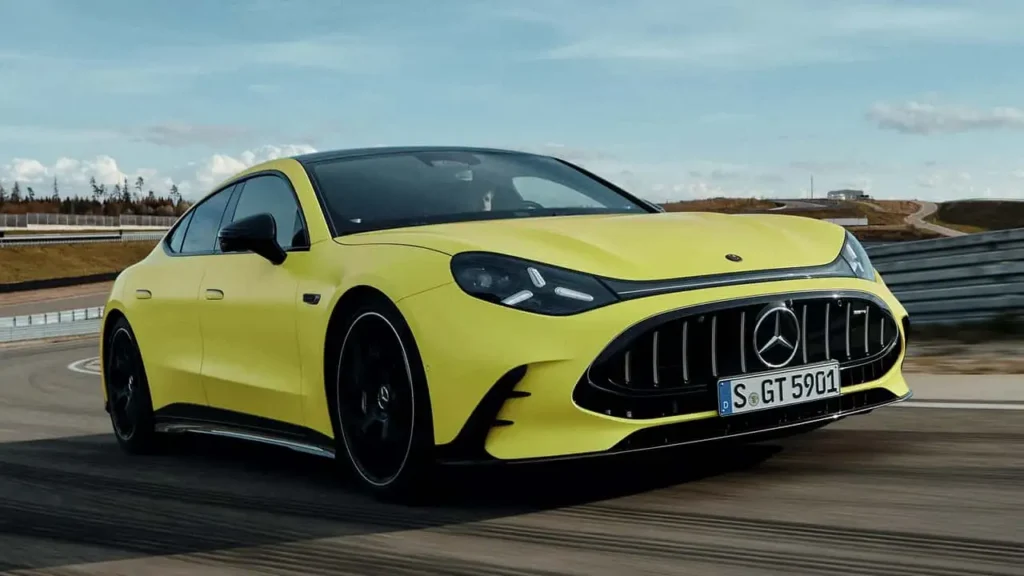
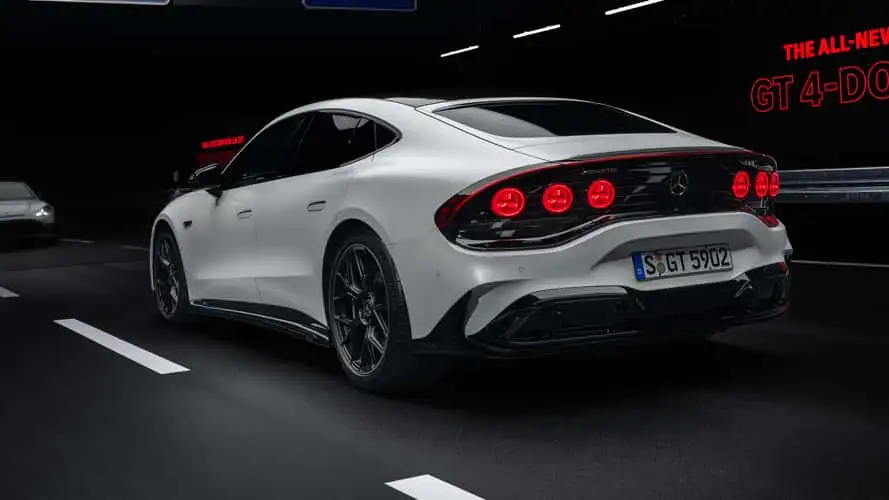
The new Mercedes-AMG GT 4-Door Coupe may be the most technologically advanced EV yet produced by a Western automaker.
Mercedes says the AMG GT is the first Western production electric vehicle to use axial flux motors, a next-generation technology developed by YASA, which Mercedes-Benz acquired in 2021. While hybrid supercars like the Lamborghini Temerario and McLaren Artura also use axial flux motors, the AMG GT becomes the first fully electric production car to adopt the technology at scale.
The benefits are staggering. The GT 63 trim uses three motors—two mounted at the rear and one at the front—to produce an incredible 1,153 horsepower and 1,475 lb-ft of torque. That allows the sedan to rocket from 0-60 mph in just 2.3 seconds and hit 124 mph in only 6.4 seconds, with a top speed electronically limited to 186 mph. A slightly less extreme GT 55 version still delivers 805 horsepower and 1,328 lb-ft of torque.
Unlike traditional radial flux motors, which resemble cylindrical “soup can” designs, axial flux motors are shaped more like pancakes. In YASA’s setup, two disc-shaped rotors surround the stator, improving torque delivery, packaging efficiency, and power density. Mercedes says the AMG GT’s power unit is 67% lighter and 67% shorter than conventional EV motors.
The new Mercedes-AMG GT 4-Door Coupe is proof in action of the trickle-down path of high tech such as axial flux motors to consumer vehicles. YASA’s motors are delivering unmatched power density, compactness, and efficiency. While axial flux designs have long promised superior performance compared to traditional radial flux motors, they were once dismissed as commercially unviable for mass production.
EVinfo.net reported in May 2025 that YASA CEO Tim Woolmer said the lessons being learned in high-performance applications are expected to ripple outward, making their way from high end EV sportscars and racecars to more accessible production EVs. “Whilst really being used in the niche sports car sector today, over time we will see that filter through to Mercedes-AMG vehicles, and then into the automotive sector more broadly,” said Woolmer.
Mercedes is also leaning heavily into emotional driving dynamics. Owners will get a simulated manual gearbox along with artificial V8-inspired sounds generated from 1,600 audio files. The system even recreates exhaust burbles and pops typically associated with combustion-powered AMG models.
Battery technology is equally advanced, this model introduces the new 800-volt AMG.EA platform. Drawing from lessons learned on the Mercedes-AMG One Formula 1-inspired hypercar, Mercedes equipped the AMG GT with a 106 kWh battery pack using 2,660 cylindrical cells arranged across 18 modules. Estimated range is around 700 km on the WLTP cycle, translating to roughly 315 miles under EPA testing.
The cells themselves are unusually tall and narrow, a design Mercedes chose to improve thermal management. Each cell is immersed in coolant and paired with cooling plates, while the battery management system can selectively cool individual modules through an “on-demand cooling” system.
Chemically, the pack uses a nickel-cobalt-manganese-aluminum (NCMA) cathode combined with a silicon-enhanced anode. Silicon anodes have long been viewed as a major breakthrough for improving EV energy density, and Mercedes claims a cell-level energy density of 298 Wh/kg—near the upper limit of current nickel-based battery technology.
Charging performance is equally impressive. The AMG GT supports up to 600 kW DC fast charging, currently the highest charging rate announced by a Western automaker. Mercedes says the car can charge from 10% to 80% in just 11 minutes and recover approximately 285 miles of WLTP range in 10 minutes when connected to a compatible charger.
For comparison, premium EVs like the Lucid Gravity peak around 400 kW. Chinese automakers such as BYD and Geely are already pushing toward megawatt-level charging speeds, but among Western manufacturers, Mercedes has now taken the lead.

Electric Vehicle Marketing Consultant, Writer and Editor. Publisher EVinfo.net.
Services