Toyota’s New All-electric Family Marketing Campaign Uses Relatable, Human-centered Storytelling
Toyota unveiled a new all-electric family marketing campaign in May, designed to introduce consumers to its growing lineup of battery-electric vehicles through relatable storytelling, intuitive technology, and everyday usability. The campaign aims to show drivers that transitioning to EVs can feel practical, simple, and accessible.
Developed through a multicultural marketing strategy, the fully integrated campaign was created in partnership with agencies including Saatchi & Saatchi, Burrell Communications Group, Conill, and Intertrend Communications. Each agency produced unique creative content tailored to different audiences while maintaining a unified visual identity across the campaign.
Burrell Communications Group focused on converting EV skeptics into believers through a humorous series of broadcast and digital ads. The centerpiece is a 30-second spot titled “Haters Anthem,” directed by Paul Hunter, where puppet characters comically criticize electric vehicles before eventually becoming fans of Toyota’s battery-electric lineup. Additional short-form spots include “Looks for Days,” “Power,” “Handle It,” “First Sight,” and “Frown Breakdown.”
Saatchi & Saatchi’s portion of the campaign highlights how Toyota EVs integrate into everyday lifestyles. Directed by Tristan Holmes, the ads feature stories ranging from a mobile coffee business powered by a Toyota bZ to drivers using EVs for weekend travel and creative pursuits. The campaign includes the 30-second spots “Carista” and “Imagine,” alongside shorter ads titled “Weekend Warriors” and “Last Run.”
Intertrend Communications drew inspiration from Asian cinema to create cinematic ads celebrating entertainment culture and emotional storytelling. Directed by Joseph Kahn, the four 30-second films — “Camping,” “Escape,” “Jangal,” and “Chase” — are set to launch in June 2026.
Conill developed the Hispanic-focused portion of the campaign, blending live action and animation to emphasize consumer trust in established brands when adopting new technologies. Directed by Felix Brady, the campaign includes the hero spot “They’re Here” along with “Test Drive” and “Tough Call,” scheduled for release in July 2026.
Toyota’s campaign will run across television, streaming, digital video, social media, audio, experiential marketing, and major media platforms including Netflix, Hulu, Amazon, ESPN Playoffs, Twitch, Spotify, SiriusXM, YouTube, and TikTok, reflecting the company’s broad push to expand mainstream EV awareness.
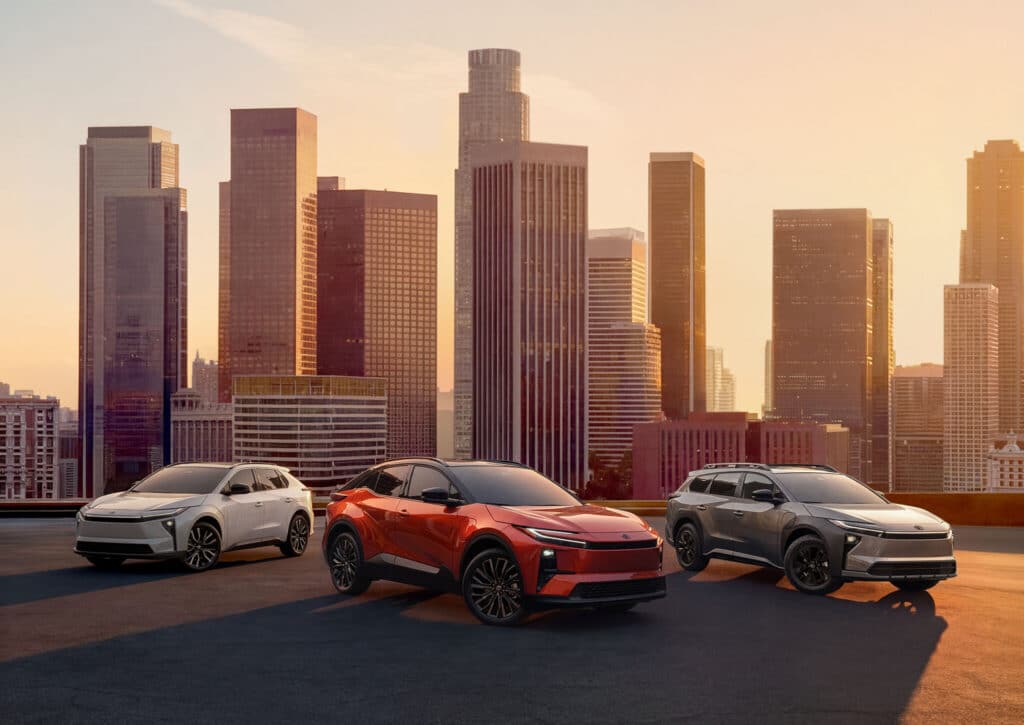
Toyota’s 2026 C-HR, bZ, and bZ Woodland
Toyota’s 2026 all-electric lineup introduces three models aimed at different types of drivers: the C-HR, bZ, and bZ Woodland.
The 2026 Toyota C-HR is a compact, coupe-inspired crossover with standard all-wheel drive and a focus on sporty performance and everyday practicality. It features flexible cargo space, a refined interior, and two trims starting around $37,000.
The 2026 Toyota bZ builds on Toyota’s core EV platform with improved range, updated design, and more advanced connected technology. Positioned as a practical small SUV, it emphasizes comfort, usability, and charging convenience, with pricing starting just under $35,000.
The 2026 Toyota bZ Woodland is the most rugged of the lineup, designed for outdoor use. It includes standard all-wheel drive, increased ground clearance, and added utility features for weekend trips and light off-road capability. Pricing starts around $45,300.
Across the lineup, Toyota is positioning its new EV family around versatility, combining everyday usability, improved performance, and lifestyle-specific options ranging from urban commuting to outdoor adventure.
EVinfo.net’s Take: The EV Industry Still Has a Marketing Problem, Toyota Breaking That Down With This Human-centered Campaign
For years, many automakers have advertised electric vehicles almost exactly like traditional gasoline cars, focusing heavily on speed, styling, abstract lifestyle imagery, or futuristic visuals while often ignoring the real-world advantages that actually convince people to switch to EVs.
That is why more relatable, human-centered storytelling is becoming increasingly important.
Most consumers are not buying EVs because they want a science-fiction experience or because a commercial showed a car drifting through a desert at sunset. They want to know whether an EV will make their daily life easier, cheaper, more convenient, and less stressful.
Some of the biggest benefits of EV ownership still do not get enough attention in mainstream advertising. Home charging convenience alone can completely change how people think about transportation. Waking up every morning with a full charge at home removes trips to gas stations entirely, which becomes a major quality-of-life improvement.
Cost savings should be the most prominently communicated advantage, yet it is often underemphasized. Electricity is generally cheaper and more stable than gasoline, especially during global fuel crises like the current conflict involving Iran and disruptions in oil markets. EVs also typically require less maintenance because they have fewer moving parts, no oil changes, and reduced brake wear from regenerative braking. For many households, these savings accumulate into a meaningful long-term financial advantage.
Environmental benefits are also a key driver of adoption. EVs produce zero tailpipe emissions, which directly reduces local air pollution in cities and improves public health outcomes. As grids continue to integrate more renewable energy such as solar and wind, the overall lifecycle emissions of electric vehicles continue to decline. This makes EVs an increasingly important tool for decarbonizing the transportation sector and reducing dependence on fossil fuels.
Modern EVs are also becoming far more practical. Charging speeds continue improving, ranges are increasing, and battery technology is advancing rapidly with cheaper chemistries like LFP batteries entering the mainstream. Yet many advertisements still fail to communicate these improvements in ways average consumers can immediately understand.
Human-centered EV marketing works better because it shows how electric vehicles fit naturally into everyday routines, whether that means commuting, family trips, small businesses, errands, or weekend travel. That type of storytelling helps normalize EV ownership instead of presenting it as something futuristic or niche.
EVinfo.net is glad to see more human-centered storytelling in EV advertising and education. We recently reported on a similar campaign by Veloz.
Well-respected Veloz, a national nonpartisan 501(c)(3) nonprofit organization, announced the launch of the Real Stories hub on Electric For All. The interactive, brand-neutral platform features firsthand experiences from EV drivers across the United States.
As the EV market matures, automakers that prioritize cost savings, real-world convenience, and authentic consumer experiences over traditional car-commercial formulas are more likely to connect with a broader audience.

Electric Vehicle Marketing Consultant, Writer and Editor. Publisher EVinfo.net.
Services