New Startup Offers Premium Car Care Products and Accessories for Tesla and Rivian EVs
Electric vehicles (EVs) have fundamentally changed what drivers expect from their cars. They require far less routine maintenance than gasoline-powered vehicles, eliminating oil changes, spark plugs, timing belts, and many of the other service items owners have accepted for decades. As EV adoption continues to grow, an entirely new ecosystem of products designed specifically for electric vehicles is beginning to emerge.
One of the newest categories is EV-specific car care, and an exciting new startup, California-based Luma Auto, is positioning itself at the forefront of this niche.
Founded by automotive industry veteran Sean Liu McLean, Luma Auto was created around a simple observation: today’s car care products were largely developed for yesterday’s vehicles.
McLean spent nearly two decades in the automotive industry, with a career spanning Toyota, Hyundai, Kia, Genesis, and Cox Automotive (KBB/AutoTrader) — through roles in consulting, dealer operations, product development, and marketing. That range has given him firsthand insight into how vehicles are designed, sold, and maintained.
After purchasing a 2025 Tesla Model Y and a Rivian R1S, McLean discovered that many traditional detailing products were no longer ideal for modern electric vehicles.
He found that ammonia-based glass cleaners could damage factory-tinted glass, acidic interior cleaners could prematurely wear vegan leather surfaces, and conventional all-purpose cleaners struggled to remove contaminants like mineral sunscreen from modern upholstery. Materials used throughout today’s EVs have evolved significantly, but many cleaning products have not.
Rather than adapting older formulas, McLean decided to build products designed specifically for electric vehicles.
Premium Car Care Products Formulated in California Exclusively for Tesla and Rivian Vehicles
Luma Auto develops premium car care products formulated in California exclusively for Tesla and Rivian vehicles. Every product is personally tested on McLean’s own Model Y and R1S before being released.
Its product lineup includes an EV-safe all-purpose cleaner for vegan leather interiors, an ammonia-free glass cleaner that protects tinted windows, a waterless quick detailer for removing fingerprints and dust, a graphene and ceramic spray coating that provides up to a year of paint protection, trim dressing for rubber and plastic surfaces, water spot remover, premium air fresheners, and a complete EV Care Kit.
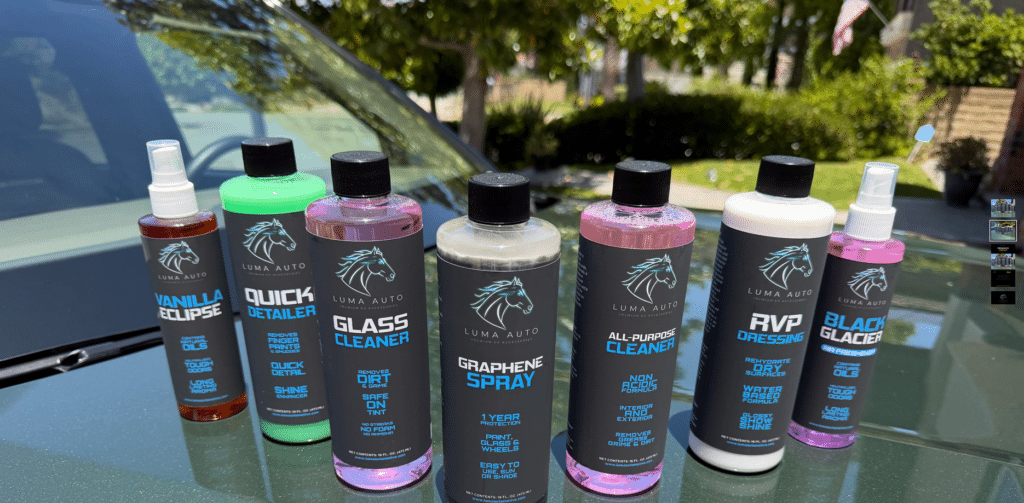
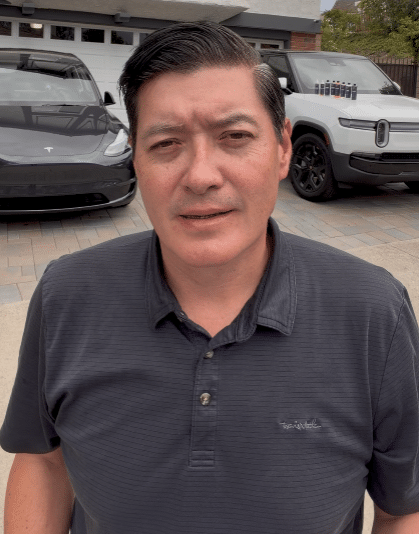
EVinfo.net Interviews Sean Liu McLean, Founder and CEO of Luma Auto
EVinfo.net had the honor of interviewing Sean Liu McLean, Founder and CEO of Luma Auto.
Bill Pierce:
What was the specific moment you knew Luma had to exist?
Sean Liu McLean:
The first summer with the Model Y. My kids in the back seat, sunscreen everywhere. Mineral sunscreen — the zinc oxide kind — leaves a chalky white residue that standard interior cleaners just smear around on vegan leather. I tried three different products from the auto parts store; none of them touched it. That was the moment. If mainstream car care wasn’t formulated for the actual life of an EV owner — including what comes with having kids — the industry had a gap.
Luma started as a personal problem I couldn’t buy my way out of. The All-Purpose Cleaner was the first product I formulated, and it’s still the one I use most across both my vehicles. It turns out I’m not alone — the messages we get most often are from parents, especially moms, who use it to clean up after their kids: car seats, snack spills, sunscreen, the whole life-with-kids reality that shows up on interior surfaces.
Bill Pierce:
What has surprised you most about developing products for EVs specifically?
Sean Liu McLean:
How many small things add up. Vegan leather doesn’t tolerate the acidity of traditional leather cleaners. Touchscreens have oleophobic coatings that ammonia strips off. Even the plastic trim in EV interiors is a different formulation than what you’d find in a legacy vehicle. Individually, each one is a small compatibility issue. Collectively, they mean that a lot of what’s on the shelf at your local auto parts store is quietly wearing out the interior of a car that costs $60,000 or more. That’s a real problem, and it wasn’t being solved.
Bill Pierce:
Which products do you like the most on your own vehicles?
Sean Liu McLean:
The Graphene Ceramic Spray. I apply it every few months, and the water beading and gloss holding up through a Southern California winter tells me it’s doing what it’s supposed to. It’s what I reach for after a wash when I want the finish to actually pop.
If I had to name a second, it would be the RVP trim dressing — Rubber, Vinyl & Plastic. EVs have rubber and plastic trim everywhere, inside and out. On my Rivian especially, the exterior black cladding, the wheel wells, the rubber seals around the doors — all of it degrades in the sun without care. One product covers all of it.
Quick Detailer is a close third. Paired with a good microfiber towel, it turns a five-minute wipe-down into a car that looks freshly detailed.
Bill Pierce:
What’s the single biggest mistake you see EV owners make when caring for their cars?
Sean Liu McLean:
Letting the exterior trim and rubber degrade before they think about it. Rubber seals, plastic cladding, tire sidewalls — they all sun-damage silently. By the time an owner notices the cracks or fading, the deterioration is often years underway. A quick monthly wipe with a trim dressing takes ninety seconds and adds real years to the visual life of the vehicle. It’s the least glamorous care habit and probably the most underrated — especially on Rivians and any EV with heavy exterior cladding. There’s a piece on our social media where I refreshed a friend’s Rivian with our RVP dressing; he still thanks me for it every time I see him, and he’s been a customer for life since.
Bill Pierce:
How do you decide what makes it into the Luma lineup?
Sean Liu McLean:
I have to use it personally, on my own Tesla or Rivian, for at least a month before I’ll consider producing it. And it has to solve a problem that a mainstream product doesn’t already handle well. Those two filters cut out probably 80% of what we could develop. The remaining 20% is what’s on the shelf. I’d rather have a small line where every product earns its place than a wide line where a few products are just there to fill space. Wider isn’t better — the customers who’ve already bought from us trust that everything on our shelf actually works. I’m not willing to lose that trust to sell more.
Bill Pierce:
What’s next for Luma after the 2026 expansion?
Sean Liu McLean:
Floor mats and interior accessories are the near-term. Beyond that, I’m interested in the aftercare side of the EV ownership experience — the places where owners are still improvising because the ecosystem hasn’t caught up. That could mean vehicle-specific formulations for particular Rivian or Tesla models, it could mean partnering with PPF and window tint installers, or it could mean products for surfaces we haven’t even talked about yet. Luma’s built around a simple question: what does an EV owner actually need that they can’t easily buy? Every product we release is trying to answer that. If you’re an EV owner reading this and there’s something you wish existed, tell me — email me at Support@LumaAutomotive.com. Customer problems are the best product roadmap I have.
The Company’s Story
The company’s name also carries a personal story.
“Luma” is derived from the word “illuminate,” reflecting McLean’s belief that electric vehicles represent the future of transportation. The name also incorporates the Chinese characters 路馬 (Lù Mǎ), meaning “road horse.”
The brand reflects McLean’s own heritage. His mother was born in China and raised in Taiwan, while his father served in the U.S. Air Force. Growing up between two cultures shaped his identity, and after his mother’s passing in 2023, he wanted to create a company that honored both his Chinese roots and his career in the American automotive industry.
The horse featured in Luma Auto’s logo carries multiple meanings. It represents 2026, the Year of the Horse in the Chinese zodiac — the same zodiac year in which McLean’s first child was born back in 2014, when the sign last came around in the 12-year cycle. For him, the symbol connects past and future, honoring his mother while representing the next generation of his family.
The philosophy behind the company is reflected in the meaning of a “road horse”: dependable, capable of going the distance, and always getting you home safely.
While Luma Auto currently focuses on specialized cleaning products for Tesla and Rivian owners, the company plans to expand its lineup in 2026 with floor mats, interior accessories, and additional vehicle protection products.
As electric vehicles continue to evolve, so do the products that support them. Just as EVs have reduced the need for traditional maintenance, they are creating opportunities for entirely new product categories designed around the unique materials, technologies, and ownership experience of modern electric transportation. Luma Auto represents one example of how bold entrepreneurs are responding to those changing needs with solutions built specifically for the next generation of vehicles.

Electric Vehicle Marketing Consultant, Writer and Editor. Publisher EVinfo.net.
Services