AI’s Power Crunch Could Get a Boost From Repurposed EV Batteries
Data centers are placing unprecedented pressure on the electric grid as demand for artificial intelligence, cloud computing, and digital services continues to grow.
Goldman Sachs Commodities Research projects that U.S. data center power demand will more than double over the next two years, increasing from 31 gigawatts (GW) in 2025 to 66 GW in 2027. The rapid growth is being driven by the accelerating expansion of artificial intelligence (AI) infrastructure, which requires significantly more computing capacity and electricity to operate.
Despite the surge in demand, only an estimated 50% to 60% of planned data center capacity scheduled for the next one to two years is expected to become operational on time. Delays in power availability, infrastructure constraints, and project cancellations are expected to slow deployment across some markets.
The impact on regional electricity systems will vary significantly. Markets in the Mid-Atlantic, Mid-Continent, and Northwest regions face higher reliability risks as utilities and grid operators work to meet rising demand. Meanwhile, Texas and Georgia may experience more limited impacts due to planned investments in additional power generation capacity.
As data centers continue expanding, their share of U.S. peak summer electricity demand is expected to increase dramatically. Goldman Sachs estimates data centers will account for 8.5% of total U.S. peak summer power demand in 2027, up from 4.1% in 2025. The rapid increase is creating tighter conditions across the national power market and highlighting the need for new generation, energy storage, and grid modernization solutions.
Redwood Leading EV Battery Repurposing in the U.S.
A new approach from Redwood Materials is demonstrating how second-life electric vehicle batteries can provide a cleaner and more flexible solution for powering the next generation of data infrastructure.
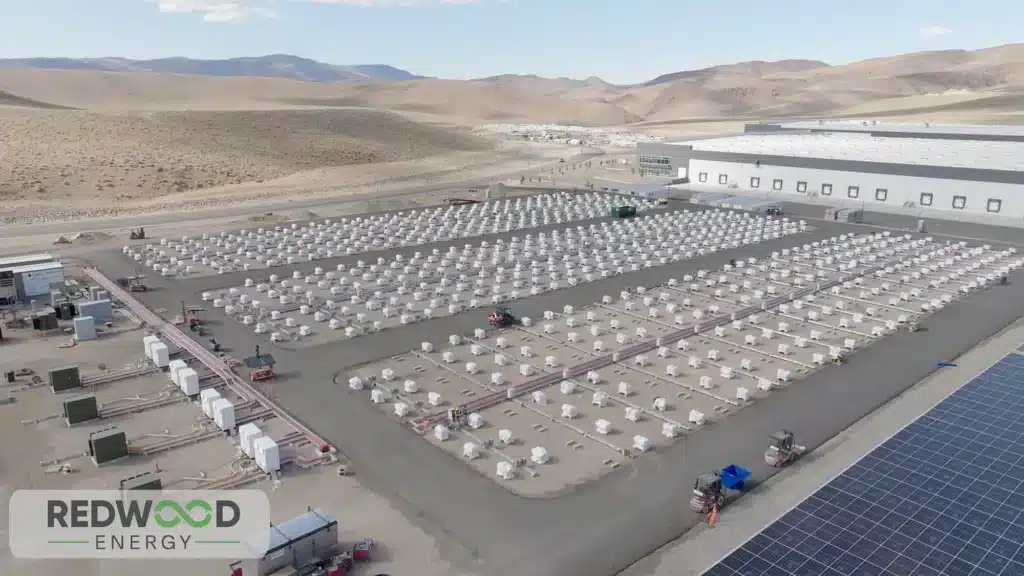
Near Reno, Nevada, a modular data center developed by Crusoe operates in a field of solar panels with minimal reliance on the traditional electric grid. The system combines renewable energy with hundreds of used EV batteries, creating a microgrid that can deliver reliable power while reducing strain on local electricity networks.
The technology is being advanced by Redwood Materials, a $6 billion battery recycling and materials company founded by CEO JB Straubel, who previously co-founded Tesla. Straubel recognized that retired EV batteries still contain significant energy capacity and could be repurposed instead of immediately recycled.
Rather than relying only on newly manufactured batteries, Redwood is creating large-scale energy storage systems using second-life EV battery packs. These systems can provide lower-cost storage for utilities, microgrids, factories, and data centers while reducing dependence on complex global battery supply chains.
The company’s goal is to scale second-life battery storage and unlock a new source of affordable energy infrastructure.
The timing aligns with rapid growth in the energy storage market. In the United States, record amounts of battery storage capacity have been deployed as renewable energy adoption increases and electricity demand rises. Battery systems are becoming increasingly important for storing solar and wind power, balancing the grid, and supporting new energy-intensive industries such as data centers.
For data center developers, second-life battery systems could reduce delays associated with grid connections while providing a cleaner alternative to building additional fossil fuel generation. Utilities can use the technology to store renewable energy, while industrial facilities can capture electricity when prices are lower and use it when demand increases.
Redwood Materials is now preparing to deploy hundreds of megawatt-hours of energy storage capacity, with plans to expand into gigawatt-hour-scale deployments. By transforming retired EV batteries into valuable energy assets, Redwood is helping redefine how future power infrastructure is built, reused, and integrated with the evolving electric grid.
Renewable Energy, Battery Storage, and Repurposed EV Batteries Can Meet Rising Data Center Demand
Solar and wind energy paired with advanced battery storage systems can help data centers reduce dependence on traditional power infrastructure while providing reliable electricity around the clock. Renewable energy generation often does not align perfectly with demand, but batteries can store excess electricity produced during periods of high generation and deliver power when demand increases.
Second-life EV batteries represent another major opportunity. Millions of EV batteries will eventually be retired from vehicles even though they retain significant energy capacity. Instead of immediately recycling these batteries, companies are developing systems that reuse them for stationary energy storage applications.
For data center operators, battery-based energy systems offer several advantages. They can reduce connection delays, provide backup power, improve energy reliability, and help meet increasing pressure to reduce emissions. Utilities can also use battery storage to balance renewable generation, support grid stability, and avoid costly infrastructure upgrades.
Solar power is the fastest-growing source of electricity in the United States, driven by utility-scale expansion, surging energy demand, and rapid battery storage integration. Solar accounted for 61% of all new electricity demand growth in 2025, bringing total operating capacity past 287 gigawatts, according to the U.S. Energy Information Administration.
Battery storage is already becoming a critical part of the U.S. energy system. Record amounts of storage capacity are being deployed as renewable energy adoption grows and electricity demand increases. As AI-driven data centers continue expanding, energy storage will become increasingly important for managing the additional load.

Electric Vehicle Marketing Consultant, Writer and Editor. Publisher EVinfo.net.
Services