Electric Vehicle Batteries Are Getting a New Life in Michigan
Electric vehicle batteries are lasting longer than automakers initially expected. Many exceed the typical eight-year or 100,000-mile warranty period and are now expected to remain in service for 12 to 15 years, with some potentially lasting up to 20 years. Even after they are no longer suitable for powering a vehicle, many batteries can retain approximately 80% of their original capacity, creating opportunities for second-life energy storage or recycling to recover materials such as lithium, cobalt and nickel.
Recovering that remaining value presents technical and safety challenges. EV batteries vary widely in design, shape and chemistry, while residual electrical charge can create fire and explosion risks. Safe reuse, repurposing and recycling require systematic handling, diagnostics and material-processing procedures. Recycling economics can also vary, with some batteries costing more to recycle than the value of the recovered materials.
Despite uncertainty over future EV sales, millions of batteries already on the road will eventually require a second-life application or recycling. Early-generation EV batteries are beginning to reach retirement, while larger volumes from vehicles sold since 2016 are expected to become available during the next decade. Recycled batteries could potentially supply approximately 36% of global cobalt demand, 31% of nickel demand and 22% of lithium demand by 2037, according to S&P Global Mobility.
Michigan Builds A Battery Circular Economy
Michigan organizations are developing the testing, handling, reuse and recycling infrastructure needed to determine the most appropriate use for retired EV batteries. The NextCycle Michigan Accelerator, funded by the Michigan Department of Environment, Great Lakes, and Energy (EGLE), provides participating organizations with business and operational guidance, technical and circular-economy expertise, supply-chain connections, funding opportunities and marketing support.
Great Lakes Recycling (GLR), a NextCycle Michigan alumni company based in River Rouge, Michigan, has shifted from ferrous metal recycling to electronics and EV battery recycling. After moving into a 60,000-square-foot facility in September 2025, GLR quadrupled its space and can now process 100 to 150 battery packs per day. The company is pursuing UL1974 certification to become one of only two U.S. companies able to officially certify batteries for reuse.
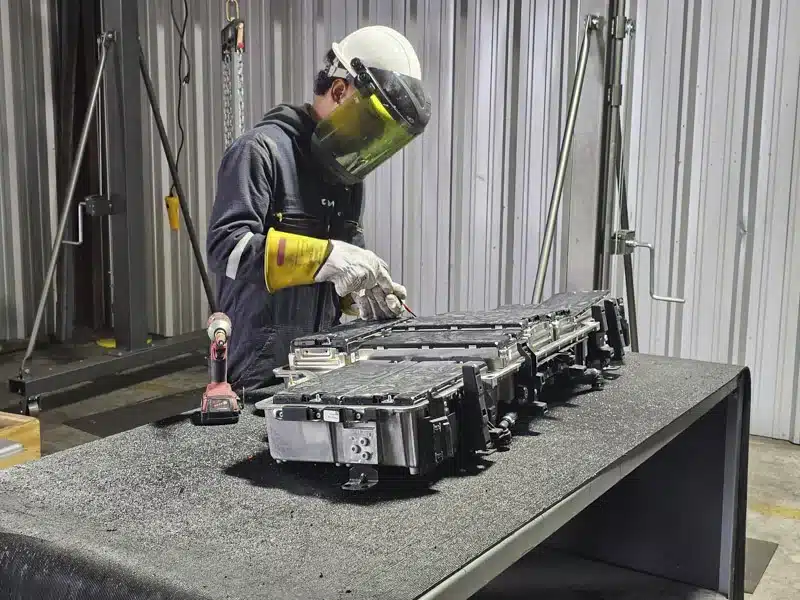
GLR weighs, tags, categorizes and electronically records every incoming battery load. Questionable loads are quarantined, while approved batteries move to staging. Temperature monitoring can automatically trigger camera alerts and notify the local fire department. GLR has also reduced the time required to dismantle standard battery packs to four to six minutes while repeatedly reducing voltage to safe levels.
GLR is partnering with Volt Harbor to prioritize battery reuse before recycling. The companies have jointly applied for NextCycle grant funding to develop battery testing for energy storage systems (ESS), which could provide portable power, grid stabilization and large-scale electricity arbitrage. GLR says batteries that are no longer effective in vehicles at 75% to 80% state of health can potentially continue operating in energy storage applications down to 30% state of health.
Volt Harbor originated from National Science Foundation-funded research at the University of Michigan focused on cost-effective reuse of retired EV batteries. Its software allows energy storage modules to work with different battery makes and models, energy capacities, voltage outputs and degradation levels without expensive balancing equipment.
The company is targeting commercial and industrial facilities where battery storage and electricity costs are high. Its modular UltraCore system can provide power and integrated functionality where existing grid infrastructure cannot handle demand, potentially reducing the need for costly grid upgrades. Data centers are another potential market because their power requirements vary significantly between facilities.
Volt Harbor is also working with the DTE Emerging Technology Fund on a pilot energy storage system designed to support EV charging. The system will store electricity during periods of low demand and supply it during expensive peak periods when the grid is constrained. The pilot is scheduled for spring 2027.
Testing Batteries For A Second Life
ReCharge Recycling, founded in 2022 as a U.S. subsidiary of United Battery Recyclers International, tests retired batteries to determine their next-best use. The company participated in the NextCycle Michigan Accelerator to develop industry connections, validate its business model and better understand EV battery volumes and end markets.
ReCharge estimates that 90% to 95% of the batteries it receives still have usable capacity, reinforcing the idea that removing a battery from a vehicle does not necessarily mean the battery has reached the end of its useful life.
The company is working with the University of Michigan-Dearborn on an algorithm designed to reduce battery testing time from four to six hours to five to 10 minutes. Faster testing could substantially increase processing capacity and operational efficiency. ReCharge is also developing additional services, including battery health data for insurers and professional auto dismantlers and a business-to-business marketplace for components such as bus bars, bolts and battery cases.
Michigan’s approach illustrates how the EV battery lifecycle can extend well beyond a vehicle’s first life. Instead of treating a retired battery as waste, companies are developing ways to test, certify, repurpose and eventually recycle these energy-storage assets, creating new supply chains while recovering materials for future batteries.

Electric Vehicle Marketing Consultant, Writer and Editor. Publisher EVinfo.net.
Services