Republic Services Details Electric Refuse Collection Fleet Strategy
On September 22, 2026, Waste Dive interviewed Republic’s Vice President of Operations Technology Brett Rogers, who discussed the company’s successes with electric collection vehicles and how the company is advancing fleet electrification.
Republic Services has become one of the waste industry’s largest electric vehicle users, deploying more than 250 electric collection vehicles through municipal partnerships across the country. The company is ahead of schedule to reach 300 electric collection vehicles by the end of 2026.
Rogers leads the company’s fleet strategy. He said the electric trucks have frequently performed better than expected while providing benefits including improved visibility, technology integration, additional torque, quieter operation and better driver comfort.
Republic’s strategy has been to carefully select routes where EVs are most likely to succeed. After approximately five years of operating electric vehicles from multiple manufacturers, the company understands how terrain, temperature and other factors affect power consumption and range.
Initially, Republic deployed EVs on conservative routes. The company found that electric trucks work on more routes than expected and can often provide a one-for-one replacement for conventional trucks, completing an entire route on a single charge without midday charging.
Customer demand is also driving deployments. Republic prioritizes municipalities interested in electric vehicles and begins feasibility studies and charging infrastructure planning before the trucks arrive.
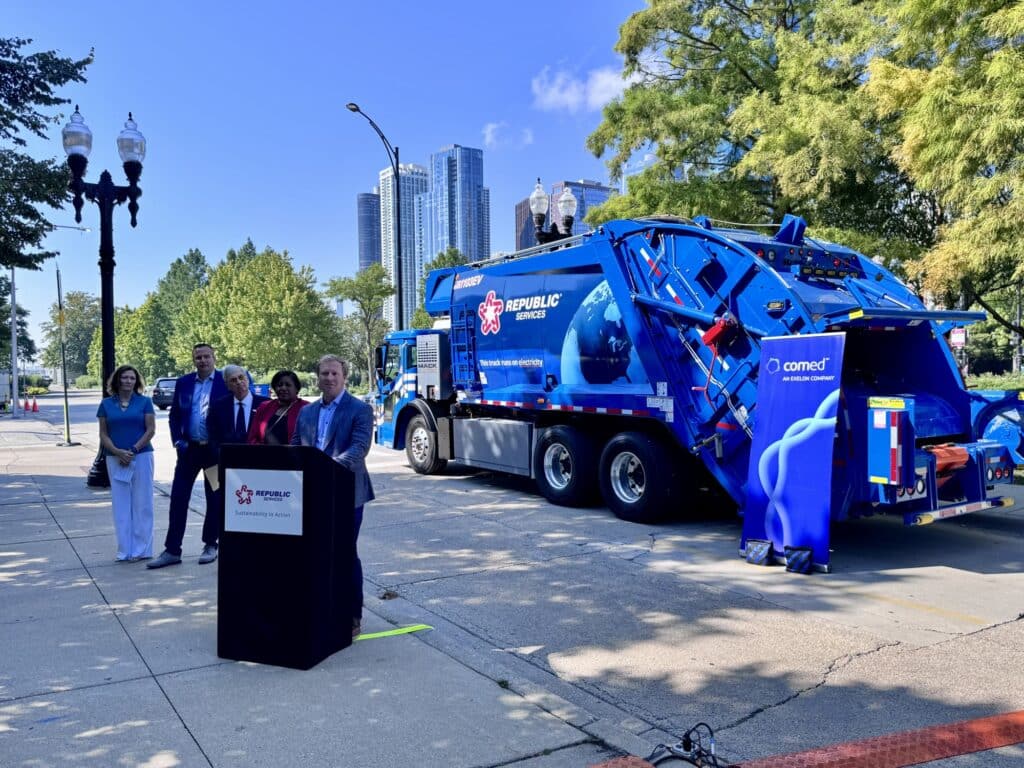
Multiple Electric Truck Models
Republic operates electric collection vehicles from multiple manufacturers, including Mack LR Electrics, Peterbilt 520s and McNeilus Volterra ZSLs.
The Volterra accounts for much of the company’s newer EV fleet because of its driver-focused cab. Its ground-up electric design provides a cab that is approximately 30% larger, quieter and less prone to vibration, while offering better air conditioning and ergonomics.
The Volterra also integrates the McNeilus body and chassis. That integration can help reduce weight, increase payload and improve range compared with traditional vocational trucks, where chassis and body manufacturers typically build separate components that are later combined.
Rogers said drivers have been particularly impressed.
“Once they get in these EVs and drive them for a little bit, they don’t want to get out of them. They love them,” he told Waste Dive.
Charging Infrastructure Comes First
Republic has built more than 30 charging stations to support its electric fleet. Rogers said the primary barriers to deployment are time and cost, making planning and utility partnerships critical.
The company determines where trucks will operate and builds the necessary charging infrastructure before the vehicles are delivered.
“That way, when the trucks get delivered, there are already chargers in place, and we’re ready to roll,” Rogers said to Waste Dive.
Municipal Benefits
Municipalities are Republic’s primary focus for EV deployments. Electric trucks can help communities meet sustainability goals while offering safety and operational advantages.
Features can include larger windshields, 360-degree cameras, blind-spot warnings, automatic braking, lane keeping and lane assist. EVs also operate much more quietly than conventional refuse trucks, reducing disruption in residential neighborhoods.
Republic expects the East and West coasts to lead electric waste-truck adoption. Colder rural areas with longer routes will likely transition later, although improving technology should eventually expand EV deployment inland.
Policy Changes Won’t Stop Electrification
Rogers said Republic’s electrification strategy is long term and does not depend on regulations or incentives remaining unchanged.
Rogers told Waste Dive: “We realize incentives are going to come and go. Regulations could come and go, but our strategy is to go electric.”
Federal incentives may be declining, but state incentives remain available and, in some cases, are increasing. Programs can help offset truck and charging infrastructure costs and may be based on emissions, electricity use or nitrogen oxide reductions.
Hydrogen Has A Potential Role
Republic continues monitoring hydrogen fuel-cell technology. Rogers believes hydrogen could make sense for applications requiring rapid refueling and longer range, including some semi-trucks and transfer vehicles.
However, battery-electric vehicles are considerably more efficient because electricity can be used directly to propel the vehicle, while hydrogen requires chemical-to-electrical conversion.
“Anything that can be electrified, you will electrify because of the upper 90 percentile in efficiencies,” Rogers said to Waste Dive.
Hydrogen could therefore serve routes where EVs cannot meet range or operating requirements. So far, however, Republic has found that EVs meet the requirements on the routes where they have been deployed.
Future battery improvements, including solid-state technology, could provide greater range while reducing battery weight and increasing payload.
Rogers expects EVs to advance faster than hydrogen, particularly for residential front-load fleets, where stop-and-go operation makes them well suited to electrification.
Electric Support Vehicles
Republic is also testing electric support vehicles, including Ford F-150 Lightning supervisor trucks and electric Mack and Peterbilt stake and box trucks.
These vehicles are not yet deployed at scale, but Republic is using them to evaluate their performance in daily operations. Rogers said feedback has been positive.
“You’re going to see us being persistent no matter what the outside environment looks like,” Rogers said to Waste Dive. “We’ll continuously grow our EV fleet and stay ahead of the game.”

Electric Vehicle Marketing Consultant, Writer and Editor. Publisher EVinfo.net.
Services