Over 858,000 in Southeast Without Power From Hurricane Isaias, EVs Provide Emergency Power
On October 10, 2026, The Center Square reported via Yahoo News that Hurricane Isaias brought destructive winds, heavy rainfall, falling trees and widespread power outages across the Southeast, killing at least two people and injuring another as emergency crews began recovery efforts.
In Escambia County, Florida, a woman died after a tree fell on her. In Jefferson County, Alabama, a tree crashed into a house, killing one person and injuring another.
More than 858,000 homes and businesses were without electricity Saturday morning, according to PowerOutage.us. Florida reported 436,147 outages, Alabama had 297,684 and Georgia recorded 95,162.
Wind gusts reached 117 mph near Oriole Beach, Florida, and 102 mph near Pensacola. Orange Beach, Alabama, recorded gusts of 75 mph, while Warner Robins, Georgia, experienced 68 mph winds. Bellwood, Alabama, received 12.97 inches of rain in 13 hours, and Destin, Florida, recorded 6.98 inches.
Emergency crews are clearing debris, restoring services and responding to calls.
Authorities urged residents to stay away from downed power lines, avoid damaged roads and follow local safety instructions as cleanup and recovery operations continued.
EVinfo.net’s Take: Electric Vehicles Can Keep Homes Powered During Outages
Electric vehicles can do more than provide transportation. Equipped with bidirectional charging technology, they can also serve as backup power sources for homes and businesses during grid outages, helping keep essential appliances, lighting and internet connections running when electricity service is interrupted.
A recent example came from Tom W., apparently a Connecticut resident, who shared a post on LinkedIn during a powerful September nor’easter. With grid power knocked out by the storm, he connected his home to his Ford F-150 Lightning electric pickup, in the image shown below. The truck supplied electricity to the house, allowing everything to continue working, including Wi-Fi.
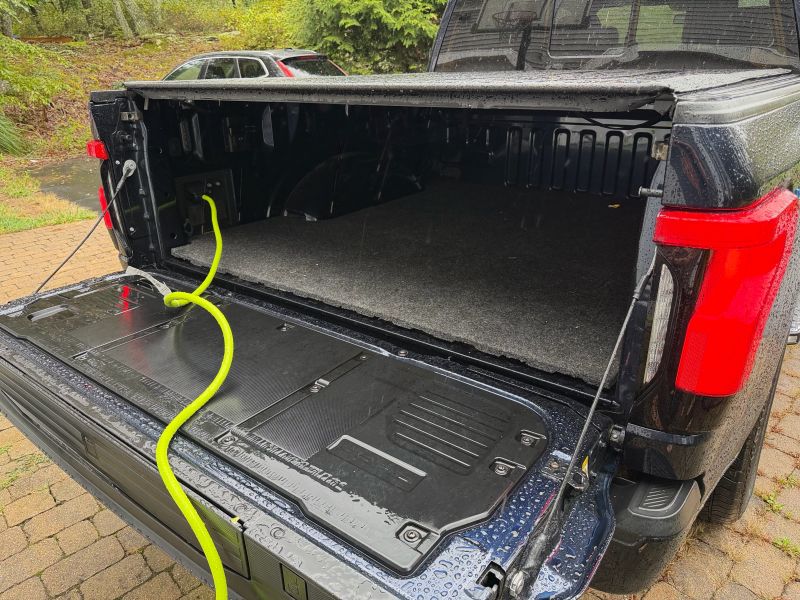
The experience illustrates one of the most practical advantages of electric vehicles: their ability to supply stored battery energy when the grid goes down. Rather than relying exclusively on a gasoline-powered generator, EV owners with compatible vehicles and home power equipment can use electricity already stored in their vehicle’s battery.
Vehicle-To-Home And Vehicle-To-Grid Technology
Vehicle-to-home (V2H) technology allows an EV to power a residence, while vehicle-to-grid (V2G) technology enables electricity to flow from a vehicle’s battery back to the electric grid. These capabilities can help turn parked EVs into valuable energy resources.
During severe weather, V2G-enabled vehicles could potentially be dispatched to areas experiencing outages, providing mobile power where it is needed. Although reconnecting to a damaged grid requires appropriate equipment, safety controls and coordination, bidirectional EVs could become part of a broader emergency energy strategy.
V2H systems can help homeowners maintain essential services during outages, potentially reducing dependence on portable generators. Depending on the vehicle, equipment, household consumption and battery charge, an EV could supply power for hours or longer.
V2G Can Reward EV Owners
Bidirectional charging also offers financial opportunities. Utilities and grid operators can compensate participating EV owners for making battery capacity available, providing electricity during periods of high demand or helping balance fluctuations in renewable energy production.
Program availability, compensation and technical requirements vary by utility and location. Not every EV supports bidirectional power, and some vehicles require specialized home charging equipment.
V2G can also help integrate more renewable energy into the electricity system. EV batteries can absorb surplus solar and wind generation and return electricity when demand rises or renewable output falls. This flexibility can reduce reliance on expensive, polluting fossil fuel peak-time generation and improve grid efficiency.
The United States Needs To Accelerate V2G Adoption
Vehicle-to-grid technology could make EVs more valuable to consumers while strengthening grid resilience. However, widespread adoption requires compatible vehicles, bidirectional chargers, utility programs, appropriate interconnection rules and compensation that makes participation worthwhile.
Europe has advanced several commercial vehicle-to-grid initiatives, while the United States still needs broader deployment and more consistent support for bidirectional charging.
The Ford F-150 Lightning example demonstrates why the technology matters to ordinary households. An EV can be a transportation asset, a backup power source and potentially a participant in the electricity market.
Supporting V2G deployment in the United States and expanding access to bidirectional charging would help consumers get more value from their EVs, improve resilience during extreme weather and make better use of clean, renewable electricity. As storms and grid disruptions threaten communities, the ability to power a home from a vehicle battery is more than a technical feature. It is a practical energy solution.
Help Hurricane Victims
EVinfo.net urges help for victims of Hurricane Isaias. Donate to organizations such as the American Red Cross, which provides emergency shelter, food, relief supplies and recovery assistance to people affected by disasters. Other organizations, including The Salvation Army, and local food banks and community relief groups, also help affected families recover. Donations to established relief organizations can support emergency response, cleanup efforts and essential supplies for residents who have lost electricity, experienced property damage or been displaced by the storm.

Electric Vehicle Marketing Consultant, Writer and Editor. Publisher EVinfo.net.
Services