EV Charging Growing Fast in U.S., as EV Adoption Stays Slow and Gas Prices Skyrocket
Public electric vehicle charging infrastructure in the United States continues to expand despite slow EV sales, with charging companies on track to install approximately as many public charging plugs in 2026 as they did during 2025, the industry’s record year. Patrick George at the Wall St. Journal (WSJ) reported the news on Oct. 10, 2026.
By adding thousands of plugs, charging executives aim to serve existing EV owners who want easier road trips, used EV buyers and future customers if demand rebounds.
“I still think people are breathing into paper bags,” Rick Wilmer, CEO of charging company ChargePoint, said to WSJ, describing the industry’s mood during the downturn. “But the growth is real. The EV-driving community wants more chargers in the world.”
Optimism has declined since the President eliminated EV tax credits and fuel-economy regulations intended to move Americans away from gasoline-powered vehicles. Automakers have abandoned ambitious EV targets, canceled models and announced multibillion-dollar write-downs as they redirect investments toward gasoline vehicles.
Nevertheless, the United States had added nearly 2,000 charging stations with more than 12,000 plugs by early October, according to charging-industry data firm Paren. That pace approaches 2025, when the country added 3,885 stations and 19,839 plugs. The U.S. now has more than 80,000 public fast-charging plugs.
Bill Ferro, Paren’s co-founder and chief technical officer, said to WSJ that charging providers are learning from past mistakes that frustrated EV drivers. New stations offer more plugs to reduce waiting, while more powerful chargers shorten charging sessions. Providers are also choosing locations near restaurants, restrooms and busy commercial areas instead of isolated parking lots.
“I’ve started calling it the Great American Build-Out,” Ferro said to WSJ. “You don’t realize you’re in it until you’re in the middle of it.”
The expansion addresses the longstanding chicken-and-egg problem facing EV adoption: consumers hesitate to purchase electric vehicles without adequate charging infrastructure, while charging providers need enough EVs on the road to justify their investments.
However, companies are building infrastructure for future demand that remains uncertain. The Biden administration targeted 50% of U.S. vehicle sales by 2030 to consist of electric, hydrogen-powered or plug-in hybrid models. Actual demand fell short of industry projections.
EVs reached approximately 12% of new-car sales in the third quarter of 2025, before federal tax credits expired, and have hovered around 6% in 2026. Automotive executives nevertheless anticipate renewed growth, particularly as less expensive electric models become available.
Charging providers also face substantial capital costs and continuing profitability challenges.
ChargePoint, one of the world’s largest charging companies, reported second-quarter revenue of $116 million, an 18% year-over-year increase that exceeded its guidance. However, it recorded a net loss of $35.6 million. EVgo reported a second-quarter net loss of $46.3 million.
Wilmer said to WSJ that losses are narrowing and ChargePoint is experiencing growth across its business lines, including public charging and fleet customers. Autonomous vehicles, which are overwhelmingly electric, could become another source of charging demand.
Charging executives maintain that the United States still lacks sufficient plugs to serve its existing EV fleet, much less accommodate substantial future growth.
Infrastructure expansion is concentrated in coastal states such as California and New York, although Ferro said Texas and Florida are scaling up quickly.
Several companies have demonstrated significant progress. IONNA, a charging network backed by Hyundai, Toyota and other automakers, has opened more than 180 public fast-charging sites since launching in early 2025, more than doubling the size of its network.
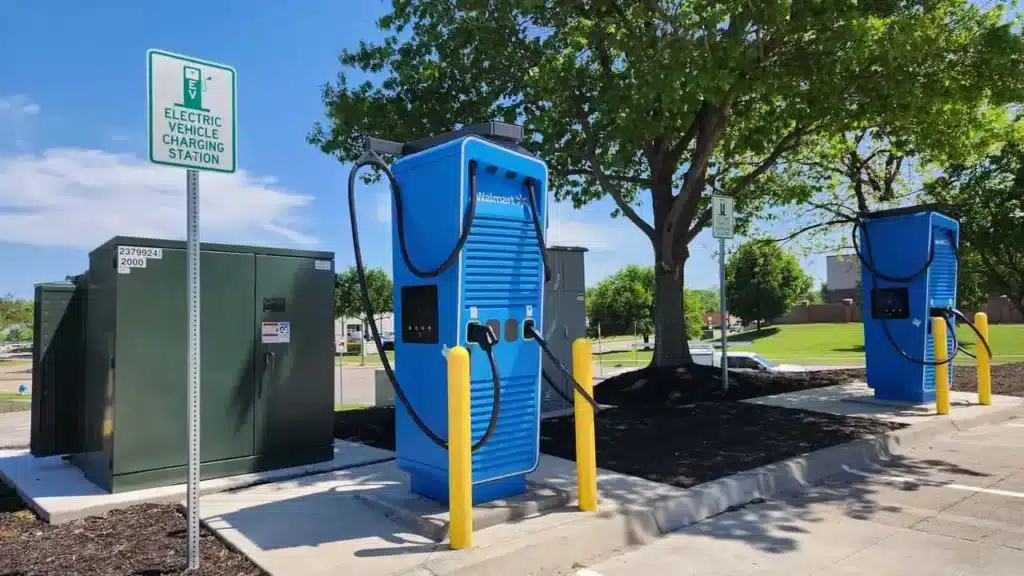
Walmart opened its 100th fast-charging station in late August. Its retail locations offer convenient charging opportunities for shoppers and road-trippers who need food, restrooms and other services. Additional stations are planned.
Tesla remains the dominant U.S. fast-charging provider. According to Paren, the company added more than 3,500 fast-charging plugs in 2026, bringing its nationwide total to approximately 40,000.
Charging executives are also watching gasoline prices, which have risen more than 50% this year amid the war with Iran, and considering how higher fuel costs could affect consumer decisions.
AAA reported on October 11, 2026, that U.S. average gas prices were $4.3585, up from the year-ago average of $3.0895, and diesel was average $6.2771, as opposed to the year-ago average of $3.6688. In California, diesel is over $8.00.
Tiya Gordon, co-founder of It’s Electric, a startup that recently secured an exclusive contract to build curbside public charging stations throughout New York City, believes sustained high fuel prices could trigger renewed interest in EVs. Gordon recently got a tattoo of the Strait of Hormuz, highlighting the connection between oil-market disruptions and transportation costs.
“We know that the cost of everything is going up, and it’s because of the price of oil,” Gordon said to WSJ. She believes rising fuel costs could encourage consumers to reconsider how they power their vehicles.
“You start to see more of your neighbors driving EVs, and you understand the benefits of it,” Gordon said.
EVinfo.net’s Take: Continued EV Charging Expansion is a Wise Move for USA
The charging industry’s wise continued expansion demonstrates that infrastructure investment is proceeding despite the current EV sales downturn caused by the foolish cut of the EV tax credit, along with bad federal policy and the OEM’s vast over-reaction to it, making far too severe EV cutbacks.
More powerful chargers, additional plugs, better station locations and growing networks will make charging more convenient for existing drivers while preparing the United States for the inevitable recovery in EV demand, once we elect better leaders in the November 3, 2026 midterm elections.
EVinfo.net Proud to Partner With it’s electric and WattsUp
EVinfo.net is very honored to work with Tiya Gordon and the stellar team at it’s electric.
Brooklyn-based it’s electric has been selected by New York City and the New York Power Authority to build a permanent curbside EV charging network featuring 700 chargers across all five boroughs over the next three years. Announced September 15, 2026, the project will replace the city’s existing pilot infrastructure, expanding the PlugNYC program beyond its original 88 heavily used Level 2 charging points.
The it’s electric network targets neighborhoods with many rideshare and Taxi and Limousine Commission (TLC) drivers who lack garages or driveways for home charging. With more than 80,000 rideshare drivers in New York City, curbside charging could make EV ownership more practical and affordable while supporting the city’s requirement for Uber and Lyft trips to be electric or accessible by 2030.

The chargers are designed by it’s electric in Brooklyn and manufactured by Boyce Technologies in Queens, supporting local jobs and domestic manufacturing. Maverick Corporation will provide engineering and construction services, while SWTCH Energy will supply the network’s software platform. The compact Level 2 chargers eliminate bulky equipment, screens and permanently attached cables, using portable charging cables instead.
The project supports New York City’s climate goals by expanding charging access, reducing transportation emissions and serving communities underserved by private charging providers. Alongside the announcement, it’s electric closed an oversubscribed bridge financing round led by Halogen Ventures, bringing its total funding to $15 million. it’s electric is also expanding its innovative curbside charging model to other North American cities.
WattsUp is Improving EV Charging Reliability
WattsUp is an EV charging technology company focused on improving charger reliability through AI-driven predictive maintenance and automated service coordination. Its platform uses machine learning, real-time monitoring, and anomaly detection to identify potential failures before they cause downtime. WattsUp helps charging network operators diagnose problems, automate parts ordering, coordinate technician scheduling, and reduce repair costs. The company serves EV charger manufacturers, charge point operators, site managers, and commercial and multifamily property owners, providing data-driven insights to improve charger performance, operational efficiency, and uptime. By helping keep charging stations functional and ready for drivers, WattsUp aims to strengthen charging infrastructure and accelerate electric vehicle adoption. Learn more at https://wattsupev.io.

Electric Vehicle Marketing Consultant, Writer and Editor. Publisher EVinfo.net.
Services