EV Batteries Get a Longer Lifespan When Weak Cells Are Bypassed
In today’s electric vehicle batteries, a single weak cell can limit the life of the entire battery pack, even when the other cells are still working well. Researchers are developing future battery systems that can bypass weak cells and make better use of the remaining capacity. A new study led by researchers at Chalmers University of Technology in Sweden shows that a “smart battery architecture” could extend electric vehicle battery life by more than 20% in certain vehicles under optimal conditions. The technology could also reduce total costs over the battery’s lifetime.
On October 8, 2026, Chalmers University of Technology reported the news.
Battery packs in electric vehicles consist of many interconnected cells that do not age at the same rate. In conventional battery designs, the weakest cell can therefore limit the performance and lifespan of the entire pack.
Albert Škegro, a doctoral student at the Department of Electrical Engineering at Chalmers University of Technology and first author of the study, compares the conventional battery structure to cells connected by a rope, with all of them trying to move forward together.
“Since they are bound to each other, everyone has to keep the same pace as the slowest cell and stop when that cell stops. With the solution in our study, the battery can instead bypass the cell that is causing problems and continue forward,” Škegro said.
The study was published in Nature Communications and conducted in collaboration with industry partners.
Previous research has demonstrated how differences between individual cells can affect EV battery performance and lifespan. In a recently published study co-authored by Chalmers researcher Changfu Zou, researchers found that the weakest cells clearly limit the performance of the entire battery pack.
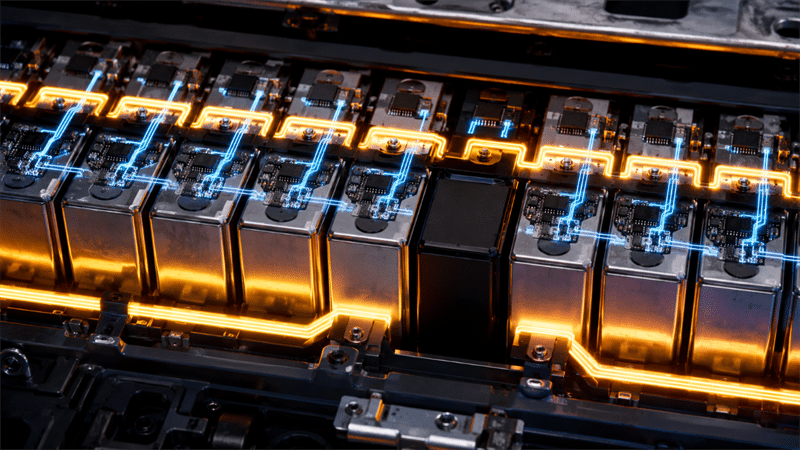
A Battery That Can Adapt as Cells Age
In the new study, researchers assessed the benefits of reconfigurable battery packs, which use switches and control systems to change the connections between cells. These systems can bypass weaker cells, allowing the battery to use more of its remaining capacity.
The researchers’ models show that the most advanced configuration, in which each cell can be controlled individually, could extend battery life by more than 20% in some high-voltage vehicles, including electric trucks and long-range electric cars. However, this result represents a theoretical upper limit. In practical applications, manufacturers are more likely to control groups of cells together.
“Reconfiguration is not a question of ‘on or off’. It is a spectrum, and where a manufacturer chooses to sit on that spectrum determines how much of the potential benefit can be realised,” said Changfu Zou, professor at the Department of Electrical Engineering at Chalmers and co-author of the study.
Longer Lifespan Can Outweigh Higher Cost
To demonstrate the potential practical benefits, researchers analyzed a typical electric car with an 80-kilowatt-hour battery and annual driving of 12,000 kilometers. The example assumes that a conventional battery pack is replaced after 10 years, in line with current industry practice.
In the model, the reconfigurable battery pack reached the same replacement point after approximately 11 years, extending its service life by roughly 14 months. It also retained a higher residual value because it had experienced less degradation.
“For a private electric car owner, it is a great advantage that the car’s battery lasts longer. For a fleet with hundreds of battery packs, extending the battery life can mean significant savings,” Škegro said.
The technology is not yet available in series-produced or mass-produced vehicles, although it has been tested in research and industrial prototypes. Because it requires additional electronics, reconfigurable battery packs have higher initial costs. However, the researchers found that a longer service life and higher residual value could outweigh the additional expense under many realistic conditions.
The greatest potential benefits are in high-voltage vehicles with long driving ranges and large numbers of cells connected in series.
Potential Sustainability Benefits
Beyond extending battery life, the researchers identified additional sustainability benefits. Battery manufacturers currently spend considerable resources testing and matching cells with similar characteristics during production. Reconfigurable battery technology could accommodate greater variation between cells, potentially reducing the need for such precise matching.
The technology could also allow more battery packs to be repurposed for a second life, including use in stationary energy storage systems.
“A battery pack that is taken out of service prematurely means both wasted material and wasted energy. Keeping battery packs in use for longer is therefore a sustainability argument even before you take the economy into account,” Škegro said.
More About the Research
The study, “System-Level Assessment of Dynamic Reconfiguration for Lifetime and Cost Outcomes in Electric Vehicle Battery Packs,” was published in Nature Communications.
The authors are Albert Škegro, Torsten Wik, and Changfu Zou of Chalmers University of Technology; Bo Bijlenga of PHINIA Inc. in Åmål, Sweden; and Alexander Bessman of Scania CV AB in Södertälje, Sweden.
The article was also highlighted by the editorial staff at Nature Communications in the field of Engineering and Infrastructure.
Read the full study: https://www.nature.com/articles/s41467-026-74951-8

Electric Vehicle Marketing Consultant, Writer and Editor. Publisher EVinfo.net.
Services