EV Charging Growing Fast in the USA
The United States is experiencing an unprecedented boom in electric vehicle (EV) charging infrastructure. A little over a decade ago, there were fewer than 20,000 public charging points nationwide. Today, that number has soared past 190,000, and the momentum shows no signs of slowing down.
This rapid buildout is being driven by several forces: surging EV adoption, government incentives, and billions in private investment. Automakers are committing to all-electric lineups, utilities are upgrading grid capacity, and federal programs like the Bipartisan Infrastructure Law are funneling funds into charging corridors across highways and cities.
Looking ahead, projections suggest the U.S. could reach more than half a million chargers by 2030. That scale will be critical for meeting demand, since EV sales are expected to make up a significant share of new vehicles by the end of the decade.
Still, challenges remain. Reliability and uptime are often cited as pain points for drivers, while rural areas lag far behind urban centers in access. Solving these issues will require not just building more stations, but also making them smarter, faster, and easier to maintain.
For now, the trajectory is clear: EV charging is growing fast in the USA, and it’s laying the foundation for an electric future on American roads.
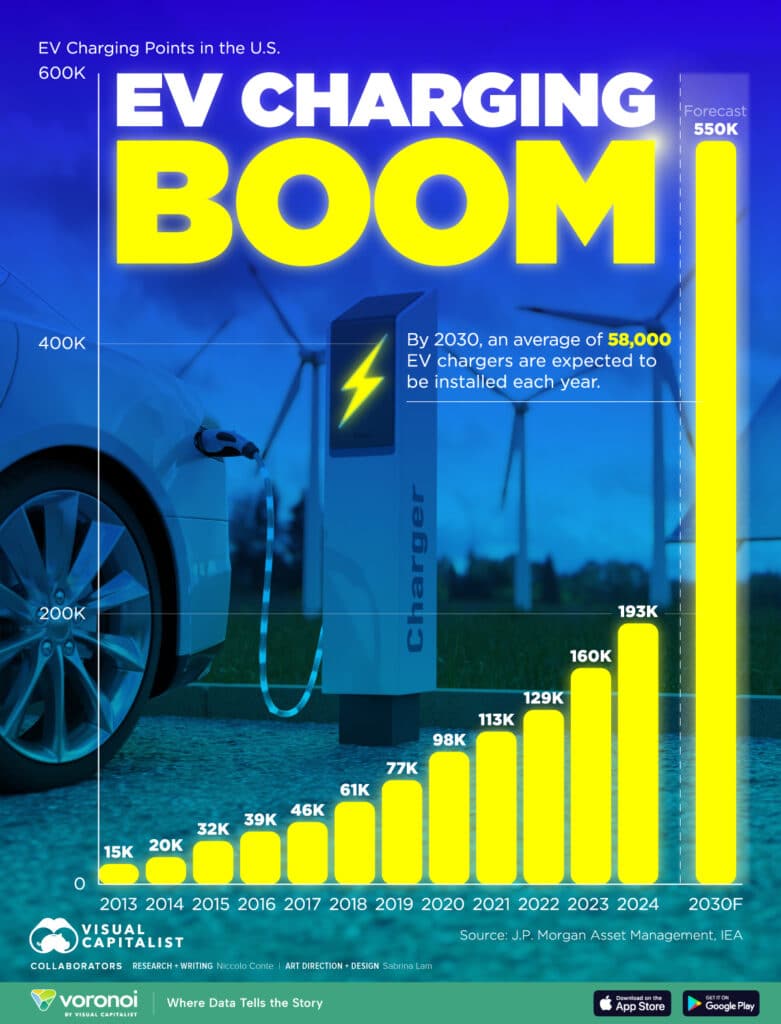
The expansion of America’s EV charging network has been accelerating for more than a decade, but the pace since 2020 has been especially dramatic. That year marked the first time the country added more than 20,000 chargers in a single year, with 21,000 new units installed. The momentum has only grown stronger, between 2022 and 2024 alone, the U.S. added an impressive 80,000 chargers, reflecting both public and private sector efforts to scale up infrastructure quickly.
Looking ahead, projections point to 550,000 public EV chargers in place by 2030. To achieve that goal, the U.S. will need to install around 58,000 new chargers every year. Historically, the average since 2013 has been closer to 16,100 per year. More recently, however, from 2020 onward, the yearly average has risen to about 23,200.
Even though that pace is still well below the 58,000 target, the upward trend is encouraging. Continued acceleration will be essential to keep pace with surging EV adoption and ensure that drivers across the country—urban and rural alike—have reliable access to charging. The next few years will be critical in determining whether the U.S. can match its ambitious goals and build the backbone of an all-electric transportation future.
Transportation is the largest source of heat-trapping pollution in the United States, with most emissions coming from cars and trucks powered by gasoline and diesel. Transitioning to electric vehicles (EVs) is critical for cutting this pollution, improving air quality, and slowing global warming. Building out public charging infrastructure is central to making that transition possible.
California leads the country by a wide margin, hosting at least three times as many chargers as any other state. New York, Florida, and Texas follow behind. When adjusting for land area, however, northeastern states dominate in charger density, with Massachusetts, Connecticut, Rhode Island, New Jersey, and Maryland ranking at the top.
The Rise of DC Fast Chargers in the U.S.
The buildout of public fast chargers has also accelerated, enabling longer road trips and cross-country travel in zero-emission vehicles.
Of the nearly 196,000 public EV chargers in the U.S., the majority, about 74%, are Level 2 chargers. These provide 10–20 miles of range per hour, making them useful for workplaces, shopping centers, and overnight charging.
Around a quarter of the network, or nearly 50,000 chargers, are direct current (DC) fast chargers. These dramatically shorten charging times, delivering about 180–240 miles of range per hour. Since 2016, the number of public DC fast chargers has surged more than fourteenfold, from just 3,434 a decade ago to nearly 50,000 today.
DC fast chargers are strategically placed along highways and busy travel corridors, where they enable zero-emission journeys beyond daily commuting distances. While only about 2% of car trips in the U.S. exceed 50 miles, having reliable access to fast charging makes longer drives far more practical. This growing network is helping to normalize EV road trips that were once considered out of reach.
Coverage is not yet universal, but progress is clear. Public DC fast chargers are becoming more common along iconic U.S. travel routes, gradually making it possible to complete cross-country adventures without relying on gasoline. One key benchmark for truly seamless travel is ensuring at least one DC fast charger every 50 miles along major roads, a goal that is inching closer to reality as infrastructure expands.
Relion & Malco: Powering Reliable EV Charging at Scale
Relion and Malco have teamed up to strengthen the reliability and scalability of EV charging in North America, combining Relion’s real-time monitoring and diagnostics platform with Malco’s engineering and field service expertise. Their partnership offers operators a unified, hardware-agnostic system for managing multi-brand charging networks, with proactive issue detection, remote diagnostics, and streamlined workflows that reduce downtime and complexity.

With Relion’s unified platform, operators gain full visibility and control, from problem detection through to resolution. Real-time monitoring, diagnostics, and structured workflows enable faster response times and reduce downtime.
Beyond the platform itself, Relion also offers white-glove O&M managed services that provide the additional support many operators need: 24/7 network monitoring, proactive maintenance, and on-the-ground repair services.
The result is a simpler, more scalable model that reduces complexity, improves the customer experience, and delivers more value than traditional extended warranty plans ever could.
Benoit Lacroix, Co-Founder & CEO at Relion will be in the speaker line-up at MOVE America 2025, where more than 500 innovators will take the stage to shape mobility’s next chapter.

From EVs to infrastructure to AI-powered logistics, it’s all at MOVE America. The event boasts over 4,000 attendees and 18 conference stages.