Mercedes Supercharges Its EV Charging Network with Alpitronic’s Megawatt-Capable Chargers
Mercedes-Benz is gearing up to revolutionize its high-power DC fast-charging network by deploying Alpitronic’s ultra-fast chargers, initially offering up to 600 kW per vehicle, and pushing toward 1 MW output for a single EV.
This leap nearly doubles the capabilities of today’s 350 kW fast chargers and positions Mercedes to rival BYD’s headline-grabbing megawatt technology.
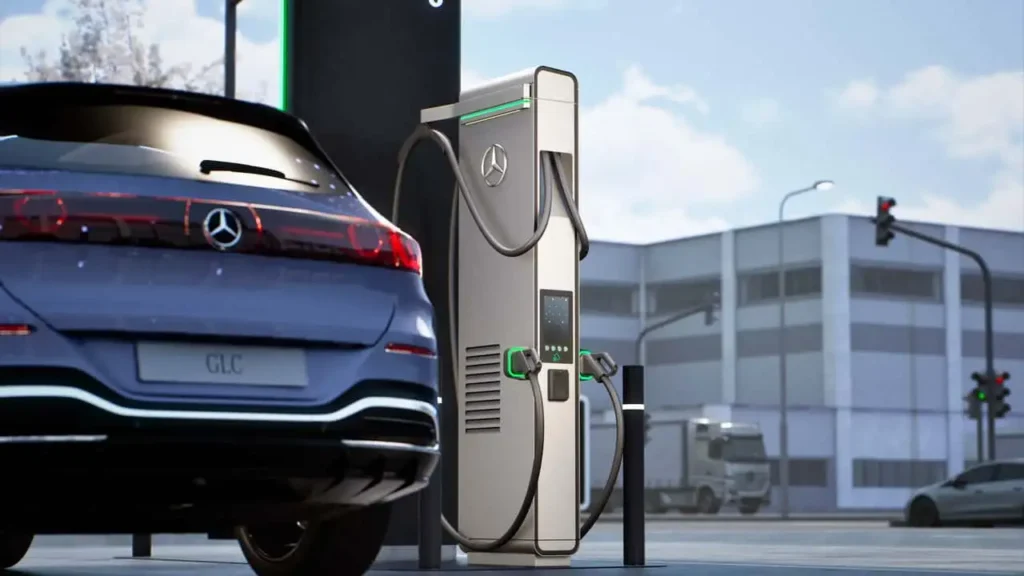
Central to this upgrade is Alpitronic’s HYC 1000 charging system, a powerful external power unit capable of delivering up to 1,000 kW at 800 A across multiple dispensers. Under ideal conditions, individual stalls can offer up to 600 kW (1,000 V × 600 A) to a single vehicle.
The system uses a modular Power Cabinet that can serve up to four stalls with dual liquid-cooled cables. If a single car is charging, it can utilize the full 600 kW; if multiple EVs are plugged in, the system dynamically allocates power among them.
Real-world scenarios underscore this potential, Mercedes’ new CLA could gain roughly 200 miles (325 km) of range in just 10 minutes at full power. Charging speeds will vary depending on vehicle compatibility—e.g., the new GLC with EQ Technology accepts up to 330 kW, while others like the Hyundai Ioniq 5 and MG4 top out at around 200 kW and under 150 kW respectively.
Looking ahead, Mercedes and Alpitronic are collaborating to develop a full 1 MW DC fast charger, and have already demonstrated this capability using a prototype charger during the Mercedes-AMG GT XX concept’s record-setting charge, delivering over 1,000 A and just above 1,000 V through a single liquid-cooled CCS cable.
Expansion plans are ambitious: Mercedes-Benz’s charging network currently spans around 80 hubs across Germany, Austria, Japan, China, and the U.S., with launches planned in eight more countries. The automaker aims to install over 10,000 fast-charging stalls by the end of the decade.
EVinfo.net’s Take: China’s 5-Minute Charging Leaves the U.S. in the Slow Lane
China has surged far ahead of the U.S. in EV technology, production, and infrastructure, with BYD delivering 250 miles of range in just five minutes at 1,000 kW charging speeds. In contrast, most U.S. EVs peak at 400 kW or less, leaving American drivers without access to this breakthrough. China’s government-backed infrastructure push, which treats charging as essential public works, has enabled rapid deployment of megawatt-scale stations, while BYD plans 4,000 “flash charging” sites across the country. Europe is already preparing to adopt these chargers, but the U.S. remains hampered by tariffs, policy inconsistency, and regulatory hurdles that slow grid upgrades.
As journalist Claire Brown asked in her August 19, 2025 New York Times piece, “Why Can’t the U.S. Build 5-Minute EV Chargers?” It’s a question that highlights the growing gap between America’s ambitions and China’s execution. EVinfo.net examined the topic in August 2025.
China’s early investment has resulted in more fast chargers than the rest of the world combined, smoother EV adoption, and healthier urban air with over 50% EV penetration in major cities. Meanwhile, U.S. automakers remain hesitant without firm policy direction, and consumers face higher EV costs, fewer models, and slower charging. The gap threatens more than convenience, it risks ceding global leadership in standards, supply chains, and next-generation mobility to China.
EVinfo.net finds efforts by Mercedes and Alpitronic encouraging. These will increase EV charging speeds in America. However, problems remain for US EV adoption, including charging speed and other barriers.
Five-minute charging could be the tipping point for mass EV adoption, but unless U.S. policymakers and manufacturers act quickly, American drivers may be the last to benefit. With federal EV tax credits set to expire in September 2025, EVinfo.net and industry advocates stress that the U.S. must recommit to electrification and infrastructure if it wants to reclaim leadership in the automotive future. The path forward is clear: transportation is electric, and waiting is no longer an option.

Electric Vehicle Marketing Consultant, Writer and Editor. Publisher EVinfo.net.
Services