CEC Releases Roadmap to Unlocking the Benefits of Bidirectional Charging
A new roadmap from the California Energy Commission (CEC) signals the agency’s commitment to realizing the benefits of bidirectional EV charging in California. The document, released on March 5, 2026, assesses the opportunity and potential of bidirectional charging, describes analysis by CEC staff and partners that modeled the impacts of vehicle-to-home (V2H) bidirectional charging, and identifies key remaining barriers while proposing clear next steps the state can take to accelerate adoption. Download the roadmap here.
California’s transition to zero-emission vehicles creates unprecedented opportunities for grid modernization. While all EVs can charge in a flexible and grid-friendly manner, bidirectional charging transforms EVs into even more flexible energy assets, enabling them to store and export electricity. The capability can accelerate the transition to EVs by fundamentally expanding the benefits they provide to end users, turning vehicles into smart e-mobility equipment capable of storing and exporting energy when and where it is needed most. The CEC draws a parallel to the shift from mobile phones to smartphones, a transformation that reshaped an entire industry within a decade.
The number of zero-emission vehicles on California roads topped 2.1 million at the end of 2025, fueled by record sales in the third quarter when over 29% of new cars sold in the state were ZEVs. The average onboard charger power for light-duty battery EVs has reached close to 11 kW, and average battery capacity now exceeds 80 kWh. Collectively, California’s EV fleet represented an estimated 18.5 GW of potential energy storage capacity as of 2025, surpassing the total capacity of stationary storage resources statewide. For context, California’s historical statewide peak electricity demand reached 52 GW in September 2022. Because personal light-duty vehicles are typically used for driving only about 5% of the time, bidirectional-capable EVs would be available for the large majority of the time to provide valuable energy services to vehicle operators and the electric grid.
Among its contributions of demand scenarios to the SB 100 Joint Agency Report, joint agency staff modeled and estimated demand flexibility from various sources during peak hours. The results show that by a wide margin, EVs represent the largest contributor to load flexibility, and that bidirectional charging provides approximately three times the value of unidirectional charging.
In 2025, the CEC collaborated with the National Laboratory of the Rockies to estimate the potential benefits of bidirectional charging at scale. The analysis focused on light-duty vehicles with access to home charging at single-family homes discharging during peak hours, without requiring any changes to driving behavior or home electricity usage, and without any intervention from drivers beyond plugging in the vehicle when returning home. The analysis considered both off-grid scenarios, where the home is physically disconnected from the grid during discharging, and grid-parallel scenarios, where the vehicle is connected to the grid through the home electrical infrastructure but discharge power is limited to match or fall below the home’s consumption.
Modeling based on 4.5 million EVs in 2030 showed that approximately 2.3 million to 2.36 million vehicles would be available to discharge at least once per week. Average potential bill savings per EV from June through September ranged from $262 in the off-grid scenario to $321 in the grid-parallel scenario. Peak grid load reductions reached 4.1 GW off-grid and 5 GW in the grid-parallel scenario, representing 9.4% and 11.6% of residential load served during peak hours, respectively.
End users have shown clear willingness to participate. Managed charging programs across the U.S. have demonstrated EV drivers’ readiness to adjust their charging behavior. A recent Plug In America survey found that a large majority of EV drivers would enroll in a bidirectional charging program, and over half would pay more for an EV with bidirectional capability.
Automakers are moving rapidly to make bidirectional charging mainstream. The 2013 Nissan Leaf was the first fully bidirectional-capable EV launched in the U.S. Today, commercially available bidirectional vehicles include the Kia EV9, the Lucid Air, the Ford F-150 Lightning, and the Tesla Cybertruck. GM stated that nearly its entire EV lineup is now bidirectional-capable, and a new Chevy Bolt with bidirectional capability priced below $30,000 is planned for 2026. Rivian, Kia, Hyundai, Volvo, and Polestar have all announced bidirectional-capable vehicles at price points equal to or lower than their current EV models. GM has announced a leasing option for bidirectional equipment to reduce high upfront infrastructure costs, and Ford has launched Ford Home Power, which adds energy-pricing arbitrage to the backup use case.
The CEC has taken multiple steps to support scaled deployment, including funding the REDWDS grant program, which at full funding would support more than 18,000 bidirectional charger deployments, primarily in the residential sector. The CEC also maintains a list of vehicle-to-grid equipment meeting required safety standards and has funded a soon-to-be-operational interoperability testing lab called Charge Yard, designed to accelerate a future where any vehicle can charge or discharge at any charger regardless of manufacturer, network operator, or distribution grid.
Despite this momentum, significant barriers remain. Most commercially available bidirectional solutions today are vertically integrated bundles where the vehicle’s bidirectional capability does not work with third-party equipment, eliminating product choice and locking customers into a single provider. Upfront costs for bidirectional equipment and installation frequently exceed $10,000, requiring components such as a bespoke bidirectional charger, a smart inverter, an automated transfer switch, and a microgrid interconnect device. Interconnection with the electric grid requires compliance with Rule 21, which in its current form is not adapted to support mobile generation facilities. Establishing a stable compensation mechanism for vehicle-to-grid services is expected to take multiple years given the complexity of the utility rate-setting process through the CPUC’s general rate case proceedings.
The CEC notes that non-export, grid-disconnected V2H sidesteps the interconnection and compensation barriers while enabling immediate benefits. The agency will continue collaborating with CARB and the CPUC to support a policy framework for enabling and scaling bidirectional vehicle-grid integration statewide, and will work to reduce the cost of installation and permitting for EV charging systems that support non-export, grid-disconnected operation.
EVinfo.net’s Take: V2G Growing Fast Around the Globe
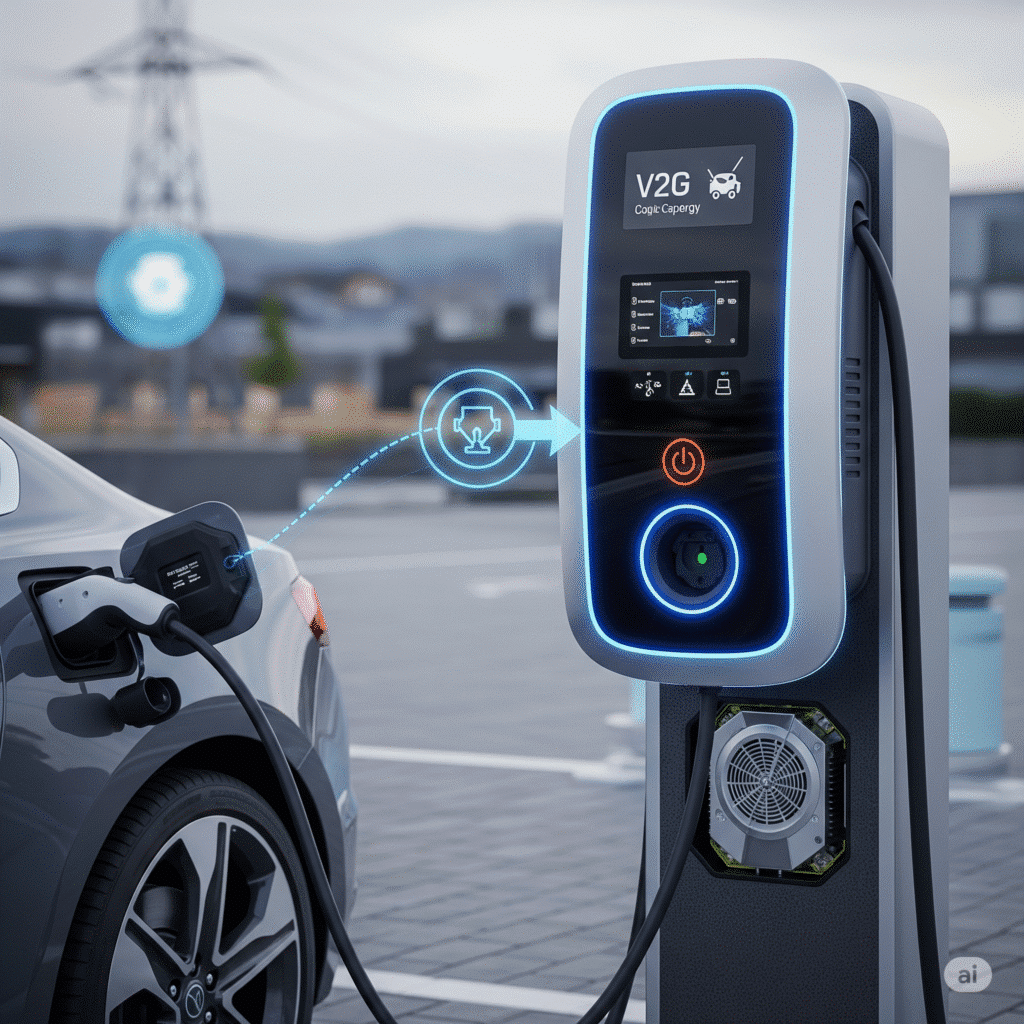
Vehicle-to-home (V2H) and vehicle-to-grid (V2G) technologies fall under the vehicle-to-everything (V2X) umbrella, and are moving from pilot programs to commercial deployment across the United States and international markets. As electric vehicle adoption accelerates, automakers, utilities, and regulators increasingly view EVs not just as transportation assets, but as distributed energy resources capable of stabilizing grids, reducing peak demand, and enhancing household resilience.
Autel Energy’s Exciting MaxiCharger DC V2X Solution
Autel Energy released its impressive intelligent bi-directional home charger, MaxiCharger DC V2X. Contact Autel if you are interested: evsolution@autel.com

Electric Vehicle Marketing Consultant, Writer and Editor. Publisher EVinfo.net.
Services