Slate Auto’s Small, Low-Cost Electric Truck May Help Solve Affordability Crisis
Slate Auto’s new electric truck is a vehicle that challenges many of the conventions surrounding car sales in the range-obsessed, high-priced U.S. market.
Slate is going all in on simplicity, to the point of austerity. The Slate is a tiny, two-door pickup that is shorter than a Honda Civic. Much of the media attention surrounding the vehicle focused on one particularly unusual feature: the base model’s windows use hand cranks, a feature that seems to have come straight out of the 20th century.
Slate is also moving away from the strategy pursued by many other EV manufacturers, which involves competing directly with gasoline-powered vehicles on range. The truck uses a relatively small 65-kWh lithium iron phosphate battery and offers a quoted maximum range of just 205 miles. For comparison, most EVs can travel 283-300 miles on a charge.
By accepting shorter range and eliminating many of the features Americans have come to expect from new vehicles, Slate can offer its base truck for less than $25,000. Customers can still customize their vehicles with optional features such as a Bluetooth stereo system and power windows. A kit to convert the truck to an SUV is available.
Even with those additions, the final price will likely remain well below the roughly $50,000 average price of a new vehicle in the U.S.
Slate’s vehicles feature injection-molded composite exterior panels and extensive do-it-yourself customization options. The company also eliminated traditional automotive paint. The exterior panels are designed to be wrapped with vinyl film, removing the need for an expensive paint shop.
For repair services, Slate partnered with RepairPal, an automotive service platform that connects vehicle owners with trusted repair shops across the United States.
Like Tesla and Rivian, Slate will sell directly to consumers instead of using traditional franchised dealerships. Slate says its truck will be “the most DIY-able vehicle ever.” Whether you just need a quick primer or want to go deep into manuals, Slate University will have content for every comfort level and learning style.
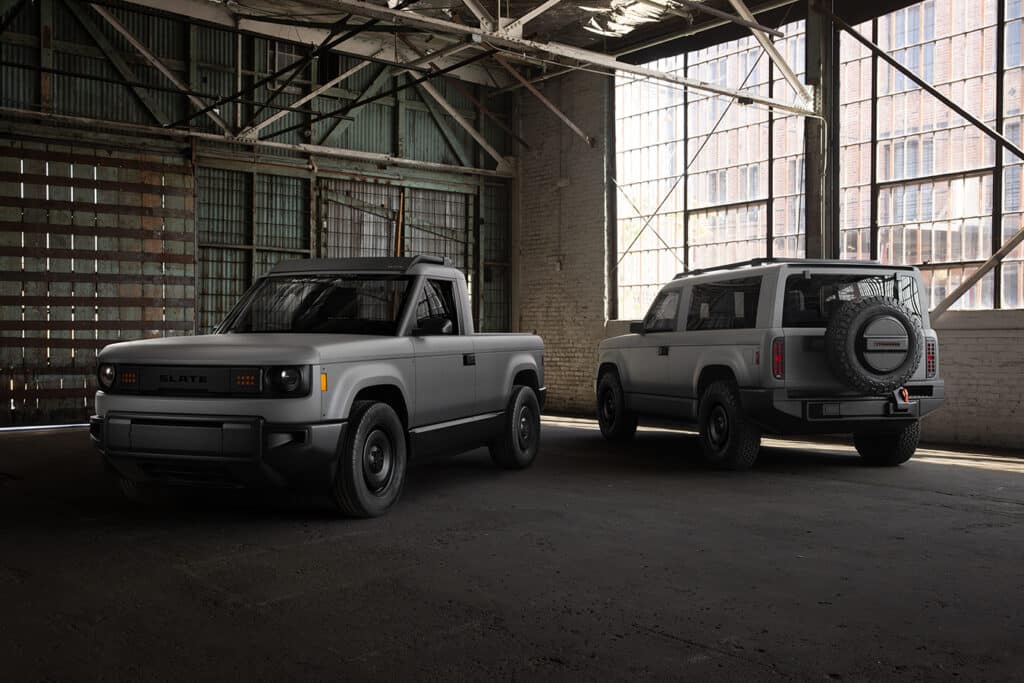
Going small and simple might seem like an unusual strategy in an American market that increasingly favors larger vehicles, but the conventional approach has not exactly been working for EV manufacturers.
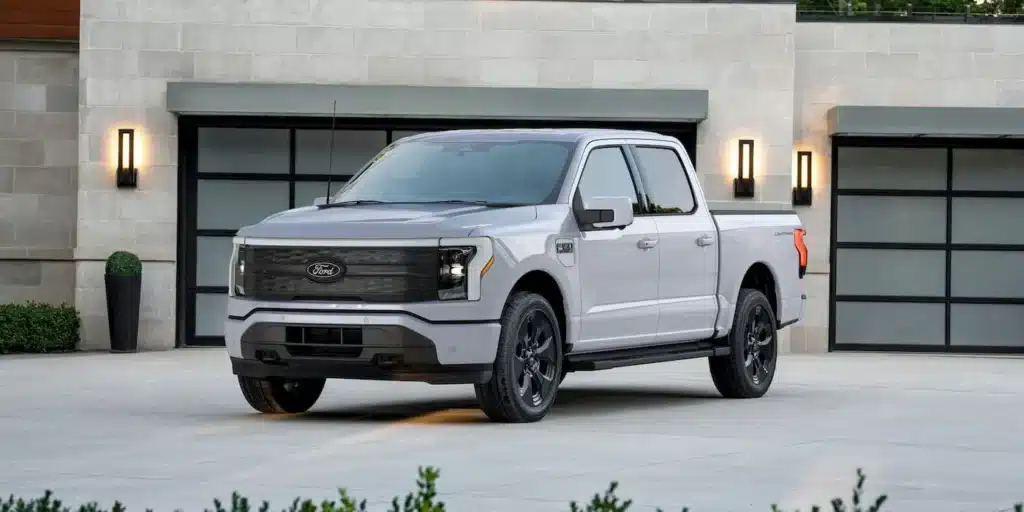
A few years ago, the Ford F-150 Lightning was supposed to serve as a flagship for American automotive electrification. Ford introduced the electric pickup in 2021 as an EV version of the country’s best-selling vehicle.
Ford discontinued the F-150 Lightning in December 2025, only four years after its introduction. The truck’s struggles were not entirely its own fault. The current federal administration cut tax credits and other forms of support designed to encourage EV adoption.
The Lightning also faced significant price increases. The base model cost roughly $40,000 when deliveries began in 2022. By its final year, prices exceeded $54,000. One factor contributing to the higher price was the truck’s enormous battery. Reaching nearly 300 miles of range required a battery with roughly twice the capacity of Slate’s 65-kWh pack.
The industry’s obsession with range may also be less justified than many consumers believe. Americans have historically prioritized vehicles capable of covering long distances, but the average driver puts fewer than 35 miles on their vehicle each day. Nearly 90% of personal-vehicle trips cover 20 miles or less.
EV drivers show a similar pattern. One study found that people typically use less than 20% of their EV’s available range during an average day.
The idea that drivers need considerably less range than they think they do could become more appealing as affordability becomes a larger concern. Americans often buy vehicles based on the occasional longest road trip rather than their everyday driving needs.
Americans are focusing on lower vehicle prices and the long-term savings that EVs provide, more now than ever before, as the affordability crisis worsens.
The President promised to cut utility bills in half within 18 months of taking office. Instead, average U.S. residential electricity rates increased by more than 9% during his first year and were 16% higher by May 2026.
An analysis by the Natural Resources Defense Council (NRDC) found that rather than reducing energy costs for American households, the current administration’s energy policies are driving costs higher for most families while benefiting fossil fuel companies.
The policies will lead to significantly higher household energy bills, the loss of clean energy jobs and economic investment in states, and greater health-care costs resulting from increased air pollution. The resulting pollution contributes to more hospital visits and premature deaths, adding further costs for American households and communities.
An inexpensive vehicle that eliminates the need to visit a gas station is therefore becoming an increasingly attractive proposition, particularly for consumers who primarily drive short daily distances.
Affordable EVs have already attracted large numbers of buyers in other parts of the world, even when those vehicles offer less range than their American counterparts. China currently has more than 40 million EVs and plug-in hybrids on the road, and roughly half of new vehicles sold there are electric.
The average new EV sold in China during 2025 offered just 247 miles of range. In the U.S., the average was 329 miles. Europe fell between the two markets at 281 miles.
Slate plans to begin delivering vehicles to customers who placed preorders in late 2026. Its factory will have an initial production capacity of 100,000 vehicles per year, with that figure expected to increase to 150,000 shortly afterward. Thousands of customers already placed preorders, according to the company.
Investors are also putting substantial money behind Slate’s strategy. The company raised nearly $1.4 billion through three major funding rounds.
Ford is also preparing to return to the small electric truck market. The automaker is developing the Fathom, a small electric truck expected to debut in 2027 with a retail price of around $30,000.
The central question for Slate is whether American drivers will accept a smaller, simpler vehicle with less range in exchange for a dramatically lower price. After years of automakers adding size, features and battery capacity to new vehicles, Slate is taking the opposite approach.
The company’s bet is that many drivers do not need a 300-mile-plus range, a massive battery or a long list of expensive features. If enough consumers agree, Slate could demonstrate that making EVs more affordable may be more important than making them bigger and longer-range.
EVinfo.net’s Take: Low-Cost EVs Needed Now More Than Ever, as Americans Continue to Struggle Financially
Slate’s imminent release could not come at a better time, as Americans are experiencing a massive affordability crisis. It’s low sticker price will be very appealing, and more buyers are realizing that EVs typically offer far more long-term savings than gas vehicles.
According to the NRDC, the administration’s efforts to slow renewable energy development and promote fossil fuels could significantly increase costs for American households while undermining investment in the U.S. power system. By 2035, consumers could spend up to $30 billion more each year on electricity, with household electricity bills rising by as much as 25% in some parts of the country. The policies could also result in as much as $700 billion in lost investment in the U.S. power system over the next decade.
The shift away from wind, solar, and energy storage could eliminate 390 to 540 gigawatts of planned new capacity, forcing the grid to rely longer on older and more expensive coal, natural gas, and oil plants as electricity demand grows. NRDC also estimates that increased air pollution could contribute to as many as 69,000 additional premature deaths and 85,000 additional emergency room visits and hospital admissions, potentially increasing health-care spending by up to $1.7 billion annually.
At the same time, power-sector carbon dioxide emissions could be twice as high by 2035, with the United States producing an additional 3.6 to 5.5 billion metric tons of greenhouse gas emissions across the economy over the next decade, worsening global human caused climate change, as people around the world suffer record high temperatures from global warming.

Electric Vehicle Marketing Consultant, Writer and Editor. Publisher EVinfo.net.
Services