Subaru Spent Big on Marketing Its New EVs, Why Is It Not Working?
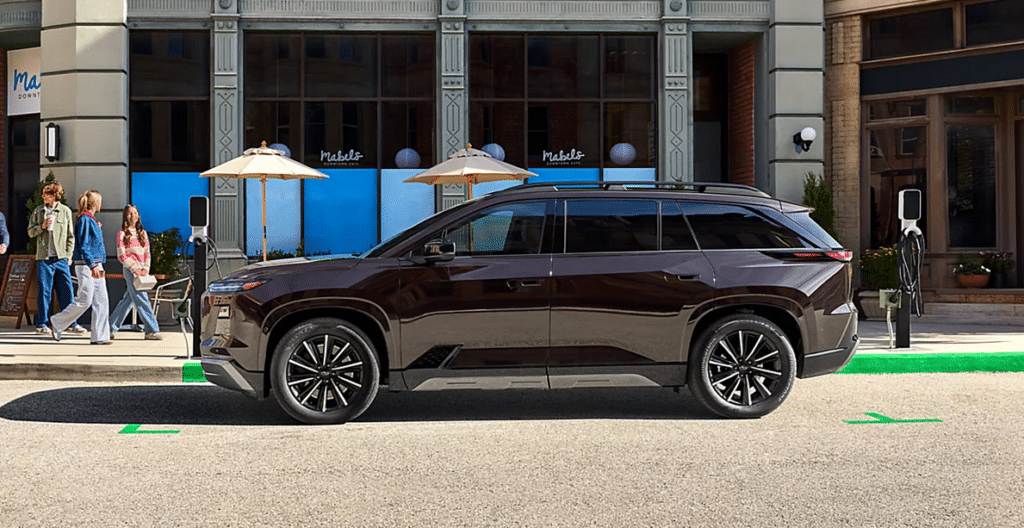
During the April through June quarter, Subaru spent roughly three times as much to promote its electric vehicle (EV) lineup, consisting of the Solterra, Uncharted and Trailseeker, compared with its gas-powered vehicles. Despite the additional spending, EV sales have so far fallen short of expectations.
Subaru now has three EVs in its U.S. lineup, three times as many as it had a year ago. That is good news for Subaru fans who have been waiting for more electric vehicles wearing the brand’s badge. However, bringing those new models to market is proving expensive, particularly when it comes to incentives and other marketing expenses.
According to Motor Intelligence data cited by Automotive News, Subaru spent an average of $9,650 in incentives for every Solterra sold between April and June. The automaker spent $9,155 for each Uncharted and $8,982 for every Trailseeker. Motor Intelligence said the marketing promotions it tracks include manufacturer incentives such as rebates and discounted financing.
The difference is substantial compared with Subaru’s gasoline-powered models. Incentive spending for the Outback, the company’s third-best-selling model in the U.S., averaged $3,036 per vehicle during the same period.
The additional spending has contributed to a significant decline in Subaru’s profitability. Operating profit fell 44% during the first fiscal quarter, which ended June 30, dropping from $472 million a year earlier to $263.2 million this year.
EV sales have also been challenging. U.S. Solterra sales declined 21% during the first half of the year, while the newer Uncharted and Trailseeker each recorded roughly 2,500 sales through the end of June.
Overall, Subaru sold 10,064 EVs in the U.S. from January through June, a relatively small portion of its 307,340 total vehicle sales. The Forester remained the brand’s best-selling model with more than 100,000 sales, followed by the Crosstrek with 87,623 units. Subaru’s overall U.S. sales declined 4.5% compared with the first half of 2025.
The unusually high level of EV incentives is not typical for Subaru, which has historically maintained a disciplined approach to spending. However, the additional support was likely necessary to help maintain sales after the $7,500 federal EV tax credit was eliminated last year.
Subaru’s EV strategy is facing additional challenges. In May, the automaker announced a $362 million impairment charge related to slowing EV demand. Subaru has also delayed production of its independently developed EV in Japan, which had been scheduled to begin production at the company’s new Oizumi plant.
EVinfo.net’s Take: Why Subaru’s EV Marketing Isn’t Working, the Market Is Changing
Subaru’s heavy spending on EV incentives highlights a larger problem: EV marketing is not keeping pace with how quickly the market is changing. Far too often, EV ads don’t address kitchen table issues like affordability, which is a priority for Americans as the economy declines, while gas prices and inflation skyrocket.
The U.S. economy unexpectedly lost 23,000 jobs in July, and the labor force participation rate fell further to 61.4%, its lowest in more than five years.
ABC News reported on August 7 that Americans are deeply negative on the economy with nearly 8 in 10 Americans rating the economy poorly.
The sudden and poorly timed elimination of the federal EV tax credit cost automakers billions of dollars, disrupted sales and damaged consumer confidence. Many drivers still do not realize that adopting an EV is easier than it has ever been.
The fundamentals increasingly favor electric vehicles. As gas prices continue to rise, the cost savings of driving an EV become more attractive.
Public charging infrastructure is expanding rapidly across the U.S., while EV prices are coming down. Affordable models such as the Chevy Bolt, Nissan Leaf, and upcoming Slate and $28,350 Ford Fathom are helping bring electric transportation to more mainstream buyers. The International Council on Clean Transportation (ICCT) reported on July 28, 2026, that the full picture on EV affordability is better than most consumers realize.
At the same time, newer EVs are offering longer ranges and faster charging, addressing two of the biggest concerns potential buyers have had.
The used EV market is also booming, giving consumers more affordable ways to go electric. New EV sales are beginning to recover after the federal credit was foolishly cut, while smart states such as California are introducing EV incentives to help fill the gap.
Growing hybrid sales are also making consumers more familiar with electrification. Meanwhile, misinformation about EV fires, battery longevity and other supposed drawbacks is increasingly being debunked by real-world data and experience.
Buyers are learning that the wait time to charge an EV at a public station isn’t a problem, when combined with meals or shopping, described in the industry as “dwell time.” Road trips, which have been a problem in the past, are now easier than ever before in most parts of the country, with proper planning.
Subaru and other automakers therefore have an opportunity to do more than offer expensive incentives. They need to explain the current EV ownership experience and show consumers that electric vehicles are becoming more affordable, practical and convenient. The EV market has changed significantly, but many consumers have not yet caught up, due in part to bad marketing. EVinfo.net was created to change that.

Electric Vehicle Marketing Consultant, Writer and Editor. Publisher EVinfo.net.
Services