U.S. Federal Investment of $3 Billion in Minerals Projects for Defense Will Strengthen EV Industry
The U.S. government plans to invest $3 billion in critical minerals and battery projects to increase domestic production and strengthen national security, CNBC reported on August 8, 2026. The funding includes a $1.4 billion conditional Defense Department loan for Sila Nanotechnologies, which makes lithium-ion battery components, along with $400 million for scandium miner Sunrise Energy Metals and $150 million for magnet developer Niron Magnetics.
EVinfo.net reported recently that Sila, a U.S.-based battery materials startup, announced that it has secured $300 million in new funding to expand its manufacturing facility in Moses Lake, Washington. The expansion will significantly increase production of the company’s silicon-carbon anode material, enough to supply batteries for more than 100,000 electric vehicles annually.
The $3 billion in funding matters for the EV industry because critical minerals are essential not only to batteries and automobiles, but also to weapons systems. The administration wants to reduce U.S. dependence on Chinese supply chains while expanding domestic mining, processing and manufacturing.
Washington is also investing in the workforce needed to support the mining industry. The Department of Energy announced $100 million in grants for U.S. mining schools, while the Pentagon plans another $80 million for projects at three schools. The administration has also launched a $12 billion strategic minerals stockpile and backed investments in domestic mines and processing facilities.
The result is a different kind of federal EV strategy. Rather than directly promoting EV adoption, the administration is investing in the American industrial base that makes EVs possible. That could mean less government support for consumers and charging infrastructure, but greater support for the mines, minerals, batteries and manufacturing capacity needed to build electric vehicles in the United States.

EVinfo.net’s Take: The Government Can’t Kill EVs Without Undermining National Security
The idea that the U.S. government can simply “kill” electric vehicles is becoming increasingly difficult to reconcile with another national priority: military readiness. Electrification is no longer just a consumer technology or climate policy. It is becoming part of the modern military’s technology and energy strategy.
Capable military leaders understand that electrification can provide important advantages on the battlefield. Electric vehicles can operate more quietly than conventional vehicles, reducing their acoustic signature and potentially making them harder to detect. They also have fewer moving parts, which can simplify maintenance and reduce some logistical requirements. Most importantly, electricity can be generated locally from multiple sources, potentially reducing dependence on vulnerable fuel supply lines.
The same logic increasingly applies to drones. Electric-powered unmanned aircraft are already an important part of modern military operations because electric propulsion can provide quiet operation, efficient power delivery and relatively simple mechanical systems. As battery energy density improves, electrification becomes increasingly useful for surveillance, reconnaissance, logistics and other missions.
This creates an interesting contradiction in U.S. energy policy. The federal government can eliminate incentives for consumers to purchase EVs or scale back support for public charging infrastructure, but it cannot easily dismiss the technologies themselves when the Department of Defense and the broader national-security establishment see strategic value in electrification.
The connection goes even deeper. The minerals and manufacturing capacity required for batteries, electric motors and power electronics in electric cars and trucks are also increasingly important to defense.
That means the United States is effectively pursuing two EV policies at once. It can discourage civilian EV adoption while simultaneously investing in the industrial base that makes electrification possible. Critical minerals support everything from batteries and automobiles to advanced weapons systems.
The government may change the incentives surrounding EVs, but it cannot simply turn back technological progress. Military planners are already evaluating how electrification can improve capabilities, resilience and energy security.
The bigger national-security question may therefore not be whether America should electrify, but whether it can afford to fall behind countries that are rapidly developing electric vehicles, batteries, drones and the supply chains supporting them.
Finally, the $3 billion in critical minerals and battery projects is one wise move from the administration out of a multitude of mistakes. Now, if it could just stop foolishly attacking cost-saving renewable energy projects.
Obstructing Clean Energy Raises Consumer Costs
The U.S. is facing rising electricity prices, growing electricity demand and more weather-related power outages from global human-caused climate change. The administration’s policies are making the situation worse by restricting the development of affordable, domestic clean energy just as the country desperately needs more electricity.
According to the cited EDF and Atlas Public Policy research, 21 GW of clean-energy projects have been canceled, equivalent to roughly 10 Hoover Dams of generating capacity. Wind and solar remain among the cheapest and fastest ways to add electricity, while natural gas plants have become more expensive to build and face turbine shortages.
Coal is both expensive and highly polluting, yet the administration foolishly announced up to $850 million in funding to support coal power in June 2026.
Limiting inexpensive clean power while relying more heavily on polluting fossil fuels drives up electricity costs while worsening environmental impacts and human health, while reducing national security.
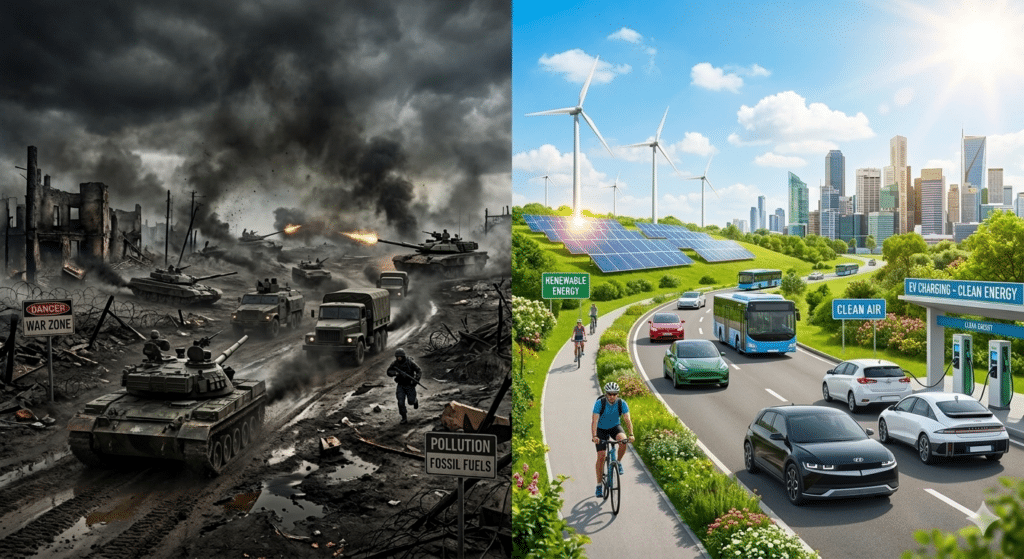
EVs and Renewable Energy Enhance National Security During Geopolitical Conflicts
EVs and renewable energy are important not only for environmental and economic reasons, but also for national security. Geopolitical conflicts can disrupt oil supplies and cause major fuel-price shocks, leaving countries dependent on foreign energy vulnerable. Electrifying transportation with domestically generated electricity, particularly from solar, wind and hydro, can reduce that dependence.
Unlike gasoline, which depends on vulnerable transportation and global supply chains, electricity can be generated locally and distributed through a more decentralized system. Combining renewable generation with battery storage and V2G technology could make communities and critical infrastructure more resilient during emergencies. EVs equipped with bidirectional charging could even provide backup power to homes, hospitals and first responders.
Reducing fossil-fuel dependence strengthens national security. Money spent on domestic electricity and renewable energy stays within the local economy while supporting energy production, jobs and infrastructure. Policies reducing EV and renewable-energy adoption increase America’s vulnerability to geopolitical conflicts, fuel shortages and energy-price volatility.

Electric Vehicle Marketing Consultant, Writer and Editor. Publisher EVinfo.net.
Services