The Iran War Is Supercharging the Global EV Revolution
The electric vehicle industry got its biggest unexpected marketing campaign and it didn’t come from a car company. It came from a war.
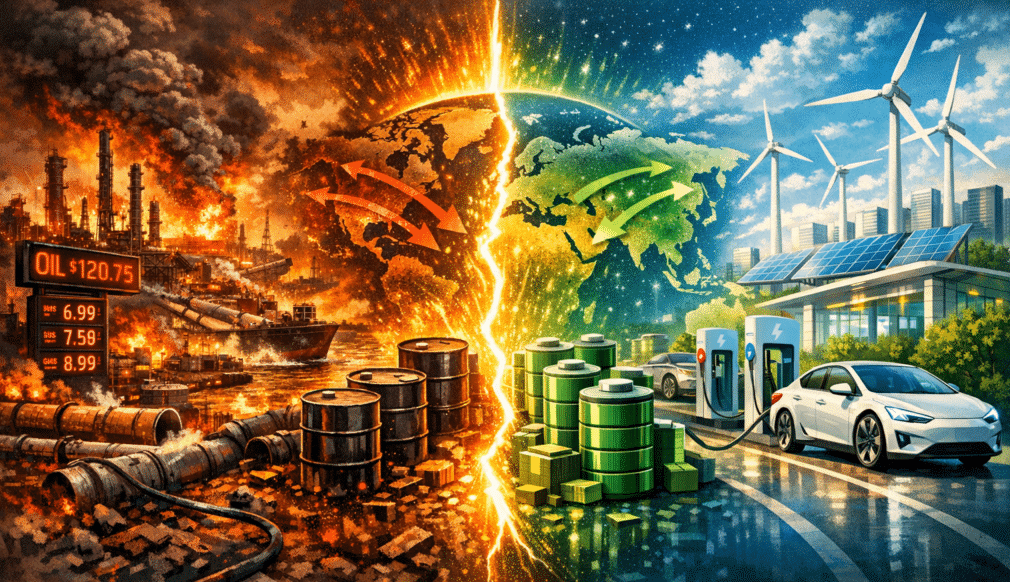
Since the U.S.-Israeli military campaign against Iran began in late February 2026, the Strait of Hormuz, the narrow waterway through which roughly 20% of the world’s traded petroleum flows on any given day, has been effectively shut down to oil tanker traffic. The consequences hit drivers almost immediately. Gas prices in the U.S. climbed 20 percent after the initial bombing campaign, reaching $4.29 a gallon, the highest level in nearly three years. In Europe, average petrol costs rose to more than 2 euros per litre in some countries. And just like that, millions of drivers started seriously thinking about going electric.
A two-week ceasefire was announced this week, but it is unclear if that will last.
The $4-a-Gallon Tipping Point
There’s a number that car dealers know well: $4 a gallon. Steven Cegelka, head of Ignition Dealer Services, a consultancy for car dealers, told Bloomberg that at around $4 a gallon, car shoppers start flocking to electric cars. That threshold has now been crossed and the data is reflecting it fast.
Morgan Stanley estimates that with gas at around $4 per gallon, it’s 60% cheaper to power an electric vehicle than a traditional gas-powered car. For high-mileage drivers, that math is impossible to ignore. Michael Prichinello, co-founder of Manhattan’s Classic Car Club and a self-described petrol-head, is now shopping “begrudgingly” for an electric pickup truck because his gas bill has stretched to $50 a day.
A Global Phenomenon
The surge in EV interest isn’t just an American story. It’s playing out on every continent.
In the UK, electric car sales reached a record high, with 86,120 vehicles sold in March, and EV leasing inquiries at Octopus Electric Vehicles rose 36% since the start of the conflict. In Germany, the share of EV searches on mobile.de tripled from 12% to 36%, with car dealers receiving 66% more inquiries. UK Autotrader saw a 28% jump in EV inquiries compared to February, while used EV inquiries were up 15%. Used EVs are now taking 19.5% of all used car inquiries, the highest share on record, with new daily records being set.
In France, used-car retailer Aramisauto reported its share of EV sales nearly doubled between mid-February and early March.
Asia is feeling the pinch acutely. Asia receives 80% of the crude oil that passes through the Strait of Hormuz, leaving the region hard-hit. South Korea reported that EV registrations more than doubled in March compared to the prior year.
In Australia, Prime Minister Anthony Albanese put it plainly: “I don’t think there’s anyone out there today who has bought an electric vehicle who’s regretting the decision at this point in time.” On March 26, 2026, Energy Terminal reported that fuel shortages across Australia are intensifying due to the war in Iran, with more than 500 service stations now out of at least one type of fuel and dozens having run completely dry.
On March 21, 2026, the Australian Broadcasting Corporation (ABC) reported that The Iran war and the blockade of the Strait of Hormuz have sent fuel prices skyrocketing. Australians are feeling it acutely, and many are responding by taking a serious look at electric vehicles for the first time.
Robert Khanal, Business Manager at Eagers Automotive Limited, commented on a wave of EV buyers descending on his dealership in Canberra, Australian Capital Territory, Australia, reporting a three-fold increase.
Khanal said: “I haven’t seen anything like this in years. People are walking into EV showrooms and buying cars the way they bought toilet paper during COVID. No exaggeration, sales are up nearly 3x and the momentum is unreal. This isn’t just about cars anymore, it’s rising fuel costs, smarter long-term decisions, and a clear shift in mindset. A year ago customers asked, “Are EVs worth it?” Today they’re asking, “Which one can I get and how soon?” We’re not approaching the EV wave, we’re in it. The switch isn’t coming… it’s already here.”
High Fuel Prices Are Here to Stay
The conflict has already caused serious, lasting damage to Middle Eastern energy infrastructure. Some analysts warn it could take years for oil supplies from the region to come back online, meaning the era of cheap gas is unlikely to return anytime soon.
The Center for American Progress, an independent nonpartisan policy institute, reported that global supply chains will still be reeling for months from the conflict and its upheaval to oil and gas production, despite this week’s ceasefire. Some consequences of the war, such as a higher baseline level of risk in the Persian Gulf region, will likely persist even if traffic again flows through the Strait of Hormuz and oil production comes back online. This will result in higher costs for shipping, fuel, and other commodities.
That changes the calculus for car buyers in a fundamental way. In past fuel spikes, drivers could reasonably hope to wait things out. This time, there may be nothing to wait for. Every month that prices stay elevated is another month that the EV math becomes harder to argue with, and another month that more buyers cross the threshold from curious to committed.
The World’s EV Fleet Is Already Cushioning the Blow
Here’s something remarkable: the global EV fleet is already softening the economic damage of the Hormuz closure. Last year, EVs worldwide avoided the consumption of 1.7 million barrels of oil per day, roughly 70% of the 2.4 million barrels Iran exported daily through the Strait of Hormuz in 2025. Countries with higher EV adoption are genuinely less exposed to this crisis than they would have been a decade ago.
“Oil is a particularly tricky resource to replace,” Daan Walter, a researcher at Ember, told Fortune. “It has been for 125 years now, except for the past five or six years, when we’ve had this new competitive lever in electric vehicles.”
Walter said to Fortune: “We’re no longer living in a world of risk-free fossil fuels. We’re living in a world where everything is risky, and it now becomes a question of which risks do you want to take.”
Because regulators set residential electricity prices annually, most EV owners are sheltered from month-to-month swings in natural gas costs, giving them a stability that gas-car owners simply don’t have. As one EV driver in Detroit noted: “Electricity can go up, but it won’t go up nearly as much as gas will and it won’t go up nearly as fast, either.”
EVinfo.net’s Take: This War Must End
This war must end. The President never had the authority to start this war, that is the responsibility of Congress. None of the stated goals were achieved. There was never a clear plan or goals. America is weaker as a result of this war. I grieve for all the people who died, and are suffering because of this war. All Americans will suffer financially because of this unnecessary war, along with many other people around the world.
There Are Real Headwinds to EV Adoption, But the Trend Is Clear
It’s not all smooth road ahead. The US administration has rolled back federal EV tax credits, cut funding to expand EV charging networks, and challenged state emissions standards. Perhaps most significant is the proposal to remove or weaken the Environmental Protection Agency’s endangerment finding. These actions will increase pollution, making Americans sicker. These mistakes will also make global human caused climate change worse.
Gas drivers will pay more, and America will be less secure. EVs and renewable energy are the strongest tools any nation has for protecting its economy, strengthening its defenses, and ensuring its energy future remains in its own hands.
America’s automotive industry and jobs have been hurt by these actions, losing billions of dollars, while China’s automotive industry has benefitted from these actions. The massive bill for the Big Three’s EV losses was $52.1 billion, Yahoo Finance reported in February.

These actions make zero sense, as one of the federal government’s own DOE webpages says: “All forms of electric vehicles (EVs) can help improve fuel economy, lower fuel costs, and reduce air quality impacts. Using electricity as a power source for transportation improves public health and the environment, and provides safety benefits, and contributes to a secure transportation system.”
It’s really ironic that the US President’s war of choice is harming the administration’s anti-EV efforts.
The Argument for Going Electric Has Never Been Better
Affordability remains a barrier, and some drivers may simply absorb higher fuel prices rather than replace their vehicle, especially given higher borrowing costs and sticker prices.
Analysts are also careful to note that this is an incremental shift, not an overnight revolution. Elevated oil prices and the renewed focus on energy security are “likely to provide a mid-term boost to BEV demand,” but this is “best understood as an incremental shift rather than a sudden market-wide acceleration,” according to industry analyst Michulski.
Still, there is historical precedent for what sustained high prices can do. After Russia invaded Ukraine in 2022, gas prices in the U.S. rose above $5 a gallon and sales of battery-powered vehicles rose 66% that year.
The Iran War didn’t create the EV revolution, but it has pressed the accelerator. Whether you’re a climate advocate, an energy security hawk, or simply someone furious about filling up your tank, the argument for going electric has never been more compelling.
The charging infrastructure still needs to grow, prices still need to come down, and the politics remain complicated. But every time a driver swaps a gas station for a charging port, the world becomes slightly less dependent on the fragile fossil fuel trade routes that are once again dominating the headlines. That driver switching from gas to EV also saves money and the environment at the same time.
The future isn’t waiting for a peace deal. It’s already plugging in. More EVs mean less war, cleaner air and lower costs. There’s no better time than now to go EV.

Electric Vehicle Marketing Consultant, Writer and Editor. Publisher EVinfo.net.
Services