Seattle Joins Blue Dot Motorworks’ Plug-in Hybrid Conversion Pilot, Saving on Rising Fuel Costs
The City of Seattle is joining an upcoming pilot program to test the Narwhal Plug-in Hybrid Conversion Kit from Blue Dot Motorworks on municipal fleet trucks. Announced by Blue Dot Motorworks CEO and founder Tom Gurski on November 3, 2026, the partnership represents another approach to reducing fleet emissions without requiring cities to immediately replace their existing vehicles with new electric trucks.
Seattle has an aggressive decarbonization program, but the transition to electric fleets presents challenges, including vehicle costs, limited availability, charging infrastructure expenses, and installation timelines. These obstacles are shared by municipalities across the country looking to reduce transportation emissions while managing public budgets and maintaining reliable fleet operations.
Blue Dot Motorworks says its Narwhal plug-in hybrid conversion technology is designed to address these challenges by converting existing vehicles rather than requiring complete fleet replacement. According to Gurski, the system can deliver significant net savings with lower upfront costs and substantially lower charging power requirements.
Lower charging power requirements could be particularly important for municipal fleets, where installing high-capacity charging infrastructure for numerous vehicles can add considerable expense and delay electrification projects.
The Seattle pilot will provide an opportunity to evaluate the technology in real-world municipal fleet operations. If successful, the approach could offer cities another pathway toward reducing fuel consumption and emissions while extending the usefulness of existing fleet vehicles.
For municipalities facing budget constraints and infrastructure limitations, plug-in hybrid conversions could become a practical option for advancing fleet decarbonization without waiting for affordable electric replacements and extensive charging infrastructure.
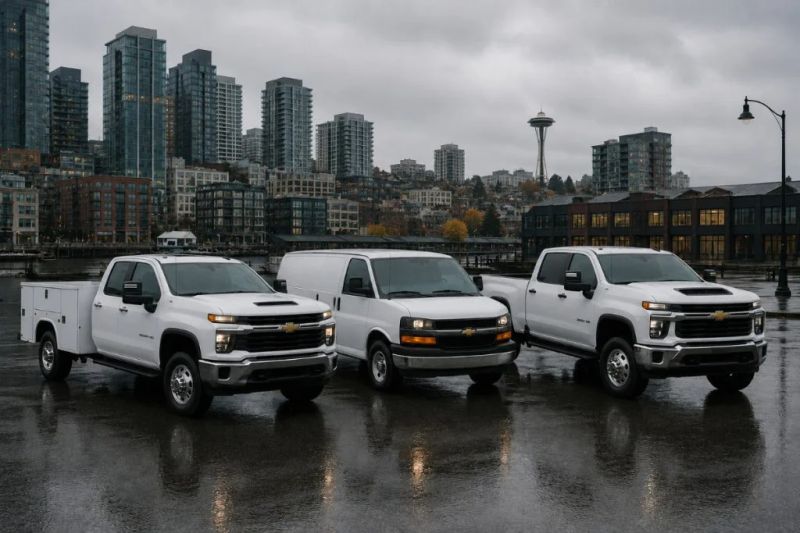
Blue Dot Motorworks Develops Plug-In Hybrid Conversion Technology to Accelerate Vehicle Electrification
Electrifying the existing vehicle fleet is an important part of reducing transportation emissions. While new battery-electric vehicles are essential to the transition, replacing hundreds of millions of gasoline and diesel vehicles will take decades. Seattle-based Blue Dot Motorworks is pursuing another approach: converting existing vehicles into plug-in hybrids.
The company develops retrofit plug-in hybrid systems designed to reduce fuel consumption, emissions, and the cost of transitioning to cleaner transportation. Its Narwhal and Humpback conversion systems aim to make electrification more accessible without requiring consumers, businesses, or fleet operators to purchase entirely new vehicles.
Blue Dot Motorworks argues that scrapping functional vehicles and manufacturing replacements creates additional environmental and financial costs. Retrofitting existing vehicles instead preserves their remaining useful life while introducing electric driving capability.
The company’s approach also addresses several challenges associated with widespread battery-electric vehicle adoption. According to Blue Dot Motorworks, its plug-in hybrid systems use batteries approximately 80% smaller than those in typical electric vehicles, reducing battery production requirements. The company also highlights the ability to charge its conversions using a standard electrical outlet, potentially reducing dependence on expensive, high-powered charging infrastructure.
Blue Dot Motorworks believes retrofit technology can complement battery-electric vehicles by reducing emissions from the enormous number of conventional vehicles that will remain on roads for decades. Rather than relying exclusively on new vehicle production, the company sees conversions as a scalable way to accelerate transportation decarbonization.

EVinfo.net spoke with Paul Nicholson, Head of Revenue at Blue Dot. He said:
“We’ve heard from quite a few groups who are now on our waiting list: They may actually use our technology on brand-new vehicles, not just converting existing fleets. In many cases, the types of trucks they need are simply not available as an EV at all (like those that need certain service body configurations), those with occasional heavy towing requirements, and emergency service and first responder vehicles that can’t be converted to a pure EV because they need to be able to operate during extended blackouts.”
“In all three cases, we offer a path to decarbonize and lower operating costs, even when new vehicles are being purchased (not just converting old vehicles). In those latter two cases, our solution lets those vehicles operate in EV mode most of the time, but fall back to ICE engines when more horsepower or non-electrified operation is required,” continued Nicholson.
For EV adoption, the broader opportunity is significant. Electrifying transportation does not have to mean replacing every gasoline and diesel vehicle with a new EV. Converting existing vehicles into plug-in hybrids could provide another pathway to lower emissions, reduce operating costs, and accelerate the transition to electric mobility.
More information: Blue Dot Motorworks.

Electric Vehicle Marketing Consultant, Writer and Editor. Publisher EVinfo.net.
Services