More Gas Stations Are Opting to Own and Operate EV Chargers
The federal EV tax credit ends within a few days of this writing, on September 30, 2025. Even with the phaseout of federal EV tax credits, adoption in the United States is expected to continue climbing. Automakers are scaling up production, battery costs are declining, and new models are arriving across nearly every vehicle segment, giving consumers more choices at lower price points. At the same time, states like California, New York, and Washington are maintaining strong EV industry support, while utilities and charging providers are rapidly expanding infrastructure to make EV ownership more practical. These structural shifts mean that while the loss of tax credits may affect short-term affordability, the overall trajectory of EV adoption remains upward.
Consumer demand is also being driven by factors that extend beyond incentives. Rising fuel prices, heightened awareness of climate issues, and the appeal of quieter, lower-maintenance electric vehicles are pushing buyers toward EVs regardless of federal subsidies. Fleet operators, from delivery services to school districts, are also electrifying to cut long-term costs and meet sustainability targets, further normalizing EVs on American roads. Together, these forces suggest that the U.S. market has reached a tipping point where adoption momentum is strong enough to withstand the loss of federal purchase incentives. The U.S. market is also nearing mass EV adoption.
EV charging infrastructure in the United States continues to grow at a rapid pace, fueled by both private investment and public funding. Major retailers, utilities, and charging networks are adding thousands of new fast-charging and Level 2 stations each year, while federal and state programs provide billions in support through initiatives like the National Electric Vehicle Infrastructure (NEVI) program. This expansion is improving access in urban centers, suburban communities, and along key highway corridors, making it easier for drivers to transition to electric vehicles. As adoption rises, charging providers are focusing not only on scale but also on reliability, speed, and convenience, ensuring that EV charging becomes as seamless and dependable as fueling with gasoline.
A little over a decade ago, there were fewer than 20,000 public charging points nationwide. Today, that number has soared past 190,000, and the momentum shows no signs of slowing down. Looking ahead, projections suggest the U.S. could reach more than half a million chargers by 2030.
A Growing Number of Fuel Retailers Are Shifting Away From EV Charging Outsourcing
A growing number of U.S. fuel retailers are shifting away from outsourcing and are instead choosing to own and operate electric vehicle charging equipment at their sites. While many companies initially partnered with charging providers to handle installation, pricing, and maintenance, retailers are increasingly recognizing that taking direct control gives them more influence over customer experience, site reliability, and the revenue potential tied to charging.
Industry executives say the move is motivated by the opportunity to strengthen brand identity, ensure competitive pricing, and capture valuable foot traffic for convenience store sales. As EV adoption steadily expands, fuel retailers see the advantage of treating charging not as an add-on service but as an integrated part of their overall business model.
In the past, companies often relied on providers like ChargePoint or EVgo, who managed the complexities of grid connections, operations, and back-end systems. For a long time, this was a practical solution, particularly when the economics of EV charging were still uncertain. But with government policies, infrastructure incentives, and wider consumer adoption creating a clearer growth path, retailers are re-evaluating how much of the upside they are leaving to third parties.
Global Partners, a fuel and c-store chain that owns, operates and supplies more than 1,700 locations in the Northeast, Mid-Atlantic and Texas, began by working with outside charging operators, but is now handling more of the operations itself to ensure customers have a consistent experience.
Similarly, Love’s Travel Stops has emphasized the importance of controlling charger reliability, incorporating the assets into its own service and support framework to meet expectations of long-haul drivers. Love’s began offering company-operated chargers in 2017, and the company has more than 650 travel stops and c-stores in 42 states.
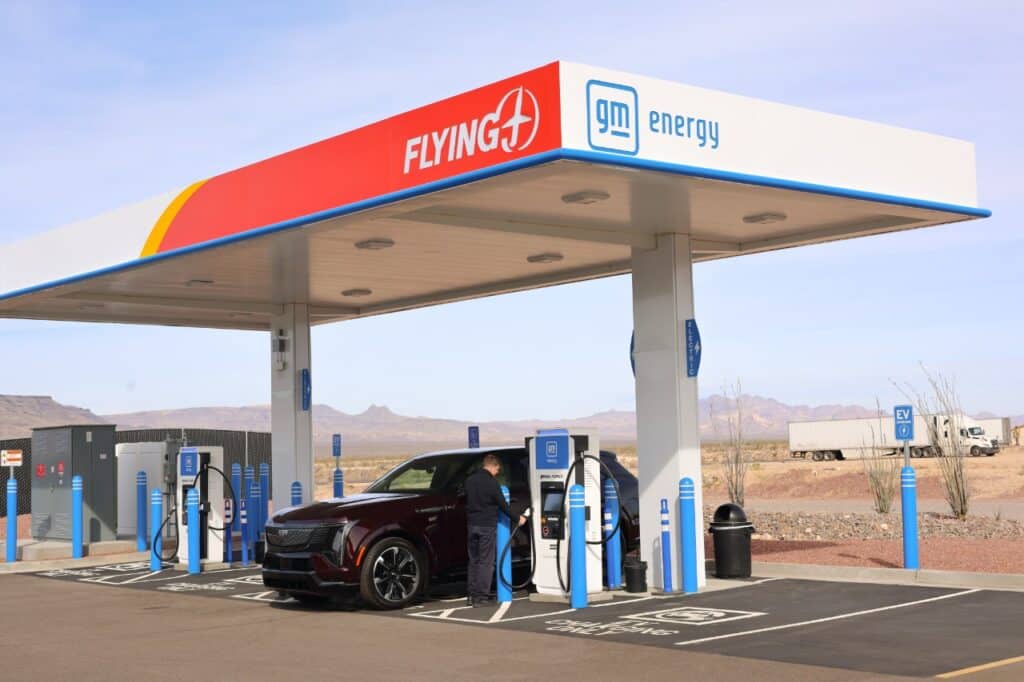
Pilot/Flying J has taken an even more aggressive approach, building out a nationwide fast-charging network at its travel centers, further embedding electrification into its future operations. Recently, Pilot Company, General Motors and EVgo announced their collaborative network now reaches more than 200 locations across nearly 40 states. In two years, the companies have worked together to bridge charging gaps by deploying nearly 850 new electric vehicle (EV) fast charging stalls across America.
Some Are Still Outsourcing
Not every large regional fuel retailer is following the strategy of Global Partners and Pilot in building and operating their own EV charging networks. Instead, chains like Wawa and Sheetz are leaning on third-party partnerships to expand their charging offerings. Wawa has teamed up with IONNA to install Ionna-branded chargers at its convenience store sites, while Sheetz announced a deal late last year to partner with Ionna on 50 fast-charging locations across the Midwest and East.
IONNA is a joint venture backed by eight global automakers, including GM, Stellantis, and Toyota, with plans to deploy more than 30,000 U.S. fast-charging points by 2030, signaling a massive expansion of nationwide charging access. The company named its locations “rechargeries.” In July, IONNA reached a milestone of more than 3,000 contracted bays with the addition of EV Rechargeries at Wawa.
Industry voices argue that retail fuel stations are a natural fit for charging infrastructure. David Failkov of NATSO, a national group representing truck stops and travel centers, said the logic is straightforward: motorists already trust and frequent these locations, whether they drive gasoline vehicles or EVs, making them well-positioned to serve as hubs for the growing charging market.
On September 1, 2025, EVinfo.net reported that NATSO, along with SIGMA: America’s Leading Fuel Marketers, and the National Association of Convenience Stores (NACS), asked the U.S. Transportation Department to amend the final National Electric Vehicle Infrastructure (NEVI) Formula Program guidance to favor their locations.
The broader trend reflects a balancing act: while third-party partnerships remain attractive for some, a growing share of retailers now view EV charging as core to their competitiveness. By bringing charging in-house, they gain greater flexibility in adjusting prices, offering loyalty programs, and ensuring uptime, all of which help draw EV drivers and boost in-store sales.
For customers, this evolution could mean more dependable charging, simpler payment systems, and stronger alignment between fueling, retail, and charging services. For the industry, it marks a pivotal shift in how fuel retailers see their role in the energy transition — moving from passive hosts of charging stations to active operators in a market that is expected to grow rapidly over the next decade.
Gas Stations With Convenience Stores Benefiting from Dwell Time
The gas stations that are installing charging the most, whether managing the charging themselves, or outsourcing, are the stations that include a convenience store. The reasoning behind this is simple, due to the significant economic advantage. These stores sell more, increasing profits, when offering EV charging and therefore attracting EV drivers, whose numbers grow daily.
One of the most overlooked advantages of EV charging is the concept of “dwell time, ”the amount of time drivers spend at a location while their vehicles are plugged in. Unlike gasoline refueling, which takes only a few minutes, EV charging naturally encourages customers to remain on-site for 20 minutes or longer, depending on the speed of the charger. For businesses, this creates a powerful opportunity to capture additional revenue, as drivers are more likely to purchase food, beverages, or retail items while they wait. Convenience stores, quick-service restaurants, and shopping centers are increasingly recognizing that EV charging isn’t just about selling electricity, it’s about extending the customer visit and creating new streams of value. So the gas stations don’t make money only from the EV charging, but also by selling the EV drivers more products.
This shift in consumer behavior is already shaping the way site hosts think about EV infrastructure. Retailers and fuel operators are designing spaces that encourage engagement, from comfortable seating areas and Wi-Fi to partnerships with well-known dining brands that appeal to customers who want to use their charging time productively. Even destinations like grocery stores, gyms, and entertainment venues benefit from longer dwell times, as charging aligns with the natural rhythm of errands and daily routines. By turning charging downtime into a positive, businesses can strengthen loyalty, increase sales, and create memorable experiences that keep drivers coming back. In this way, dwell time transforms EV charging locations from mere utility stops into dynamic centers of commerce and community.

Electric Vehicle Marketing Consultant, Writer and Editor. Publisher EVinfo.net.
Services