Ai-Driven Validation Methods Reveal a Structural EV Battery System That’s Lighter, Denser, and Faster to Validate
Scientists in Germany have accelerated the development of structural EV battery systems by combining advanced engineering with AI-driven validation tools.
Researchers from the Chair of Production Engineering of E-Mobility Components (PEM) at RWTH Aachen University recently completed the PEAk-Bat research project after three and a half years of intensive testing. Funded by the German Federal Ministry for Economic Affairs and Energy (BWME), the project aimed to shorten EV battery development timelines, refine structural system designs, and inch them closer to commercialization. It also demonstrated how artificial intelligence, digital simulation, and redesigned battery-vehicle integration can reduce development cycles, lower costs, and improve energy density.
“The time saved on testing allows for faster development of innovative battery systems and, as a result, earlier market launch,” said Heiner Heimes, PhD, mechanical engineering professor and PEM management member.
Structural integration boosts efficiency
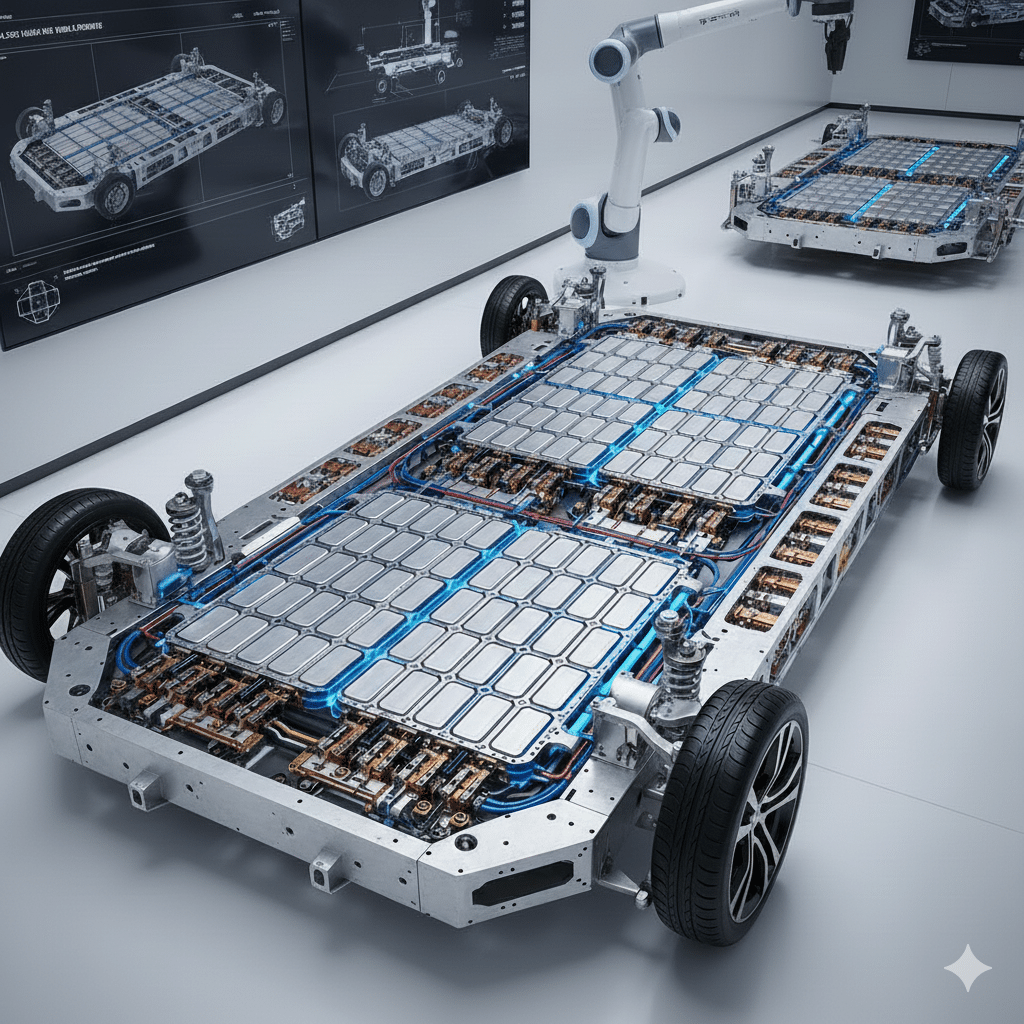
Instead of treating the battery as a standalone component within the vehicle frame, PEM researchers adopted a module-to-chassis approach that integrates the battery directly into the vehicle’s structure. This design increased volumetric energy density by more than 10% and gravimetric energy density by more than 15%. To evaluate the concept, RWTH Aachen University and partners—including Ford, Trumpf, TÜV Rheinland, and Magna—built 10 vehicle bodies with embedded structural battery systems. TÜV Rheinland and Magna conducted rigorous testing using both physical measurements and digital simulations validated through real-world trials.
AI-driven validation speeds development
A major achievement of the project was its use of AI and advanced digital models to assess safety, structural strength, and thermal behavior early in the development cycle. By validating these models against physical tests, the team reduced the number of costly, time-intensive real-world experiments required. According to PEM director Achim Kampker, PhD, AI-enabled early validation helps identify problems sooner, minimize prototype costs, and accelerate development. Chief engineer Christian Offermanns, PhD, noted that shorter test times make faster market entry possible.
The consortium also published a new framework—Methodology for Analyzing Changes to Battery Systems and Evaluating the Resulting Testing Requirements—to guide safety assessments and testing needs across the industry.
Researchers believe the project’s gains in energy density and reduced development timelines could help automakers bring next-generation EV technologies to consumers more quickly.