Innovative Sun-Tracking Solar EV Charging Comes to California
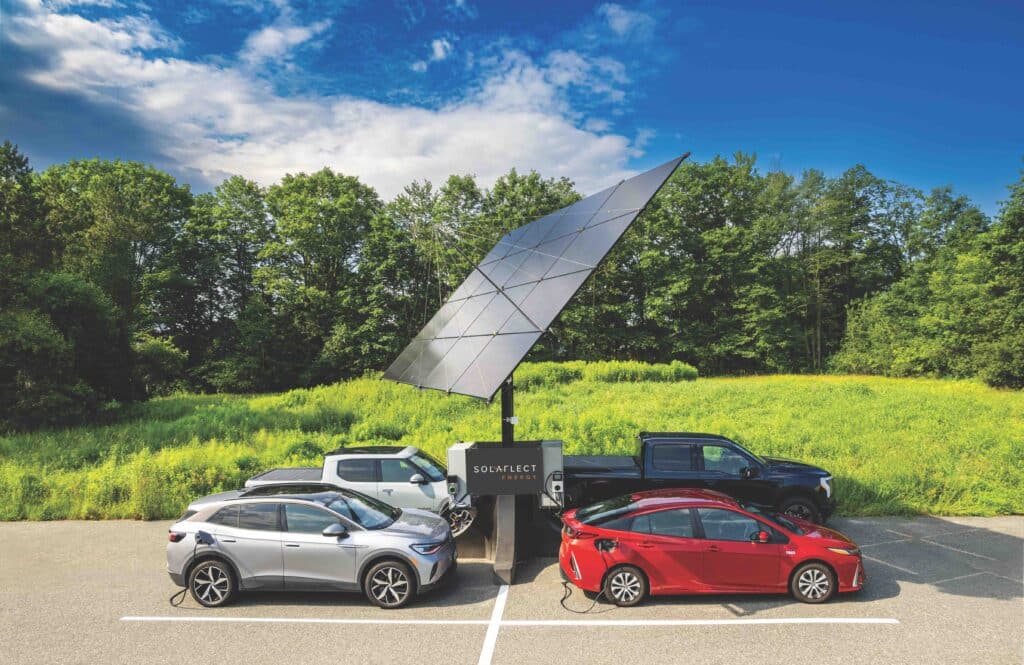
Solaflect Energy announced this week its first commercial installation of the Apollo dual-axis solar EV charging system in California. The New England–based company is partnering with Clear Blue Commercial to deploy three units in West Sacramento. The Apollo uses a suspension-bridge-style cabling system that reduces weight while maintaining strength, and Solaflect sees California, with its high electricity costs, abundant sunshine, and fast EV adoption, as an ideal expansion market after a dozen Apollo pilot deployments in VT, NH and MA.
Each unit includes four Level 2 chargers and delivers up to 6.88 kW of solar output using Axitec 430-watt panels, an 8 kW Sol-Ark inverter, and 10 kWh of LFP battery storage. COO Rob Adams said the systems fit especially well in workplace parking lots with daytime traffic. Cars parked throughout the workday top off their batteries straight from the sun, more than offsetting the electricity used during commuting.
To demonstrate how solar workplace charging supports corporate sustainability, Solaflect shared a U.S. Department of Energy case study featuring Hypertherm, a 2,000-employee manufacturing company. Hypertherm encouraged EV adoption but realized range anxiety varied based on weather, schedule, and errands. The company surveyed employees and created a policy directing all EV drivers to charge first at their two Apollo solar units (with 8 charging ports) before using standard wall chargers, reducing grid load and maximizing solar utilization. Hypertherm has since added a third Apollo to support another campus.
Adams says an Apollo can deliver up to 250 miles of range per day, or as much as 60,000 miles annually. The dual-axis tracking technology has been field tested for nearly 15 years with more than 1,300 tracker deployments in Vermont, New Hampshire and Massachusetts. Deployment of Apollo EV chargers involves none of complexity and delay associated with grid-tied EV charger installation – no construction project, no utility involvement, no infrastructure upgrades, and usually no permitting – and can be completed in 30-60 days. Installation requires only two small pavement penetrations per foundation leg, and an Apollo can be installed in a single day.
For commercial buyers, the economics are strong. The system costs $59,000 before incentives. Customers can apply the 30 percent federal tax credit plus accelerated depreciation, reducing the net price by nearly 50 percent. With California’s higher solar production of about 16,000 kWh, the lifetime cost of energy can drop below $0.10 per kWh.
Solaflect currently assembles the Apollo in Vermont from mostly domestic components. Several of its first customers have held workplace lotteries to determine which EV drivers got to park under the new solar-powered chargers, among many indications of growing demand for clean, on-site charging solutions.