New Kind of Gel Electrolyte Could Extend EV Battery Life by Almost 3 Times
Electric vehicles could soon deliver nearly triple the range and battery life thanks to a new gel electrolyte developed by researchers at the Ulsan National Institute of Science and Technology (UNIST). The material blocks destructive oxygen reactions inside high-voltage lithium-ion batteries and may help EVs achieve up to 2.8 times more driving range while lasting almost three times longer.
To increase range, EV manufacturers continue raising battery voltages beyond about 4.4 volts, which allows more energy storage but also destabilizes nickel-rich cathodes. When pushed to these higher voltages, the cathode begins releasing oxygen that transforms into reactive oxygen species, including singlet oxygen. These molecules aggressively attack the electrolyte, damage the cathode, dissolve nickel, create gas, and swell the battery. The result is faster degradation and a greater risk of failure. Engineers often compare this process to battery rust happening at extreme speed.
The UNIST team created a new gel polymer electrolyte, known as An-PVA-CN, that stops these oxygen reactions before they can cascade into larger problems. Anthracene molecules in the gel act like an oxygen bodyguard by binding to unstable oxygen on the cathode so it cannot transform into reactive oxygen species and by neutralizing any reactive molecules that have already formed. At the same time, nitrile groups in the polymer attach to nickel on the cathode surface, preventing it from dissolving and helping the structure remain stable under high-voltage conditions. This combination reduces cracking, slows degradation, and significantly limits capacity loss.
In testing at 4.55 volts, batteries containing the new electrolyte maintained 81 percent of their capacity after 500 cycles. Gas formation also dropped sharply, with only about 13 micrometers of swelling compared with roughly 85 micrometers in regular electrolyte cells. The sixfold reduction highlights how controlling oxygen chemistry through electrolyte design can make high-voltage batteries safer, more stable, and far more durable.
Researchers say the approach could enable long-range EVs, longer-lasting grid storage systems, and lightweight aerospace batteries that avoid the need for frequent replacement. Professor Hyun-Kon Song of UNIST noted that the work shows oxygen behavior in high-voltage batteries can be controlled through electrolyte engineering, opening the door to safer and higher performing lithium-ion systems.
The study appears in the journal Advanced Energy Materials.
How Long Do Electric Car Batteries Last?
Battery life is one of the biggest concerns for anyone considering an electric vehicle, and the worry makes sense. Lithium-ion packs are expensive, complex, and difficult to assess from the outside. If the battery fails, the car is effectively unusable until it is repaired, and the battery alone accounts for roughly 15 to 30 percent of a new EV’s total price.
That makes it important for buyers to understand how long today’s electric car batteries actually last. Predictive modeling from the National Renewable Energy Laboratory suggests that modern EV batteries can operate for about 12 to 15 years in moderate climates. In areas with extreme heat or cold, lifespans tend to fall in the range of eight to 12 years, according to a U.S. Department of Energy report. These are still estimates, since real-world battery life depends on many variables.
Edmunds reported that most electric car batteries are designed to reach at least 100,000 miles, which matches the minimum warranty required by federal rules. A pack that fails before this point is usually suffering from a manufacturing flaw and would qualify for a warranty replacement. Beyond 100,000 miles, the picture becomes more uncertain, although most EVs on the road today continue to operate with their original packs.
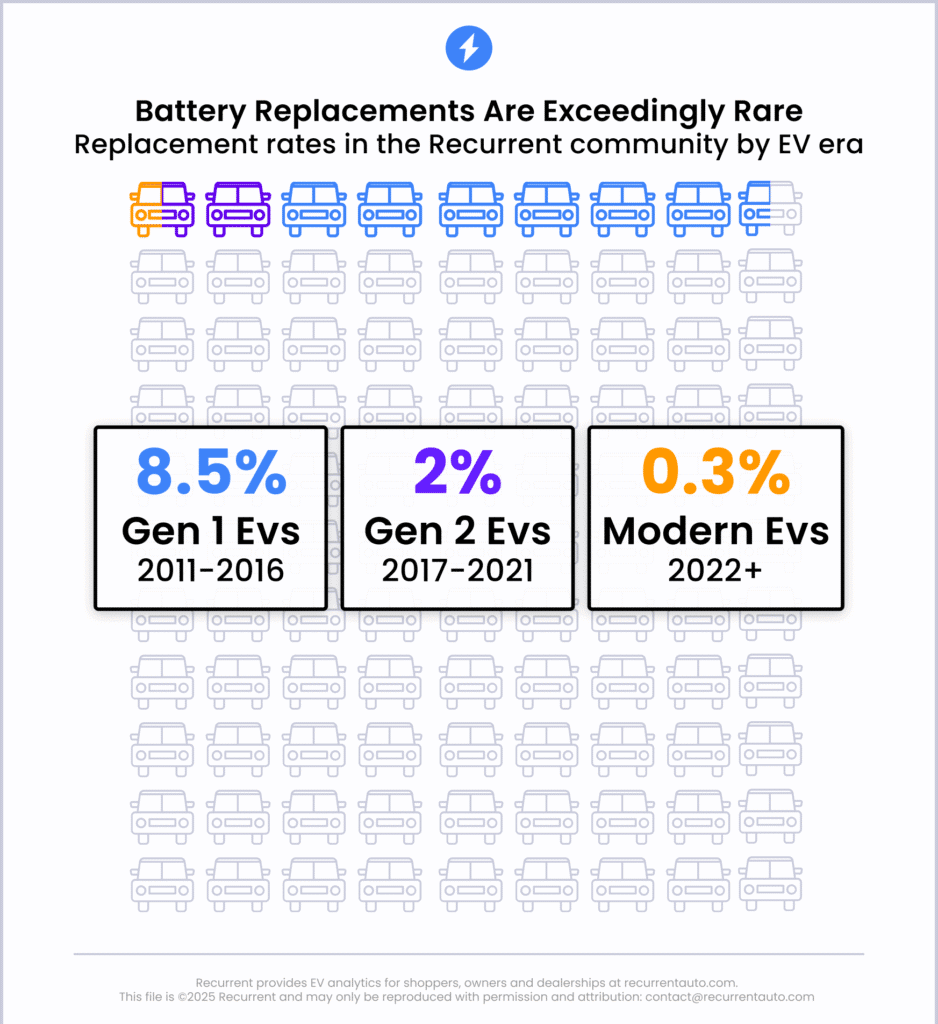
Authoritative new data from Recurrent Auto, released in November 2025, helps fill in some of the gaps. After examining battery replacements among more than 30,000 electric vehicles in its community, the company found that the oldest, first-generation EVs see the highest replacement rates. These cars are now more than 14 years old and were built with early battery technology. Battery sizes have grown dramatically since 2015, increasing by 167 percent on average, which means newer packs can lose more capacity before owners feel the need to replace them. Improvements in battery management systems and advances in chemistry are also helping extend battery life.
Aside from two major recalls involving the Chevrolet Bolt EV and Hyundai Kona EV, both caused by defects traced to a single battery manufacturer, replacements remain uncommon. Across all models and years, excluding those recalls, fewer than 4 percent of packs have been replaced, including in vehicles more than 10 years old. Replacement rates for the earliest EVs (2011-2016) are around 8.5 percent, while second-generation vehicles (2017-2021) such as the early Chevrolet Bolt EV and Tesla Model 3 sit at about 2 percent. For the newest EVs built from 2022 onward, the rate drops to just 0.3 percent.
EV Cells Slowly Lose Capacity Over Time, a Process Known as Degradation
Like the batteries in phones and laptops, EV cells slowly lose capacity over time, a process known as degradation. Many factors influence how quickly this happens, including charge cycles, climate, driving habits, and charging routines. A full cycle, from a complete charge to a full discharge, slightly reduces a battery’s total capacity each time. Most EV batteries are expected to last through 1,000 to 2,000 cycles. Drivers rarely empty their batteries to zero, and modern vehicles often limit maximum charge levels to reduce stress, so the process unfolds gradually.
Charging habits also play a major role. Keeping the battery from fully draining or fully charging helps preserve long-term health. Many experts recommend avoiding dips below roughly 20 percent state of charge and avoiding regular charges above about 80 percent. Fast charging places additional strain on the battery chemistry. In testing by the Idaho National Laboratory, Nissan Leafs that relied on frequent DC fast charging lost about 3.5 percent more capacity after 50,000 miles than those using Level 2 charging. That amounted to only a few miles of range difference, but the effect compounds over the lifespan of the vehicle. For that reason, Level 2 charging is generally preferred for daily use, while fast charging is best saved for travel or urgent situations.
Climate is another important factor. Lithium-ion batteries are sensitive to temperature, and both hot and cold conditions can reduce performance and charging speed. The Idaho National Laboratory found that at 32 degrees Fahrenheit, fast charging slowed by more than 30 percent compared with charging at 77 degrees. Heat has the opposite but equally damaging effect. At temperatures around 95 degrees, internal reactions accelerate, which can lead to faster discharge, reduced range, higher resistance, and slower charging. Preconditioning the cabin while plugged in, avoiding fast charging in very hot weather, and maintaining smooth driving habits can help offset some of these stresses.
Driving style also influences battery longevity. Sudden, repeated bursts of acceleration draw high currents from the pack and can accelerate wear, especially in larger or less aerodynamic vehicles. Towing heavy loads or climbing steep grades increases the strain as well. A steady driving approach, even in demanding conditions, is one of the simplest ways to help the battery age more slowly.
Together, these factors highlight why EV battery life varies so widely, and why most modern electric vehicles still perform well years after they leave the showroom.

Electric Vehicle Marketing Consultant, Writer and Editor. Publisher EVinfo.net.
Services