Global Transition to EVs Has Reached a Potential Tipping Point, Says New Report
A new December 2025 report authored by Andy Hackett and Izzy Woolgar of Centre for Net Zero, alongside Laurens Speelman and Yuki Numata of Rocky Mountain Institute and Jan Rosenow of the Environmental Change Institute at the University of Oxford, states that the global transition to electric vehicles (EVs) has reached a potential tipping point. The report is titled Scaling the S-Curve: The Exponential Phase of EV Adoption.
One in five new cars sold globally is now electric, and adoption continues to accelerate. Following years of targeted policy support, declining battery costs, and the expansion of global supply chains, EVs are positioned to enter the steep, exponential phase of the S-curve of technological diffusion. The authors note that this moment presents both a significant opportunity and a major policy challenge, requiring the transition to be rapid, equitable, and closely integrated with clean energy systems. The S-curve is pictured below.
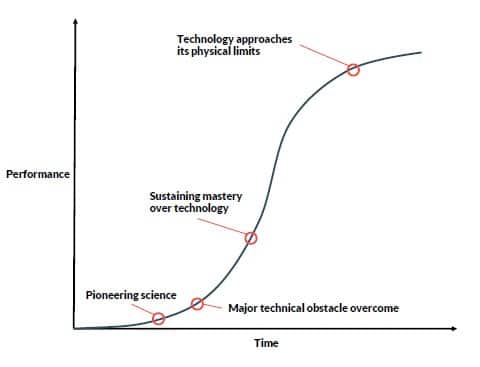

The S-curve of technology diffusion describes how new technologies typically move from slow initial adoption, to rapid exponential growth, and eventually to saturation as markets mature. Early uptake is often constrained by high costs, limited infrastructure, and uncertainty, but once key thresholds are crossed, such as cost competitiveness, scalability, and social acceptance, adoption accelerates quickly through self-reinforcing feedback loops.
These include falling costs from scale, learning effects, expanding supply chains, and network effects that make the technology increasingly attractive to mainstream users. As the technology becomes established, growth naturally slows as it approaches market saturation, shifting the focus from expansion to optimization, integration, and long-term system performance.
The report emphasizes that transformations of this scale are rarely linear. Small interventions can trigger reinforcing feedback loops such as cost reductions, social diffusion, industrial scaling, and technological learning, all of which can drive exponential growth. However, these same dynamics can stall if political commitment or infrastructure development fails to keep pace. Whether EV adoption continues to accelerate or begins to plateau now depends on deliberate, coordinated policy action. The authors stress that successful technology transitions historically have not occurred in isolation.
Drawing on analysis from Centre for Net Zero, with support from Rocky Mountain Institute and Oxford University’s Environmental Change Institute, the paper sets out a high-level policy framework for the next phase of EV deployment. It identifies three interlinked priorities: accelerating EV adoption, integrating EVs into clean electricity systems, and ensuring sustainability across supply chains and emerging mobility systems.
On accelerating adoption, the report argues that closing the cost gap between electric and internal combustion engine vehicles is essential. This requires strong regulatory frameworks, innovative financing mechanisms, and clear zero-emission vehicle mandates, supported by international coordination to provide long-term certainty for both industry and consumers. Charging infrastructure must expand ahead of demand, particularly in underserved communities, while maintaining affordability through a competitive public charging market and extending smart charging innovations from homes into public spaces.
On energy system integration, the authors state that the next stage of the transition will be defined by how EVs interact with power grids. Beyond preparing networks for increased demand, EVs must become active contributors to flexible, decarbonized electricity systems. Smart charging can shift demand to periods of high renewable generation, reducing costs and grid stress, while vehicle-to-grid technologies allow EVs to function as mobile energy storage assets. Policymakers are urged to reform grid connection regimes, support anticipatory investment, and mandate interoperability and dynamic pricing to unlock this system value.

On sustainability, the report calls for a full lifecycle approach to EV deployment, encompassing responsible mineral extraction, circular battery supply chains, reuse, and recycling. Based on current trends in battery chemistry innovation and second-life applications, demand for virgin minerals could peak by the mid-2030s, creating a pathway toward net-zero mining before 2050. The authors also highlight the need for efficiency gains and changes in urban design, including smaller vehicles, stronger public transport systems, and expanded micromobility options to reduce resource use, congestion, and emissions while improving equity and accessibility.
The report concludes that while the exponential phase of EV adoption is within reach, it is not inevitable. Recent policy shifts demonstrate that technological progress alone will not guarantee success. Without decisive policy action, sustained investment, and coordination, feedback loops could weaken or reverse, reinforcing fossil fuel dependence and the dominance of global oil markets. To secure the full economic, environmental, and social benefits of electrification, the authors argue that governments must move beyond incremental approaches and pursue a coherent global effort that aligns industry, infrastructure, and citizens around clean mobility.

Electric Vehicle Marketing Consultant, Writer and Editor. Publisher EVinfo.net.
Services