ChargeSmart EV Brings DC Fast Charging to Hamburg, New York
On March 1, 2026, ChargeSmart EV announced it has activated a new DC fast charging location at an Arby’s restaurant in Hamburg, New York. The installation includes four DC fast charging ports, two CCS and two NACS connectors, capable of delivering up to 320 kW, positioning it among the fastest public charging options in the Southtowns region.
Strategically located along the Camp Road corridor, the site offers a convenient, high-powered charging stop for EV drivers traveling through the area without requiring a detour. At peak output, most compatible vehicles can charge in under 30 minutes, aligning with typical quick-service restaurant dwell times.
For retail hosts such as Arby’s, integrating ultra-fast charging infrastructure can increase customer dwell time and incremental spending while supporting the transition to electric mobility. The Hamburg deployment reflects ChargeSmart EV’s broader strategy of pairing high-traffic retail destinations with reliable, high-capacity charging assets.
“Quick-service and retail locations are a perfect fit for fast charging,” said Christian Spenziero, Co-Founder of ChargeSmart EV.
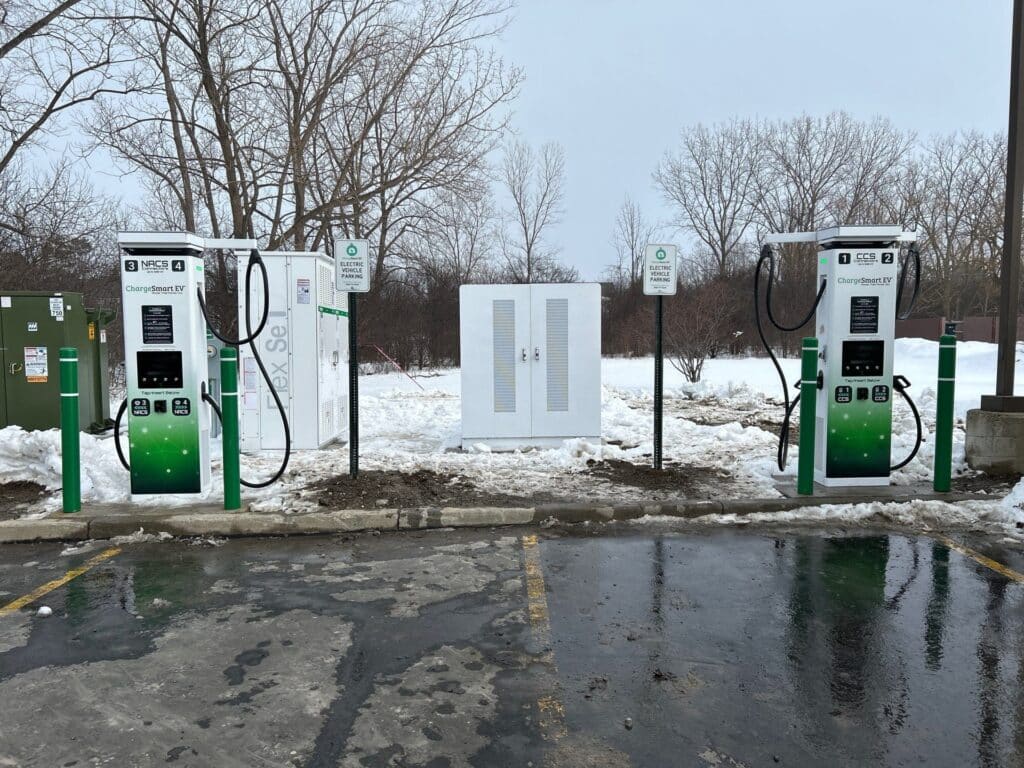
ChargeSmart EV continues expanding its national footprint, with additional deployments planned throughout 2026 as part of its growth strategy focused on reliability, network connectivity, and site host partnerships.
Site Details
Location: 5115 Camp Rd, Hamburg, NY 14075
Charger Type: DC Fast Charging, up to 320 kW
Ports: 4 total, 2 CCS and 2 NACS
Status: Open
Drivers can locate and activate the station via the ChargeSmart EV mobile app or at chargesmartev.com.
ChargeSmart EV develops, owns, and operates a connected EV charging network across the United States, emphasizing uptime, scalable growth, and long-term value creation for commercial site partners.
EVinfo.net’s Take: Why Quick-Service Restaurants Are Ideal Hosts for EV Charging
Quick-service restaurants (QSRs) are emerging as one of the most strategic site categories for public EV charging deployment. Their operating model aligns almost perfectly with the dwell time, location patterns, and infrastructure requirements of modern electric vehicle drivers.
Dwell Time Alignment
DC fast charging sessions typically range from 15 to 35 minutes, depending on battery size, state of charge, and charger power. That window mirrors the average visit duration at most QSRs. Drivers can plug in, order, eat, and return to their vehicle as charging completes. This natural overlap eliminates perceived waiting time and improves overall customer satisfaction.
For Level 2 charging, which may require 1 to 3 hours for meaningful range addition, QSRs located near retail clusters or mixed-use corridors provide additional synergy. Customers may combine dining with adjacent errands, increasing effective utilization.
High-Traffic, High-Visibility Locations
QSRs are typically positioned along major arterials, highway exits, commuter corridors, and suburban retail hubs. These are precisely the nodes where EV drivers seek convenient charging access. Strong ingress and egress, ample parking, and established wayfinding make integration operationally straightforward.
From a network planning perspective, QSR real estate often meets key site selection criteria:
- Proximity to three-phase power
- Parking layouts that accommodate pull-through or accessible stalls
- Extended operating hours
- Established lighting and security infrastructure
Revenue and Basket Expansion
Hosting EV charging increases dwell time and drives incremental foot traffic. Charging customers frequently spend during sessions, and repeat charging behavior can translate into brand loyalty. For franchise operators, this can improve same-store sales metrics while enhancing property value.
Additionally, charging infrastructure may qualify for federal, state, or utility incentives, reducing capital outlay and improving ROI for host partners.
Grid and Power Optimization
Modern 150 kW to 350 kW chargers can be integrated with smart energy management systems, demand response programs, and in some cases on-site battery storage. QSR operators with predictable load profiles can coordinate charging energy use to minimize peak demand charges and optimize operating costs.
Brand Alignment and ESG Strategy
Consumers increasingly associate EV infrastructure with sustainability leadership. Hosting chargers signals environmental responsibility and future readiness. For national chains, this supports ESG reporting and decarbonization commitments while improving public perception.
A Scalable Deployment Model
QSR chains offer network operators multi-site standardization opportunities. Uniform parking layouts, construction templates, and permitting pathways streamline deployment across portfolios. This reduces soft costs and accelerates rollout timelines.
As EV adoption continues to rise, charging infrastructure must integrate into everyday destinations rather than standalone fueling environments. Quick-service restaurants represent one of the most operationally efficient, financially viable, and customer-aligned environments for scalable EV charging growth.

Electric Vehicle Marketing Consultant, Writer and Editor. Publisher EVinfo.net.
Services