Could Power Hero Be the Airbnb of EV Charging?
When EVinfo.net recently covered both Co-Charger and Power Hero Corp., we noted the similarities in their business models. But the more we looked, the more we wondered whether that similarity was coincidental at all. Could it instead be signaling something bigger? A broader revolution in how electric vehicle (EV) drivers access charging? And could one of these companies become the next Airbnb?
That last question is not as far-fetched as it sounds. Airbnb did not build hotels. It converted existing, underutilized private spaces into a massive hospitality network, and in doing so disrupted an entire industry.
Hotels dominate global accommodation with 15 to 17 million rooms, making up roughly 60 to 70 percent of supply. Short-term rentals like Airbnb and Vrbo come in second with 7 to 8 million listings globally, representing 25 to 35 percent of the market and rivaling hotels in some destinations. Hostels and cruise ships account for less than 10 percent combined. In total, around 27 million guest spaces are available worldwide on any given night.
Today, Airbnb carries a market cap of $82.51 billion and represents the second-largest accommodation segment in the world, behind only traditional hotels. Short-term rentals now account for roughly 25 to 35 percent of global lodging supply, rivaling hotels in many major tourist destinations. The company did not create new inventory. It unlocked inventory that already existed.
Power Hero Corp. appears to be attempting something structurally very similar, but in the EV charging space.
The Cameo Device and the Airbnb Parallel
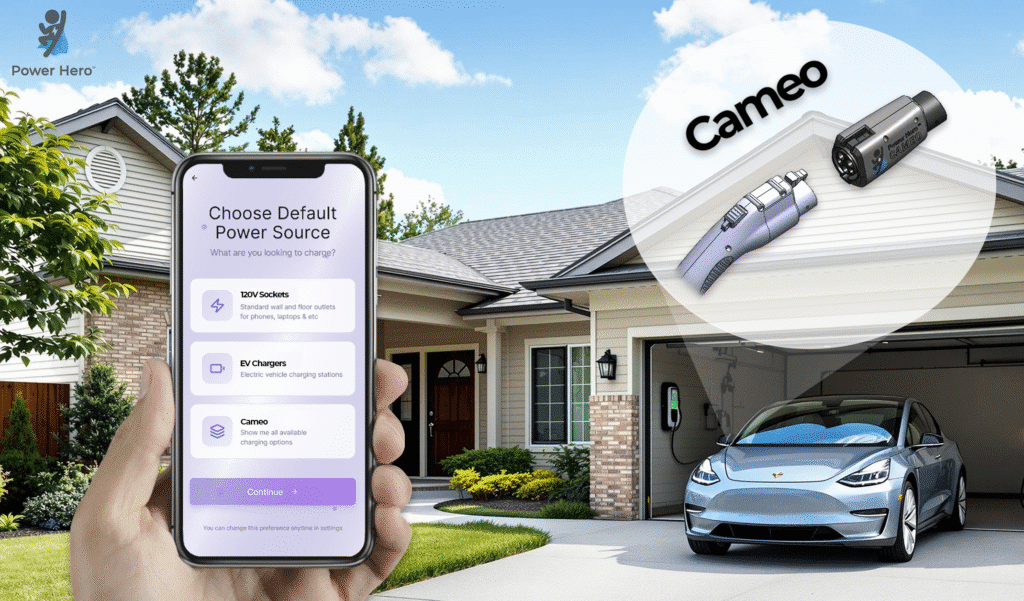
At the center of Power Hero’s strategy is a patented device called Cameo. In a recent EVinfo.net interview with Esmond Goei, Founder and CEO of Power Hero, he explained what it does: the Cameo converts existing, unconnected home Level-2 fast chargers into nodes on Power Hero’s cloud network.
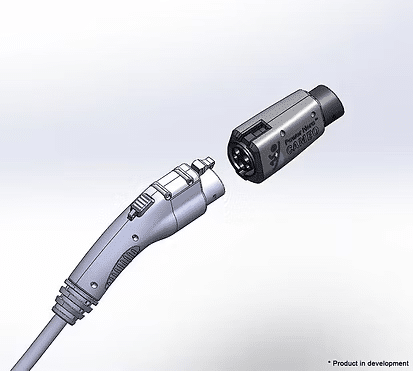
Once connected, those home chargers can be listed for rent by other EV drivers through the company’s Aircue smartphone app. The parallel to Airbnb is not subtle. Just as Airbnb took spare bedrooms and idle vacation homes and turned them into a bookable inventory, Power Hero is taking the millions of home chargers sitting idle in American garages and driveways and potentially turning them into a rentable national charging network.
Goei also revealed something that raised our eyebrows considerably. He has recruited two former Senior Program Managers from Airbnb. That hiring decision is not random. It suggests that Power Hero is not merely inspired by the Airbnb model in concept. It is actively borrowing the operational and strategic expertise that helped build Airbnb into what it is today. An imminent product launch of Power Hero’s Cameo feels closer than ever.
The TAM Is Enormous
Let’s look at the numbers, because they matter here. In 2026, the total addressable market for home Level-2 chargers in the United States is estimated at around 4 million units. That alone would represent a formidable national charging network if even a fraction were listed on Power Hero’s platform. But the longer-term opportunity is far larger.
The U.S. EV population is forecast to surpass 26 million vehicles on the road by 2030. Given that over 68 percent of EV owners install a home Level-2 charger, that points to a TAM of approximately 18 million home chargers within the next few years. A company that successfully monetizes even a portion of that inventory, by connecting charger owners with drivers who need a charge, would be sitting on an extraordinarily valuable asset.
To put that in context with the Airbnb analogy: Airbnb’s entire platform is built on roughly 4 to 7 million global listings. Power Hero’s potential domestic TAM by 2030 is more than double that figure, within a single country.
Should ChargePoint or Airbnb Be Paying Attention?
This raises a pointed question. Would a company like ChargePoint, which has spent years and considerable capital building out a public charging network, not be interested in acquiring a platform that could instantly add millions of home chargers to its network? ChargePoint’s infrastructure strategy has always depended on physical installation at scale. Power Hero’s model sidesteps that entirely by activating existing hardware.
And what about Airbnb itself? The company already understands the peer-to-peer asset-sharing model better than almost anyone. EV charging could represent a natural adjacency, particularly as EV ownership grows among the very homeowners who already list their properties on Airbnb. The strategic logic of an acquisition writes itself.
The window for acquiring Power Hero at a reasonable valuation may not stay open indefinitely. If the Cameo launches successfully and the Aircue platform begins aggregating home chargers at scale, the company’s value proposition becomes dramatically harder to ignore and dramatically more expensive to acquire.
A Harbinger of Something Bigger
Co-Charger and Power Hero arriving at similar business models around the same time is unlikely to be pure coincidence. It suggests that the market itself is signaling a need. Public charging infrastructure, while growing, remains uneven and sometimes unreliable. Home chargers, by contrast, are already installed, already fast, and already sitting idle for large parts of the day. The peer-to-peer model simply makes sense.
Airbnb proved that you do not need to own the inventory to dominate a market. You need the platform, the trust layer, and the network effect. Power Hero is building all three. Whether it becomes the Airbnb of EV charging depends on execution. But the blueprint is compelling, the TAM is massive, and the team now includes people who helped build one of the most disruptive platforms in modern business history.
Power Hero is expanding infrastructure while reimagining how the country powers its future. Its mission is straightforward yet revolutionary: Plug in. Charge up. Power everything.
See Power Hero’s WeFunder page for more information on investing.

Electric Vehicle Marketing Consultant, Writer and Editor. Publisher EVinfo.net.
Services