A New CA Law Would Replace Fossil Peaker Plants With Clean VPPs
A new proposal moving through California’s legislature aims to give virtual power plants (VPPs) a real shot at replacing fossil-fueled peaker plants, a shift that could ease the state’s rapidly rising electricity costs, as well as meet the state’s forward-thinking environmental goals.
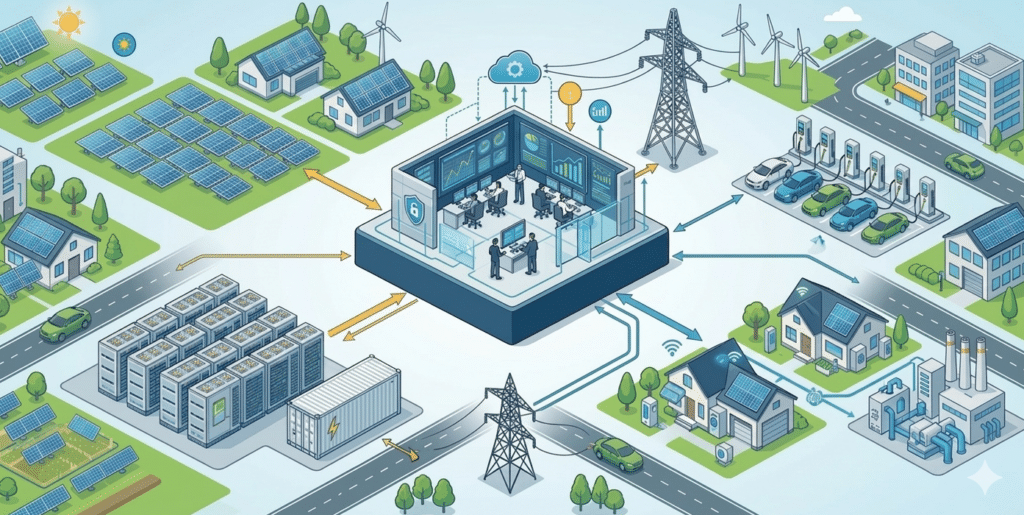
Virtual power plants, or VPPs, combine distributed, customer-owned resources such as home batteries, electric vehicles, smart thermostats, and other flexible devices. When aggregated and coordinated, these systems can supply capacity to the grid at critical moments, often at a lower cost than conventional power plants. While California already has several VPP programs in operation, existing utility rules and market structures do not provide a clear pathway for these resources to displace traditional peaker plants.
California Senate Bill 913, introduced by State Senator Josh Becker, is designed to change that. The legislation would allow VPPs to compete directly with conventional generation sources to deliver grid reliability at the lowest possible cost. It recently cleared the Senate Energy, Utilities, and Communications Committee, marking an early but important step toward a full legislative vote.
“Californians are struggling with rising electricity bills, and we need to use our grid more intelligently and cost-effectively,” said Senator Becker. “Instead of always building expensive new infrastructure to meet just a few peak hours of demand, we should be making better use of the resources we already have in our homes. Millions of Californians already have tools like smart thermostats, home batteries, and electric vehicles that can help support the grid. SB 913 ensures we can use those resources to lower costs, reduce pollution, and improve reliability.”
“As peak electricity demand rises, California should look to the millions of local, clean energy resources already installed in our homes and businesses to stabilize the grid,” said Kurt Johnson, Community Energy Resilience Director for The Climate Center. “Electric vehicles and stationary batteries, for example, can help meet demand while lowering electricity bills. We look forward to working with Senator Becker to pass SB 913 and deliver clean, reliable, affordable electricity to all Californians.”
Peaker plants, typically powered by natural gas, play a disproportionate role in driving up electricity bills. Although they operate only during short periods of peak demand, ratepayers fund their availability year-round. By contrast, VPP advocates argue that distributed resources can fulfill the same role more efficiently because the underlying equipment has already been installed and paid for by customers.
The scale of this opportunity is significant. Millions of California households have devices capable of reducing consumption during peak periods, and hundreds of thousands have batteries that can send electricity back to the grid. Together, these resources could substantially reduce reliance on peaker plants.
Despite this potential, the bill faces political and institutional challenges. The state’s major investor-owned utilities, including Pacific Gas & Electric, Southern California Edison, and San Diego Gas & Electric, have not publicly opposed the measure but are seen by advocates as resistant to programs that could limit their ability to invest in and earn returns on traditional grid infrastructure.
Regulatory dynamics also present hurdles. The California Public Utilities Commission, whose members were appointed by Governor Gavin Newsom, has taken steps in recent years that restrict the role of customer-owned resources in supporting the grid. Newsom himself vetoed several VPP-related bills last year, raising questions about whether SB 913 will ultimately gain executive approval.
Still, growing concern over energy affordability may shift the political landscape. The bill has garnered support from clean energy companies, environmental organizations, and consumer advocates, all of whom see VPPs as a way to lower costs, improve reliability, and cut emissions by making better use of existing distributed energy assets.
At its core, SB 913 addresses a central issue: how to reduce dependence on gas-fired plants that are rarely used but remain expensive to maintain. In California, these plants are supported through the resource adequacy framework, which ensures sufficient capacity is available to prevent blackouts. The cost of maintaining this backup capacity has steadily increased and now represents a substantial portion of customer bills.
Although utility-scale batteries are beginning to participate in resource adequacy programs, they cannot yet fully replace gas plants. As a result, aging peaker facilities remain the system’s fallback option. Becker estimates that Californians spend roughly $1 billion annually to keep these plants available, including payments through resource adequacy and state funding used to extend the operation of certain coastal facilities.
SB 913 would direct the CPUC to establish clearer mechanisms for distributed energy resources to qualify for resource adequacy. This change could enable VPPs to take on a larger share of peak demand. A 2024 analysis by The Brattle Group for GridLab found that VPPs could meet more than 15 percent of California’s peak demand by 2035 while delivering approximately $550 million in annual savings, largely by deferring the need for new generation capacity.
Evidence from existing programs supports these projections. California’s Demand Side Grid Support program has grown to more than one gigawatt of capacity and demonstrated that aggregated home batteries can perform like conventional power plants. In a July 2025 test, around 100,000 batteries delivered roughly 476 megawatts over a two-hour period, comparable to a typical peaker plant.
Even so, DSGS has faced funding cuts and potential cancellation, prompting advocates to push for its continuation. The program serves as a model for SB 913, particularly in how it structures participation and compensation.
One of the bill’s key objectives is to address longstanding issues with demand-response programs. Traditional programs often involve complex enrollment processes and compensation mechanisms that can penalize participants based on imperfect measurements of their contributions. SB 913 calls for streamlined enrollment and more flexible participation, allowing individual devices such as batteries, EV chargers, and smart thermostats to qualify independently.
It also proposes improved measurement methods, including weather-normalized baselines, to more accurately capture the impact of demand reductions. This approach is especially important for devices like thermostats, whose performance varies with temperature conditions.
Another critical element of the legislation focuses on compensation for energy exported to the grid. Currently, most VPP programs in California prohibit households from earning value for sending electricity back to the grid, limiting their role to reducing on-site consumption. SB 913 would require regulators to develop a framework for recognizing and compensating these exports.
Implementing such a framework presents technical and economic challenges. Existing rules from the California Independent System Operator require revenue-grade metering for exported power, which can add significant costs for residential participants. VPP advocates argue that modern inverters and smart devices can provide sufficiently accurate data at a much lower cost, making broader participation economically viable.
There are indications that CAISO is exploring rule changes that could better integrate distributed energy resources into wholesale markets, including potential mechanisms for crediting individual battery exports. While these efforts are still evolving, they suggest a possible path forward.
Major industry players, including Sunrun and others, support the bill and emphasize the untapped potential of distributed battery capacity already deployed across the state. They argue that enabling these resources to participate fully in grid markets would help reduce electricity rates while improving system reliability.
Ultimately, SB 913 represents an effort to modernize California’s grid by aligning policy with the growing presence of distributed energy technologies. Whether it succeeds will depend on overcoming regulatory inertia, utility resistance, and the technical complexities of integrating thousands of small-scale resources into a system historically built around centralized power plants.
Kitu Systems’ Whitepaper, “Virtual Power Plants: Essential Infrastructure for Grid Transformation”
Virtual Power Plants are a compelling alternative to fossil fuel peaker plants. To fully understand VPPs, Kitu Systems’ white paper, “Virtual Power Plants: Essential Infrastructure for Grid Transformation,” is recommended reading.
The white paper argues that Virtual Power Plants (VPPs) have become essential infrastructure as the U.S. electric grid faces mounting pressure from renewable energy growth, electrification, and climate-driven extreme weather. Traditional grid models, built around centralized generation, are increasingly unable to provide the flexibility and resilience required, while building new infrastructure is costly, slow, and inefficient.
VPPs address this challenge by aggregating distributed energy resources such as batteries, EV chargers, solar systems, and flexible loads into a coordinated, software-driven network that operates like a single power plant. These systems can deliver rapid, dispatchable capacity for peak demand, grid stability services, emergency response, and renewable integration, often outperforming conventional solutions in speed, cost, and emissions.
The U.S. VPP market is expanding, supported by regulatory changes like FERC Order 2222 and growing participation from utilities, aggregators, and technology providers. However, scaling VPPs remains complex due to device diversity, integration challenges, and rising performance requirements.
Kitu Systems positions itself as a key enabler through its Convoy platform, which provides end-to-end orchestration of distributed resources. Its technology focuses on interoperability, real-time control, automation of market participation, and high-performance scalability.
The paper concludes that VPPs are no longer experimental but critical to achieving a reliable, decarbonized grid. With technology barriers largely solved, the focus shifts to execution, and utilities that adopt VPPs early are better positioned to manage costs, integrate renewables, and maintain grid stability in a rapidly evolving energy landscape.
Kitu Systems Accelerates Consumer Adoption of EVs, Renewables and BESS by Modernizing the Grid
Kitu Systems is a cleantech and IoT, last-mile software company focused on enabling the energy transition. Their platform provides end-to-end solutions that ensure connectivity, control, and communication with distributed energy resources like EVs, solar, and battery systems. By stabilizing and securing the grid, Kitu Systems empowers utilities and energy providers to coordinate millions of devices in a smart, scalable, and efficient manner.
Through its software and SaaS offerings, Kitu embeds intelligence and control directly into renewable energy devices, aggregates their data and communications in the cloud, and securely integrates them with utility and customer management platforms.
Built on open standards, Kitu Systems’ platform establishes the foundation for energy networks that are intelligent, resilient, adaptive, efficient, and scalable.
Reach out to Kitu Systems for more information.
Electric Vehicle Marketing Consultant, Writer and Editor. Publisher EVinfo.net.
Services