GM Began Prototyping of Sodium-Ion Battery Cells in Michigan Tech Center Campus
On August 10, 2026, Kurt Kelty, VP of Battery and Sustainability at General Motors, announced progress on sodium-ion EV battery development.
Kelty said: “The grid needs more affordable, reliable power that can operate in real-world conditions over decades. This is exactly where sodium-ion shines and why we’re developing next-generation sodium-ion batteries at General Motors for grid-scale storage in partnership with Peak Energy. It is our battery development philosophy in practice: the right battery for the right application.”
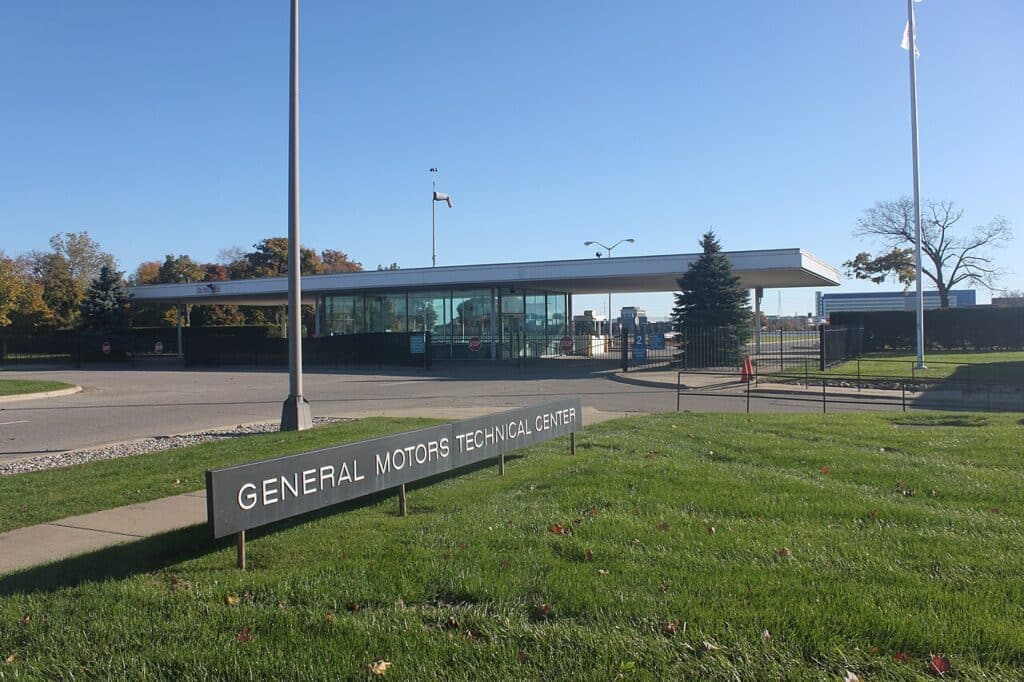
“And because sodium-ion’s built from one of the most abundant elements on Earth, it offers a path toward a more American, more resilient battery supply chain. We’ve already begun prototyping of sodium-ion cells on our Tech Center campus in Michigan. Production-validation cells are being kicked off at our Battery Cell Development Center next year,” continued Kelty.

Sodium-Ion vs. Lithium-Ion EV Batteries: What’s the Real Difference?
Ever since the modern era of EVs began in the 2010s, different battery chemistries have emerged that were initially hailed as the “next big thing,” only to fade away as they got closer to reaching the road. Lithium-ion batteries, in their various forms, have prevailed. A few alternatives, including solid-state and sodium-ion batteries, have remained in development for years and are now becoming reality. Sodium-ion has already arrived, with the technology appearing in production cars in 2026.
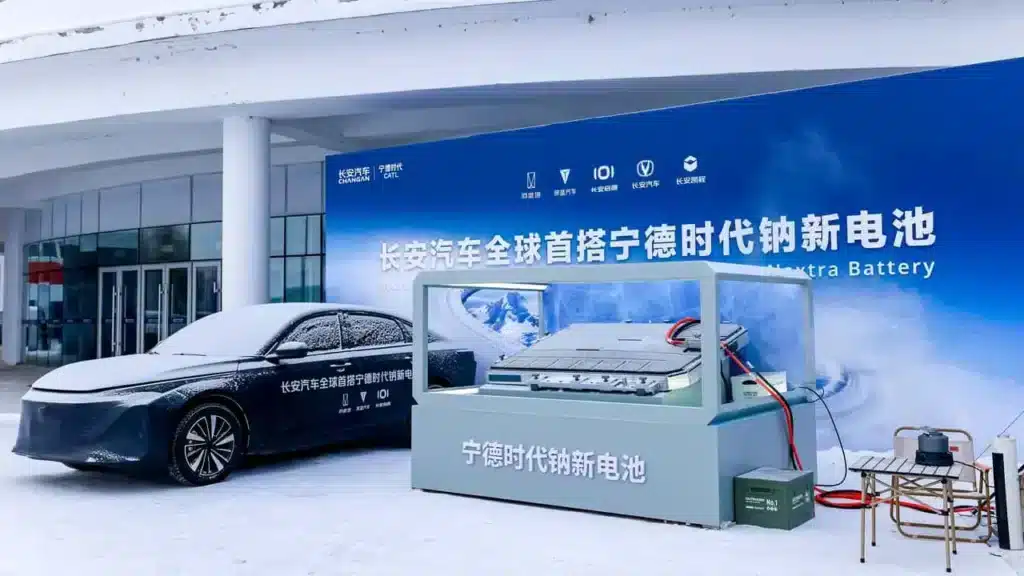
The technology is already on roads in China and has not yet reached Europe, although that is expected to change. CATL, the world’s largest battery producer, began mass-producing its Naxtra sodium-ion battery in 2026. The first mass-production passenger EV using the technology, the Changan Nevo A06, was unveiled in February 2026. CATL has confirmed that sodium-ion batteries will expand into passenger EVs, commercial vehicles, battery swapping and grid storage by the end of 2026. The sodium-ion versus lithium-ion debate is therefore no longer theoretical. The chemistry is now being used in cars, trucks, battery-swap stations and battery factories.
In some countries and languages, sodium is called by its Latin name, natrium. As a result, searches for natrium-ion batteries refer to the same technology.
Why Sodium-Ion vs. Lithium-Ion Finally Matters in 2026
For more than a decade, the EV battery market was dominated by one chemistry family with several variations. Under the lithium-ion umbrella are NMC, or nickel-manganese-cobalt, NCA, or nickel-cobalt-aluminum, LFP, or lithium iron phosphate, and LMFP, or lithium-manganese iron phosphate. Each chemistry makes different trade-offs involving energy density, cost, longevity and safety, but lithium remains the underlying ion.
The simplest explanation is that sodium-ion changes the ion itself. Instead of lithium moving between the cathode and anode, sodium does. That change is more significant than it sounds. Sodium ions are larger and heavier than lithium ions, so the cathode, anode and electrolyte materials must also change. Most sodium-ion cells use hard-carbon anodes instead of graphite, with cathodes based on layered oxides, polyanionic compounds or Prussian blue analogues.
The sodium-ion versus lithium-ion comparison matters now because three developments occurred around the same time in 2025 and 2026. Sodium-ion batteries can now be mass-produced at the gigawatt-hour scale required by the EV industry. The technology also passed China’s new GB 38031-2025 EV battery safety standard, with CATL’s Naxtra becoming the first sodium-ion battery to do so. At the same time, energy density reached 175 Wh/kg, putting sodium-ion technology into competition with mid-range LFP cells.
Energy density was once the point where sodium-ion consistently lost the argument. That is no longer necessarily the case, particularly when compared with the middle of the LFP market.
How the Chemistries Differ
The sodium-ion versus lithium-ion comparison ultimately comes down to physics. Lithium is light, while sodium is abundant. Those two facts explain much of the difference. Lithium ions are smaller and lighter, allowing lithium-ion cells to store more energy within the same mass or volume.
Sodium is roughly 1,000 times more abundant in Earth’s crust than lithium and can be extracted from common compounds such as ordinary salt. The resulting trade-off is lower energy density in exchange for potentially cheaper, safer and less geopolitically exposed materials.
Changing the ion affects virtually every major component of the battery. Lithium-ion batteries commonly use LFP, NMC or NCA cathodes, while sodium-ion batteries use layered oxides, polyanionic compounds or Prussian blue and Prussian white materials. Lithium-ion batteries generally use graphite anodes, while sodium-ion batteries typically use hard carbon. Lithium-ion still has the advantage in energy density, particularly in premium EV applications, while sodium-ion can offer better cold-weather performance and, depending on the design, reduce exposure to lithium, cobalt and nickel.
Production maturity is another major difference. Lithium-ion batteries are manufactured at enormous global scale, supported by mature supply chains, factories and service networks. Sodium-ion production is only now beginning its volume-production ramp. None of these differences are absolute, and battery-pack engineering can be just as important as cell chemistry. However, they provide a useful framework for understanding the sodium-ion versus lithium-ion debate.
Sodium-Ion vs. Lithium-Ion: Where Each One Wins
Energy density is usually where the comparison begins because lithium-ion still has a clear advantage. CATL’s Naxtra reaches 175 Wh/kg, placing sodium-ion around the higher end of LFP performance. Competitive LFP cells can reach roughly 200 to 210 Wh/kg, while high-end NMC cells can reach about 255 Wh/kg.
For a long-range premium EV targeting 600 km on a single charge, that difference matters. For a city car or delivery van designed to travel 250 to 400 km, however, the difference becomes less important. The question is therefore not which chemistry is universally better. It is which chemistry is better for a particular application.
Lithium-ion remains the stronger choice for long-range passenger EVs, high-performance EVs where battery weight matters, vehicles where maximum energy storage with minimum mass is critical, and markets with mature warranty and service networks. Sodium-ion has advantages in affordable city EVs and shorter-range cars, two- and three-wheelers, small delivery vehicles, cold-climate fleets, depot-charged commercial vehicles, battery-swap networks where cost and durability are more important than pack volume, and stationary energy storage where battery weight is largely irrelevant.
The sodium-ion versus lithium-ion answer in 2026 therefore depends heavily on what the vehicle needs to do.
Cold Weather Is Where Sodium-Ion vs. Lithium-Ion Gets Interesting
Cold weather is one of the weaknesses of lithium-ion batteries. Charging slows down, driving range decreases and, in extreme cold, the battery may need to be actively heated before it can deliver sufficient power.
Anyone who has tried to fast-charge an LFP-equipped EV at -15°C knows the routine. The vehicle warms the battery first, the charger waits and the actual charging session takes longer than the headline charging-power figure suggests.
Sodium-ion behaves differently in this environment. According to CATL, its Naxtra cells operate across a -40°C to +70°C temperature range, retain about 90% of their usable capacity at -40°C and can continue delivering stable power down to -50°C. At -30°C, sodium-ion discharge power is roughly three times higher than that of equivalent LFP cells.
That makes the sodium-ion versus lithium-ion question particularly relevant in the Nordics and Central and Eastern Europe. The same chemistry change that could cost some driving range during mild conditions may provide a significant advantage during winter.
Who Is Making Sodium-Ion Batteries and Which EVs Will Use Them?
The sodium-ion battery production race is currently concentrated in China, where most of the actual hardware is being manufactured. CATL is the largest player. Its Naxtra brand was unveiled in April 2025 and entered mass production in 2026.
The first passenger EVs using Naxtra cells include GAC Aion and the Changan Nevo A06, also known as the Qiyuan A06. The Nevo A06 is expected to use a 45 kWh sodium-ion battery pack with a claimed range of more than 400 km.
BYD is another major player. Its FinDreams Battery unit has started construction of a 30 GWh sodium-ion plant in Xuzhou with partner Huaihai. The facility is focused on smaller vehicles, scooters and low-cost mobility. BYD has also developed a third-generation sodium-ion cell with more than 10,000 cycles and improved high-temperature performance.
HiNa Battery, LG Energy Solution and JAC are also active in the technology. HiNa supplied cells for earlier sodium-ion EVs, including the JAC Yiwei in 2024 and a sodium-ion version of the JMEV EV3. LG Energy Solution opened a pilot sodium-ion manufacturing line in Nanjing in January 2026.
Outside China, the field is considerably smaller. Faradion remains active in lower-cost transportation and stationary storage. European companies such as Altris are developing sodium-ion technology but remain relatively small. Northvolt was one of Europe’s most credible sodium-ion contenders until its bankruptcy in 2025.
Two U.S. companies, Bedrock Materials and Natron Energy, also demonstrate how difficult it is to move sodium-ion technology from pilot production into commercial-scale manufacturing. Bedrock Materials shut down in April 2025, while Natron Energy ceased operations in September 2025.
For consumers asking where they can buy a sodium-ion EV in 2026, the answer remains straightforward: China.
European Buyers Should Watch Sodium-Ion
For European EV buyers today, the choice remains lithium-ion, and that is the sensible choice. Modern LFP and NMC battery packs are proven, supported by established service networks and continuing to improve.
Sodium-ion available in some Chinese EVs expands the available options when this technology comes to Europe. The EV market is beginning to separate into more specialized battery chemistries, meaning a long-range family EV, a depot-charged van and a city car no longer necessarily need to use the same type of battery.
Which is More Eco Friendly, Sodium or Lithium?
Sodium-ion batteries can be more environmentally friendly than lithium-ion batteries in several respects, although the advantage depends on how they are manufactured. Sodium is far more abundant than lithium and can be sourced from widely available materials, including common salts. Sodium-ion batteries can also reduce reliance on critical minerals such as lithium, nickel and cobalt, potentially lowering the environmental impacts associated with mining and refining those materials. Their simpler and more widely available raw-material supply could also improve supply-chain resilience and reduce pressure on resources as EV adoption grows.
Lithium-ion batteries currently have a major environmental advantage in manufacturing maturity and energy density. Their higher energy density means an EV can carry more energy with less battery mass, which can reduce material use for a given driving range. Lithium-ion batteries also have established recycling systems and highly developed manufacturing processes. Sodium-ion production is still scaling, so its full environmental footprint is not yet as well established. However, sodium-ion could become particularly attractive for shorter-range EVs, commercial vehicles and stationary storage where maximum energy density is less important. Ultimately, the most environmentally friendly battery is the chemistry that uses the fewest resources while providing the required performance and is manufactured, powered and recycled efficiently.
Both Chemistries Can Coexist in the EV Market
The sodium-ion versus lithium-ion answer in 2026 is not that one chemistry will replace the other. Instead, both are developing distinct roles.
Lithium-ion will continue handling long-range, premium and performance EVs for years. Sodium-ion is positioned to expand into affordable city EVs, fleet vehicles, two-wheelers, battery-swap networks, cold-weather applications and grid storage. The first major passenger EVs using sodium-ion technology are arriving in 2026, with GAC Aion and Changan Nevo A06 among the early examples.
For EV drivers in cold climates and price-sensitive segments, this is positive news. More battery choices can mean better-matched vehicles, more reasonable prices and improved winter charging performance when temperatures fall below freezing.
After more than a decade in which lithium-ion batteries handled virtually every EV application, the market finally has a credible second option. In 2026, sodium-ion began moving from the laboratory and factory floor into real cars. How quickly will this come to American-made EVs? Only time will tell.

Electric Vehicle Marketing Consultant, Writer and Editor. Publisher EVinfo.net.
Services