Spain’s Solar, Wind Power Overtake Fossils, EV Sales Boomed 44.4% in April
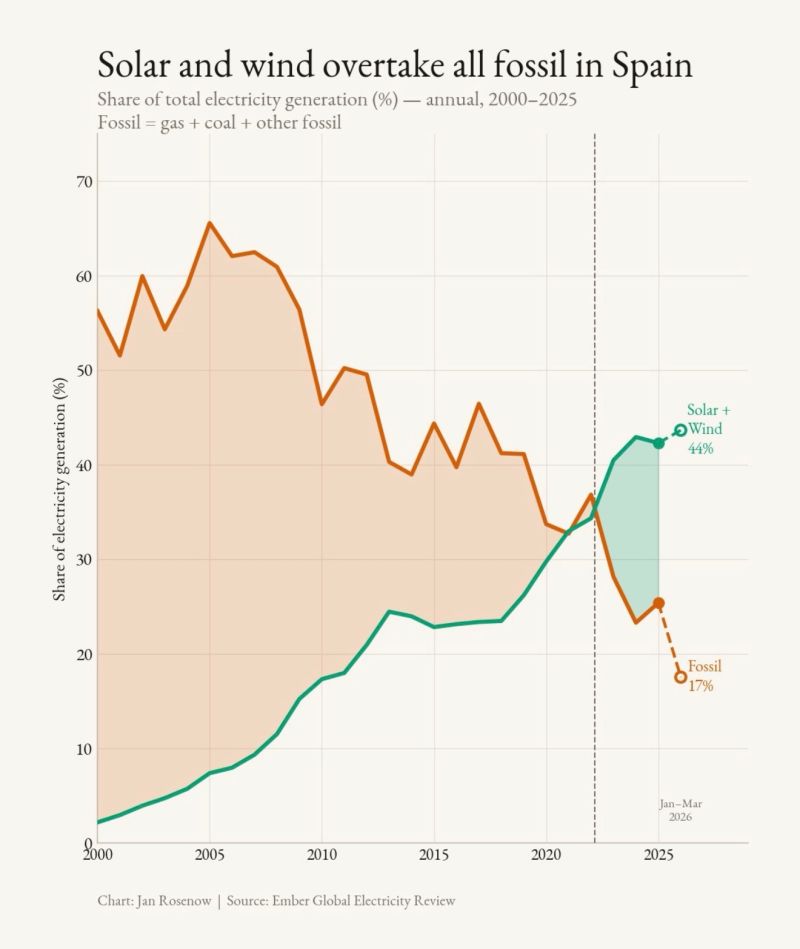
On May 7, 2026, Jan Rosenow, Professor of Energy and Climate Policy at Oxford University, reported that solar and wind power overtook all fossil fuel power in Spain.
Rosenow reported on his Linkedin account, “In 2000, fossil fuels generated 56% of Spain’s electricity. Solar and wind generated 2%. By early 2026, that has inverted: solar and wind now account for 44% of generation, fossil just 17%. The crossover happened in 2023 — the first year solar and wind together permanently outpaced the combined output of gas, coal and other fossil fuels. The implications for wholesale prices are significant. Gas is the marginal price-setter in many competitive electricity markets — when it runs, it sets the clearing price for all generators. In 2026 gas set the price only 15% of the time compared to Italy where it was 89%.”
Rosenow continued: “Fewer hours of gas marginal pricing means more hours where wind and solar — with near-zero running costs — set a much lower price. This means Spain was largely shielded in the power sector from the energy crisis. More in my forthcoming Substack newsletter – sign up here: https://lnkd.in/ey3jr8JK.”
Sales of Electric Cars Increase Across Most of Western Europe in April 2026
On May 5, 2026, The Driven reported that Western Europe is seeing continued EV growth in April 2026.
Even as Norway continues to shatter electric vehicle (EV) sales records, much of Western Europe is also experiencing strong EV momentum, with European automakers gaining significant traction across the region.
Norway remains the global leader in battery-electric vehicle (BEV) adoption, reaching a new record BEV market share of 98.6 percent in April, surpassing the previous month’s 98.4 percent. Through the first four months of 2026, BEVs accounted for 98.15 percent of all new passenger vehicle registrations in the country.
The dominance of electric vehicles in Norway is striking. Of the 11,103 new passenger vehicles registered in April, only 87 diesel vehicles and 31 gasoline-powered vehicles were sold. Hybrid sales were also minimal, totaling just 33 units across all hybrid categories.
Neighboring Denmark also posted impressive EV growth, with BEVs representing 81.9 percent of all new vehicle registrations in April. Among private buyers, EV adoption climbed even higher, reaching a record 96.3 percent market share.
That marks a significant increase from April 2025, when electric vehicles accounted for 63.3 percent of overall registrations and 83 percent of private vehicle sales.
According to Mobility Denmark, citing Bilstatistik.dk data, electric vehicles represented 80.5 percent of all newly registered vehicles during the first four months of 2026.
While the organization does not clearly specify whether “electric vehicles” refers exclusively to BEVs or includes plug-in hybrids and conventional hybrids, the top 10 best-selling models in Denmark during April were all BEVs. Combined, those vehicles totaled 5,571 registrations, accounting for 40 percent of the 13,721 electric vehicles sold during the month.
Sweden also recorded continued EV growth in April. Of the 24,147 new passenger vehicles registered, 9,834 were BEVs, giving electric vehicles a 41 percent market share — up 15 percent compared to April 2025.

Spain Posted One of the Strongest Year-over-year Gains, BEV Sales Rose 44.4 Percent in April
Spain posted one of the strongest year-over-year gains, with BEV sales rising 44.4 percent in April. A total of 11,039 BEVs were registered during the month, representing 8.7 percent of the total market, more than two percentage points higher than a year earlier.
The momentum in Spain has continued throughout 2026. Through the first four months of the year, 41,741 BEVs were sold, a 40.7 percent increase compared to the same period in 2025, accounting for 8.59 percent of the total market.
When plug-in hybrids and traditional hybrids are included, electrified vehicles captured a 19.7 percent market share in April, nearly five percentage points higher than the same month last year.
Several other European markets also reported solid EV growth.
In the Netherlands, 9,616 BEVs were registered in April, up 3.4 percent year-over-year and accounting for a 37.4 percent market share. Ireland recorded 2,779 new BEV registrations, more than doubling the 1,335 units sold in April 2025, resulting in a 22.35 percent market share.
Belgium registered 37,802 new vehicles in April, with BEVs representing 37 percent of total sales, maintaining a year-to-date market share near 35 percent. France also saw strong growth, with BEVs accounting for 26 percent of all new vehicle registrations in April, significantly higher than the 18 percent share recorded one year earlier.
In markets where detailed model sales data is available, European automakers are increasingly leading the EV transition.
Czech automaker Škoda claimed the top two best-selling vehicles in Denmark during April with the all-electric Škoda Elroq and Škoda Enyaq. The Elroq also became the best-selling BEV in the Netherlands, while the Enyaq led EV sales in Ireland.
German automaker Volkswagen remained dominant in Norway, capturing more than 15 percent of all vehicle sales in April. The Volkswagen ID.4 and ID.3 ranked as the country’s best-selling and third best-selling vehicles, respectively. The ID.4 also placed fourth in Denmark, while the Volkswagen ID.7 became the fifth best-selling vehicle in Sweden.
Tesla sales softened during the month, consistent with the company’s typical quarterly delivery patterns. In Norway, Tesla ranked as only the eleventh best-selling automotive brand in April with 379 registrations, including 326 Tesla Model Y vehicles.
EVinfo.net’s Take: Europe and China Move Forward, While America Moves Backward
As much of the world accelerates toward an electrified and renewable-powered future, the United States keeps falling behind. Across Europe and China, governments, automakers, utilities, and consumers are continuing to invest heavily in electric vehicles (EVs), renewable energy, battery storage, and grid modernization. Meanwhile, policy uncertainty and political resistance in the U.S. are slowing momentum at a critical moment in the global clean energy transition.
Europe continues to demonstrate that large-scale EV adoption is not only possible, but inevitable. Norway has now reached nearly complete battery-electric vehicle (BEV) adoption, with EVs accounting for almost every new passenger vehicle sold. Denmark, Sweden, the Netherlands, Belgium, France, Ireland, and Spain are all reporting continued EV growth, with market shares climbing steadily year after year.
What is particularly notable is that European automakers are regaining strength in the EV sector. Volkswagen, Škoda, BMW, Renault, Volvo, and Mercedes-Benz are expanding their electric lineups and increasingly dominating sales charts across Europe. Consumers are embracing EVs not because they are forced to, but because the vehicles have become more practical, affordable, efficient, and technologically advanced.
At the same time, Europe continues investing aggressively in renewable energy infrastructure. Wind, solar, battery storage, and electrified public transportation are becoming central pillars of long-term economic and industrial strategy. The European Union increasingly views clean energy leadership not simply as environmental policy, but as economic competitiveness and energy security.
China is moving even faster.
China has become the undisputed global leader in EV production, battery manufacturing, solar deployment, and energy storage. Chinese automakers such as BYD, NIO, XPeng, Geely, and SAIC are scaling rapidly both domestically and internationally. China now produces the majority of the world’s lithium-ion batteries and dominates large portions of the global solar supply chain.
The scale of China’s renewable energy deployment is staggering. The country continues installing solar and wind power at record levels while simultaneously building massive battery storage projects and modernizing transmission infrastructure. Chinese cities are rapidly electrifying buses, delivery fleets, taxis, ports, and industrial transportation systems.
Meanwhile, parts of the United States appear increasingly divided on the future of electrification.
While EV adoption continues growing in forward-thinking states with smart leaders such as California, New York, Colorado, and Washington, national policy momentum has become less certain. Foolish political attacks on EVs, renewable energy incentives, charging infrastructure investments, and climate-related policies are creating instability for automakers, suppliers, utilities, and consumers alike.
EVs and renewable energy are important for economic growth in America. An April Gallup poll said 73% of Americans said the economy is getting worse.
This uncertainty comes at a dangerous time for American competitiveness.
The global automotive industry is undergoing its largest transformation in more than a century. Countries leading in batteries, semiconductors, EV manufacturing, charging infrastructure, and renewable energy deployment will likely dominate future industrial growth. Nations that hesitate risk surrendering economic leadership, supply chain control, and technological influence.
Ironically, many of the technologies powering the clean energy transition were pioneered or heavily advanced in the United States. Tesla helped prove EVs could become mainstream. American companies helped accelerate battery innovation, software integration, and advanced semiconductor technologies. U.S. researchers and startups continue driving breakthroughs in grid technology, autonomous systems, and energy storage.
But innovation alone is not enough without consistent long-term execution.
Europe and China are increasingly treating electrification as national infrastructure strategy. The U.S., by contrast, often treats it as a political argument.
The result is that while other regions move aggressively toward cleaner transportation systems, modernized grids, domestic battery production, and renewable energy independence, America risks slowing itself down precisely when the global race is accelerating.
The clean energy transition is no longer theoretical. It is already happening. The question is no longer whether transportation and energy systems will electrify, but which countries will lead, and which will struggle to catch up later.
High Fuel Prices From the Iran War Make EV Adoption More Compelling
The ongoing conflict involving Iran is once again exposing one of the biggest vulnerabilities of the global economy: dependence on oil.
As geopolitical tensions disrupt energy markets and push gasoline and diesel prices higher around the world, electric vehicles are becoming increasingly attractive to consumers, businesses, and governments looking for long-term stability and lower operating costs. Oil prices have surged amid concerns over supply disruptions near the Strait of Hormuz, one of the world’s most critical oil shipping corridors.
For drivers, the effects are immediate. Rising fuel costs mean higher commuting expenses, more expensive deliveries, increased airline ticket prices, and inflation across nearly every sector tied to transportation.
In contrast, EV owners are largely insulated from oil market volatility.
Electricity prices are generally far more stable than gasoline prices, particularly when paired with home charging or renewable energy systems like rooftop solar. That stability becomes increasingly valuable every time geopolitical conflict sends crude oil markets into turmoil.
The result is already becoming visible across global automotive markets.
Reports from Europe, Asia, and even parts of the United States show increased consumer interest in EVs and hybrids since fuel prices began rising following the Iran conflict. Analysts are seeing stronger EV search activity, higher used EV sales, and growing interest in fuel-efficient transportation alternatives.
In Europe, EV inquiries reportedly surged as much as 40 percent in several markets following the spike in fuel prices. Used EV demand has also accelerated sharply as consumers search for alternatives to volatile gasoline costs.
China and other Asian markets are also seeing increased EV momentum as higher oil prices reinforce the economic advantages of electrification.
Historically, periods of high fuel prices have often accelerated adoption of more efficient vehicles. The difference now is that the EV market is far more mature than it was during previous oil shocks.
Consumers today have access to significantly better electric vehicles, longer driving ranges, expanding charging infrastructure, and a growing used EV market with more affordable pricing. Battery costs continue to decline, while automakers across Europe and China are introducing a wider range of competitive EV models across nearly every segment.
For fleet operators, delivery companies, rideshare drivers, and commercial transportation businesses, the math is becoming even harder to ignore. Every increase in diesel or gasoline prices strengthens the total cost of ownership advantage of EVs.
The geopolitical lesson is becoming increasingly clear: countries and consumers that remain heavily dependent on oil remain vulnerable to instability far beyond their control.
EVs are not simply cleaner vehicles anymore. They are increasingly becoming energy security assets.
Renewable energy and electrified transportation reduce exposure to oil supply disruptions, global conflicts, refinery shortages, and fuel price spikes. Nations investing heavily in electrification are building more resilient transportation and energy systems that are less tied to geopolitical volatility.
Ironically, every major oil shock may now accelerate the very transition away from oil itself.
The Iran conflict is a reminder that fossil fuel dependence carries economic and geopolitical risks that extend far beyond climate concerns. For many consumers, rising fuel prices are turning EV adoption from an environmental choice into a financial and strategic one.
Support politicians, companies, and organizations that support EVs and renewable energy. America can’t afford to keep foolishly moving backward while the rest of the world wisely moves forward.

Electric Vehicle Marketing Consultant, Writer and Editor. Publisher EVinfo.net.
Services